Functions | |
| CASClient::setUser ($user) | |
| This method sets the CAS user's login name. | |
| CASClient::getUser () | |
| This method returns the CAS user's login name. | |
| CASClient::forceAuthentication () | |
| This method is called to be sure that the user is authenticated. | |
| CASClient::checkAuthentication () | |
| This method is called to check whether the ser is authenticated or not. | |
| CASClient::isAuthenticated () | |
| This method is called to check if the user is authenticated (previously or by tickets given in the URL. | |
| CASClient::wasPreviouslyAuthenticated () | |
| This method tells if the user has already been (previously) authenticated by looking into the session variables. | |
| CASClient::redirectToCas ($gateway) | |
| This method is used to redirect the client to the CAS server. | |
| CASClient::logout ($url="") | |
| This method is used to logout from CAS. | |
Variables | |
| CASClient::$_user | |
| The Authenticated user. | |
Function Documentation
| CASClient::checkAuthentication | ( | ) | [inherited] |
This method is called to check whether the ser is authenticated or not.
- Returns:
- TRUE when the user is authenticated, FALSE otherwise.
Definition at line 603 of file client.php.
References $_SESSION, $res, CASClient::isAuthenticated(), and CASClient::redirectToCas().
    {
      phpCAS::traceBegin();

      if ( $this->isAuthenticated() ) {
            phpCAS::trace('user is authenticated');
            $res = TRUE;
      } else if (isset($_SESSION['phpCAS']['auth_checked'])) {
        // the previous request has redirected the client to the CAS server with gateway=true
        unset($_SESSION['phpCAS']['auth_checked']);
        $res = FALSE;
      } else {
        $_SESSION['phpCAS']['auth_checked'] = true;
            $this->redirectToCas(TRUE/* gateway */);
            // never reached
            $res = FALSE;
      }
      phpCAS::traceEnd($res);
      return $res;
    }
 Here is the call graph for this function: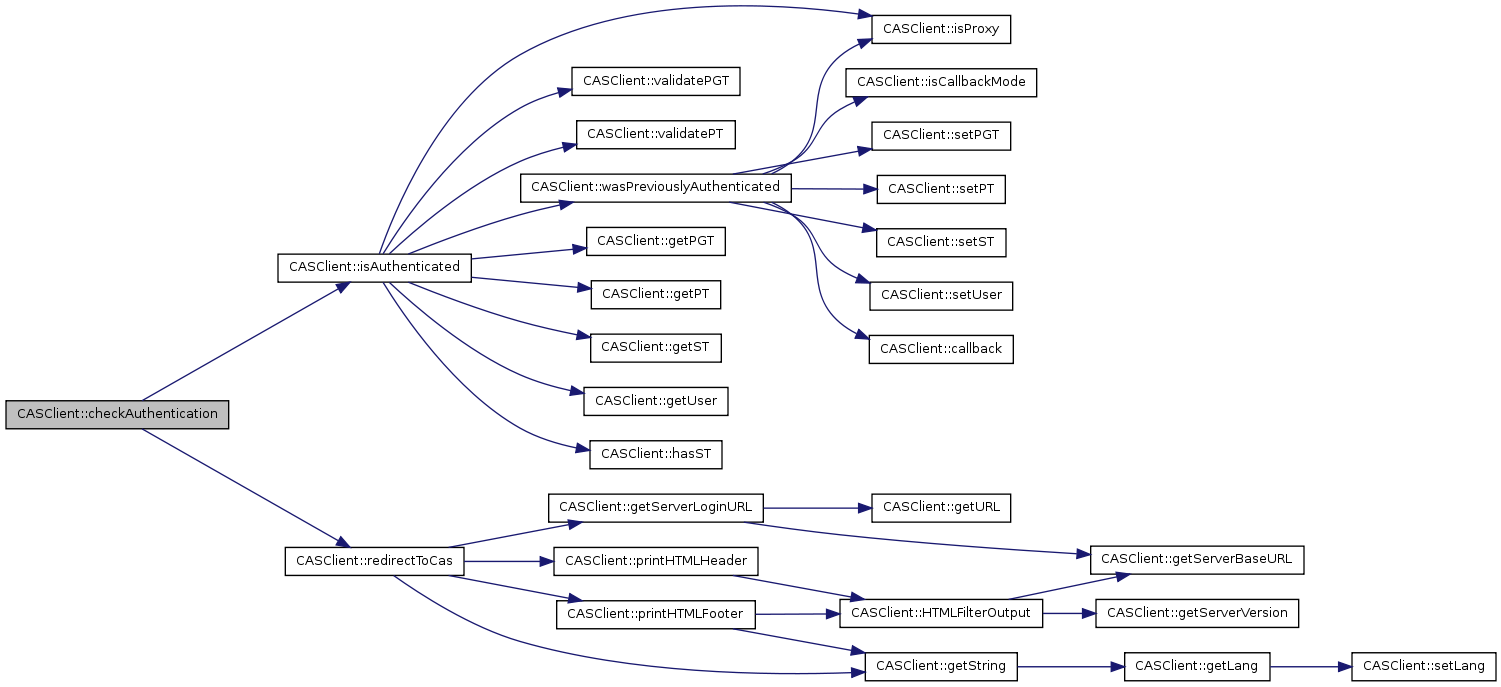
| CASClient::forceAuthentication | ( | ) | [inherited] |
This method is called to be sure that the user is authenticated.
When not authenticated, halt by redirecting to the CAS server; otherwise return TRUE.
- Returns:
- TRUE when the user is authenticated; otherwise halt.
Definition at line 579 of file client.php.
References $_SESSION, $res, CASClient::isAuthenticated(), and CASClient::redirectToCas().
    {
      phpCAS::traceBegin();

      if ( $this->isAuthenticated() ) {
        // the user is authenticated, nothing to be done.
            phpCAS::trace('no need to authenticate');
            $res = TRUE;
      } else {
            // the user is not authenticated, redirect to the CAS server
        unset($_SESSION['phpCAS']['auth_checked']);
            $this->redirectToCas(FALSE/* no gateway */);
            // never reached
            $res = FALSE;
      }
      phpCAS::traceEnd($res);
      return $res;
    }
Here is the call graph for this function: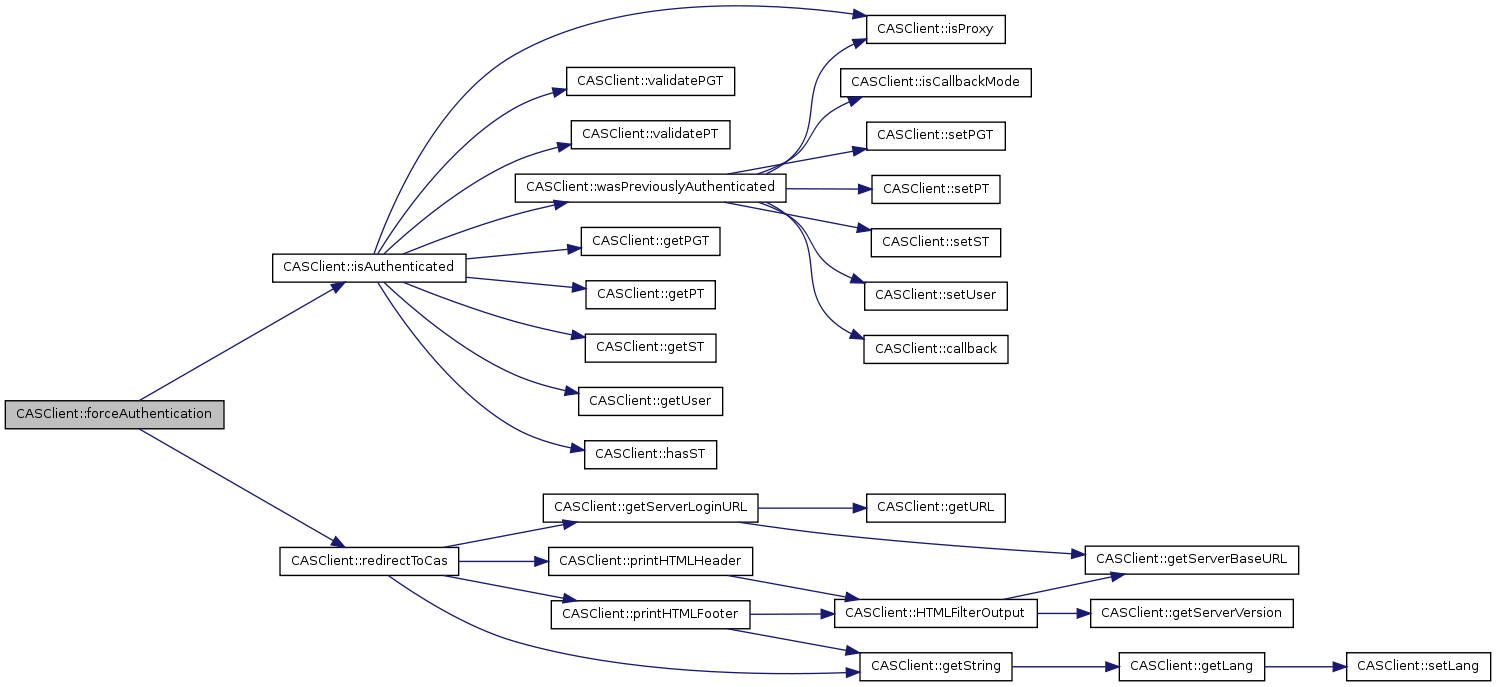
| CASClient::getUser | ( | ) | [inherited] |
This method returns the CAS user's login name.
- Warning:
- should be called only after CASClient::forceAuthentication() or CASClient::isAuthenticated(), otherwise halt with an error.
- Returns:
- the login name of the authenticated user
Definition at line 565 of file client.php.
Referenced by CASClient::isAuthenticated().
    {
      if ( empty($this->_user) ) {
        phpCAS::error('this method should be used only after '.__CLASS__.'::forceAuthentication() or '.__CLASS__.'::isAuthenticated()');
      }
      return $this->_user;
    }
Here is the caller graph for this function:
| CASClient::isAuthenticated | ( | ) | [inherited] |
This method is called to check if the user is authenticated (previously or by tickets given in the URL.
- Returns:
- TRUE when the user is authenticated; otherwise halt.
Definition at line 632 of file client.php.
References $_SESSION, $res, CASClient::getPGT(), CASClient::getPT(), CASClient::getST(), CASClient::getUser(), CASClient::hasST(), CASClient::isProxy(), CASClient::validatePGT(), CASClient::validatePT(), and CASClient::wasPreviouslyAuthenticated().
Referenced by CASClient::checkAuthentication(), and CASClient::forceAuthentication().
    {
      phpCAS::traceBegin();
      $res = FALSE;
      $validate_url = '';

      if ( $this->wasPreviouslyAuthenticated() ) {
        // the user has already (previously during the session) been
        // authenticated, nothing to be done.
        phpCAS::trace('user was already authenticated, no need to look for tickets');
        $res = TRUE;
      } elseif ( $this->hasST() ) {
        // if a Service Ticket was given, validate it
        phpCAS::trace('ST `'.$this->getST().'\' is present');
        $this->validateST($validate_url,$text_response,$tree_response); // if it fails, it halts
        phpCAS::trace('ST `'.$this->getST().'\' was validated');
        if ( $this->isProxy() ) {
          $this->validatePGT($validate_url,$text_response,$tree_response); // idem
          phpCAS::trace('PGT `'.$this->getPGT().'\' was validated');
          $_SESSION['phpCAS']['pgt'] = $this->getPGT();
        }
        $_SESSION['phpCAS']['user'] = $this->getUser();
        $res = TRUE;
      } elseif ( $this->hasPT() ) {
        // if a Proxy Ticket was given, validate it
        phpCAS::trace('PT `'.$this->getPT().'\' is present');
        $this->validatePT($validate_url,$text_response,$tree_response); // note: if it fails, it halts
        phpCAS::trace('PT `'.$this->getPT().'\' was validated');
        if ( $this->isProxy() ) {
          $this->validatePGT($validate_url,$text_response,$tree_response); // idem
          phpCAS::trace('PGT `'.$this->getPGT().'\' was validated');
          $_SESSION['phpCAS']['pgt'] = $this->getPGT();
        }
        $_SESSION['phpCAS']['user'] = $this->getUser();
        $res = TRUE;
      } else {
        // no ticket given, not authenticated
        phpCAS::trace('no ticket found');
      }

      phpCAS::traceEnd($res);
      return $res;
    }
Here is the call graph for this function: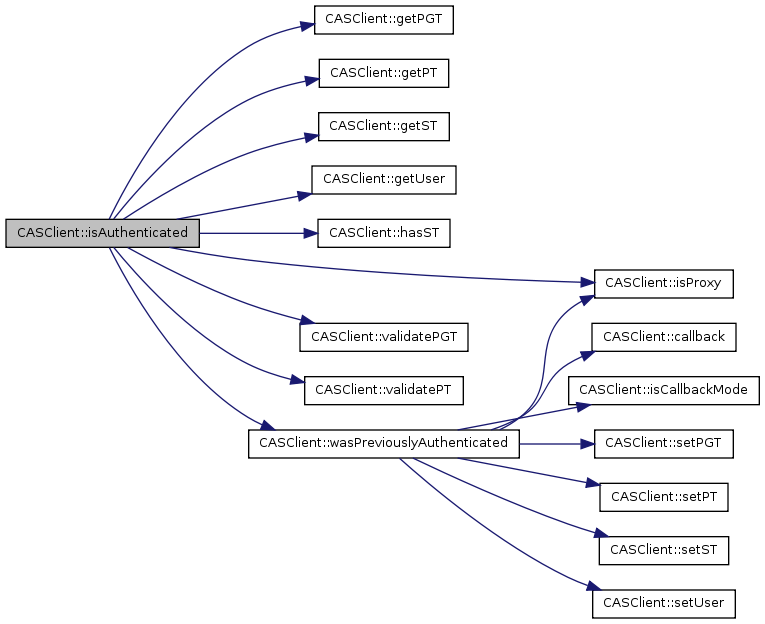 Here is the caller graph for this function:
| CASClient::logout | ( | $ | url = "" |
) | [inherited] |
This method is used to logout from CAS.
- Parameters:
-
$url a URL that will be transmitted to the CAS server (to come back to when logged out)
Definition at line 760 of file client.php.
References exit, CASClient::getServerLogoutURL(), CASClient::getString(), CASClient::printHTMLFooter(), and CASClient::printHTMLHeader().
    {
      phpCAS::traceBegin();
      $cas_url = $this->getServerLogoutURL();
      // v0.4.14 sebastien.gougeon at univ-rennes1.fr
      // header('Location: '.$cas_url);
      if ( $url != "" ) {
        $url = '?service=' . $url;
      }
      header('Location: '.$cas_url . $url);
      session_unset();
      session_destroy();
      $this->printHTMLHeader($this->getString(CAS_STR_LOGOUT));
      printf('<p>'.$this->getString(CAS_STR_SHOULD_HAVE_BEEN_REDIRECTED).'</p>',$cas_url);
      $this->printHTMLFooter();
      phpCAS::traceExit();
      exit();
    }
Here is the call graph for this function:
| CASClient::redirectToCas | ( | $ | gateway | ) | [inherited] |
This method is used to redirect the client to the CAS server.
It is used by CASClient::forceAuthentication() and CASClient::checkAuthentication().
- Parameters:
-
$gateway true to check authentication, false to force it
Definition at line 743 of file client.php.
References exit, CASClient::getServerLoginURL(), CASClient::getString(), CASClient::printHTMLFooter(), and CASClient::printHTMLHeader().
Referenced by CASClient::checkAuthentication(), and CASClient::forceAuthentication().
    {
      phpCAS::traceBegin();
      $cas_url = $this->getServerLoginURL($gateway);
      header('Location: '.$cas_url);
      $this->printHTMLHeader($this->getString(CAS_STR_AUTHENTICATION_WANTED));
      printf('<p>'.$this->getString(CAS_STR_SHOULD_HAVE_BEEN_REDIRECTED).'</p>',$cas_url);
      $this->printHTMLFooter();
      phpCAS::traceExit();
      exit();
    }
Here is the call graph for this function: Here is the caller graph for this function: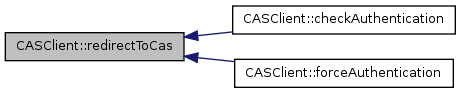
| CASClient::setUser | ( | $ | user | ) | [private, inherited] |
This method sets the CAS user's login name.
- Parameters:
-
$user the login name of the authenticated user.
Definition at line 553 of file client.php.
References $user.
Referenced by CASClient::validateST(), and CASClient::wasPreviouslyAuthenticated().
    {
      $this->_user = $user;
    }
Here is the caller graph for this function:
| CASClient::wasPreviouslyAuthenticated | ( | ) | [private, inherited] |
This method tells if the user has already been (previously) authenticated by looking into the session variables.
- Note:
- This function switches to callback mode when needed.
- Returns:
- TRUE when the user has already been authenticated; FALSE otherwise.
Definition at line 686 of file client.php.
References $_SESSION, $auth, CASClient::callback(), CASClient::isCallbackMode(), CASClient::isProxy(), CASClient::setPGT(), CASClient::setPT(), CASClient::setST(), and CASClient::setUser().
Referenced by CASClient::isAuthenticated().
    {
      phpCAS::traceBegin();

      if ( $this->isCallbackMode() ) {
        $this->callback();
      }

      $auth = FALSE;

      if ( $this->isProxy() ) {
        // CAS proxy: username and PGT must be present
        if ( !empty($_SESSION['phpCAS']['user']) && !empty($_SESSION['phpCAS']['pgt']) ) {
          // authentication already done
          $this->setUser($_SESSION['phpCAS']['user']);
          $this->setPGT($_SESSION['phpCAS']['pgt']);
          phpCAS::trace('user = `'.$_SESSION['phpCAS']['user'].'\', PGT = `'.$_SESSION['phpCAS']['pgt'].'\'');
          $auth = TRUE;
        } elseif ( !empty($_SESSION['phpCAS']['user']) && empty($_SESSION['phpCAS']['pgt']) ) {
          // these two variables should be empty or not empty at the same time
          phpCAS::trace('username found (`'.$_SESSION['phpCAS']['user'].'\') but PGT is empty');
          // unset all tickets to enforce authentication
          unset($_SESSION['phpCAS']);
          $this->setST('');
          $this->setPT('');
        } elseif ( empty($_SESSION['phpCAS']['user']) && !empty($_SESSION['phpCAS']['pgt']) ) {
          // these two variables should be empty or not empty at the same time
          phpCAS::trace('PGT found (`'.$_SESSION['phpCAS']['pgt'].'\') but username is empty');
          // unset all tickets to enforce authentication
          unset($_SESSION['phpCAS']);
          $this->setST('');
          $this->setPT('');
        } else {
          phpCAS::trace('neither user not PGT found');
        }
      } else {
        // `simple' CAS client (not a proxy): username must be present
        if ( !empty($_SESSION['phpCAS']['user']) ) {
          // authentication already done
          $this->setUser($_SESSION['phpCAS']['user']);
          phpCAS::trace('user = `'.$_SESSION['phpCAS']['user'].'\'');
          $auth = TRUE;
        } else {
          phpCAS::trace('no user found');
        }
      }

      phpCAS::traceEnd($auth);
      return $auth;
    }
Here is the call graph for this function: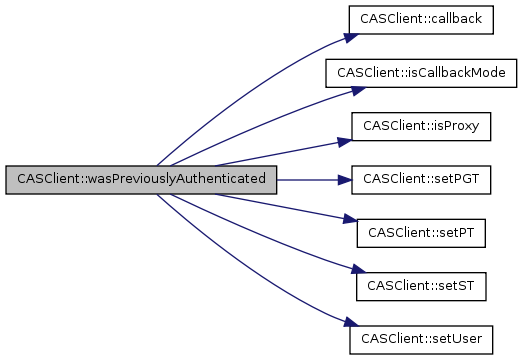 Here is the caller graph for this function:
Variable Documentation
CASClient::$_user [private, inherited] |
The Authenticated user.
Written by CASClient::setUser(), read by CASClient::getUser().
- Attention:
- client applications should use phpCAS::getUser().
Definition at line 544 of file client.php.