getID3() by James Heinrich <info@getid3.org> // More...
Public Member Functions | |
| PrintHexBytes ($string, $hex=true, $spaces=true, $htmlsafe=true) | |
| SafeStripSlashes ($text) | |
| trunc ($floatnumber) | |
| CastAsInt ($floatnum) | |
| DecimalBinary2Float ($binarynumerator) | |
| NormalizeBinaryPoint ($binarypointnumber, $maxbits=52) | |
| Float2BinaryDecimal ($floatvalue) | |
| Float2String ($floatvalue, $bits) | |
| LittleEndian2Float ($byteword) | |
| BigEndian2Float ($byteword) | |
| BigEndian2Int ($byteword, $synchsafe=false, $signed=false) | |
| LittleEndian2Int ($byteword, $signed=false) | |
| BigEndian2Bin ($byteword) | |
| BigEndian2String ($number, $minbytes=1, $synchsafe=false, $signed=false) | |
| Dec2Bin ($number) | |
| Bin2Dec ($binstring, $signed=false) | |
| Bin2String ($binstring) | |
| LittleEndian2String ($number, $minbytes=1, $synchsafe=false) | |
| array_merge_clobber ($array1, $array2) | |
| array_merge_noclobber ($array1, $array2) | |
| fileextension ($filename, $numextensions=1) | |
| PlaytimeString ($playtimeseconds) | |
| image_type_to_mime_type ($imagetypeid) | |
| DateMac2Unix ($macdate) | |
| FixedPoint8_8 ($rawdata) | |
| FixedPoint16_16 ($rawdata) | |
| FixedPoint2_30 ($rawdata) | |
| CreateDeepArray ($ArrayPath, $Separator, $Value) | |
| array_max ($arraydata, $returnkey=false) | |
| array_min ($arraydata, $returnkey=false) | |
| md5_file ($file) | |
| sha1_file ($file) | |
| hash_data ($file, $offset, $end, $algorithm) | |
| iconv_fallback_int_utf8 ($charval) | |
| iconv_fallback_iso88591_utf8 ($string, $bom=false) | |
| iconv_fallback_iso88591_utf16be ($string, $bom=false) | |
| iconv_fallback_iso88591_utf16le ($string, $bom=false) | |
| iconv_fallback_iso88591_utf16 ($string) | |
| iconv_fallback_utf8_iso88591 ($string) | |
| iconv_fallback_utf8_utf16be ($string, $bom=false) | |
| iconv_fallback_utf8_utf16le ($string, $bom=false) | |
| iconv_fallback_utf8_utf16 ($string) | |
| iconv_fallback_utf16be_utf8 ($string) | |
| iconv_fallback_utf16le_utf8 ($string) | |
| iconv_fallback_utf16be_iso88591 ($string) | |
| iconv_fallback_utf16le_iso88591 ($string) | |
| iconv_fallback_utf16_iso88591 ($string) | |
| iconv_fallback_utf16_utf8 ($string) | |
| iconv_fallback ($in_charset, $out_charset, $string) | |
| MultiByteCharString2HTML ($string, $charset='ISO-8859-1') | |
| RGADnameLookup ($namecode) | |
| RGADoriginatorLookup ($originatorcode) | |
| RGADadjustmentLookup ($rawadjustment, $signbit) | |
| RGADgainString ($namecode, $originatorcode, $replaygain) | |
| RGADamplitude2dB ($amplitude) | |
| GetDataImageSize ($imgData) | |
| ImageTypesLookup ($imagetypeid) | |
| CopyTagsToComments (&$ThisFileInfo) | |
| EmbeddedLookup ($key, $begin, $end, $file, $name) | |
| IncludeDependency ($filename, $sourcefile, $DieOnFailure=false) | |
Detailed Description
getID3() by James Heinrich <info@getid3.org> //
Definition at line 14 of file getid3.lib.php.
Member Function Documentation
| getid3_lib::array_max | ( | $ | arraydata, | |
| $ | returnkey = false | |||
| ) |
Definition at line 483 of file getid3.lib.php.
Referenced by getid3_mp3::getOnlyMPEGaudioInfoBruteForce().
                                                         {
                $maxvalue = false;
                $maxkey = false;
                foreach ($arraydata as $key => $value) {
                        if (!is_array($value)) {
                                if ($value > $maxvalue) {
                                        $maxvalue = $value;
                                        $maxkey = $key;
                                }
                        }
                }
                return ($returnkey ? $maxkey : $maxvalue);
        }
 Here is the caller graph for this function:
| getid3_lib::array_merge_clobber | ( | $ | array1, | |
| $ | array2 | |||
| ) |
Definition at line 358 of file getid3.lib.php.
Referenced by getid3_gzip::getid3_gzip(), getid3_tar::getid3_tar(), getid3_zip::getid3_zip(), and getid3_iso::ParseDirectoryRecord().
                                                       {
                // written by kcŘhireability*com
                // taken from http://www.php.net/manual/en/function.array-merge-recursive.php
                if (!is_array($array1) || !is_array($array2)) {
                        return false;
                }
                $newarray = $array1;
                foreach ($array2 as $key => $val) {
                        if (is_array($val) && isset($newarray[$key]) && is_array($newarray[$key])) {
                                $newarray[$key] = getid3_lib::array_merge_clobber($newarray[$key], $val);
                        } else {
                                $newarray[$key] = $val;
                        }
                }
                return $newarray;
        }
Here is the caller graph for this function: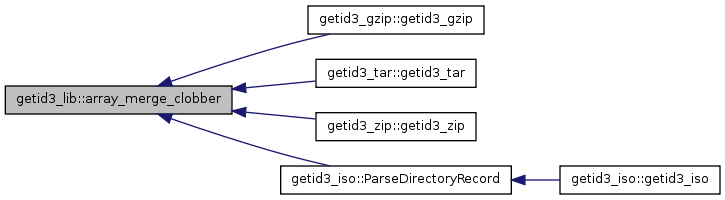
| getid3_lib::array_merge_noclobber | ( | $ | array1, | |
| $ | array2 | |||
| ) |
Definition at line 376 of file getid3.lib.php.
Referenced by getid3_asf::getid3_asf(), getid3_id3v2::getid3_id3v2(), and getid3_riff::getid3_riff().
                                                         {
                if (!is_array($array1) || !is_array($array2)) {
                        return false;
                }
                $newarray = $array1;
                foreach ($array2 as $key => $val) {
                        if (is_array($val) && isset($newarray[$key]) && is_array($newarray[$key])) {
                                $newarray[$key] = getid3_lib::array_merge_noclobber($newarray[$key], $val);
                        } elseif (!isset($newarray[$key])) {
                                $newarray[$key] = $val;
                        }
                }
                return $newarray;
        }
Here is the caller graph for this function:
| getid3_lib::array_min | ( | $ | arraydata, | |
| $ | returnkey = false | |||
| ) |
Definition at line 497 of file getid3.lib.php.
                                                         {
                $minvalue = false;
                $minkey = false;
                foreach ($arraydata as $key => $value) {
                        if (!is_array($value)) {
                                if ($value > $minvalue) {
                                        $minvalue = $value;
                                        $minkey = $key;
                                }
                        }
                }
                return ($returnkey ? $minkey : $minvalue);
        }
| getid3_lib::BigEndian2Bin | ( | $ | byteword | ) |
Definition at line 271 of file getid3.lib.php.
Referenced by BigEndian2Float(), FixedPoint2_30(), getid3_flac::FLACparseSTREAMINFO(), getid3_aac::getAACADIFheaderFilepointer(), getid3_ac3::getid3_ac3(), getid3_id3v2::getid3_id3v2(), getid3_mpeg::getid3_mpeg(), and getid3_id3v2::ParseID3v2Frame().
                                          {
                $binvalue = '';
                $bytewordlen = strlen($byteword);
                for ($i = 0; $i < $bytewordlen; $i++) {
                        $binvalue .= str_pad(decbin(ord($byteword{$i})), 8, '0', STR_PAD_LEFT);
                }
                return $binvalue;
        }
Here is the caller graph for this function:
| getid3_lib::BigEndian2Float | ( | $ | byteword | ) |
Definition at line 159 of file getid3.lib.php.
References BigEndian2Bin(), Bin2Dec(), and DecimalBinary2Float().
Referenced by getid3_riff::getid3_riff(), LittleEndian2Float(), getid3_id3v2::ParseID3v2Frame(), and AMFStream::readDouble().
                                            {
                // ANSI/IEEE Standard 754-1985, Standard for Binary Floating Point Arithmetic
                // http://www.psc.edu/general/software/packages/ieee/ieee.html
                // http://www.scri.fsu.edu/~jac/MAD3401/Backgrnd/ieee.html

                $bitword = getid3_lib::BigEndian2Bin($byteword);
                $signbit = $bitword{0};

                switch (strlen($byteword) * 8) {
                        case 32:
                                $exponentbits = 8;
                                $fractionbits = 23;
                                break;

                        case 64:
                                $exponentbits = 11;
                                $fractionbits = 52;
                                break;

                        case 80:
                                // 80-bit Apple SANE format
                                // http://www.mactech.com/articles/mactech/Vol.06/06.01/SANENormalized/
                                $exponentstring = substr($bitword, 1, 15);
                                $isnormalized = intval($bitword{16});
                                $fractionstring = substr($bitword, 17, 63);
                                $exponent = pow(2, getid3_lib::Bin2Dec($exponentstring) - 16383);
                                $fraction = $isnormalized + getid3_lib::DecimalBinary2Float($fractionstring);
                                $floatvalue = $exponent * $fraction;
                                if ($signbit == '1') {
                                        $floatvalue *= -1;
                                }
                                return $floatvalue;
                                break;

                        default:
                                return false;
                                break;
                }
                $exponentstring = substr($bitword, 1, $exponentbits);
                $fractionstring = substr($bitword, $exponentbits + 1, $fractionbits);
                $exponent = getid3_lib::Bin2Dec($exponentstring);
                $fraction = getid3_lib::Bin2Dec($fractionstring);

                if (($exponent == (pow(2, $exponentbits) - 1)) && ($fraction != 0)) {
                        // Not a Number
                        $floatvalue = false;
                } elseif (($exponent == (pow(2, $exponentbits) - 1)) && ($fraction == 0)) {
                        if ($signbit == '1') {
                                $floatvalue = '-infinity';
                        } else {
                                $floatvalue = '+infinity';
                        }
                } elseif (($exponent == 0) && ($fraction == 0)) {
                        if ($signbit == '1') {
                                $floatvalue = -0;
                        } else {
                                $floatvalue = 0;
                        }
                        $floatvalue = ($signbit ? 0 : -0);
                } elseif (($exponent == 0) && ($fraction != 0)) {
                        // These are 'unnormalized' values
                        $floatvalue = pow(2, (-1 * (pow(2, $exponentbits - 1) - 2))) * getid3_lib::DecimalBinary2Float($fractionstring);
                        if ($signbit == '1') {
                                $floatvalue *= -1;
                        }
                } elseif ($exponent != 0) {
                        $floatvalue = pow(2, ($exponent - (pow(2, $exponentbits - 1) - 1))) * (1 + getid3_lib::DecimalBinary2Float($fractionstring));
                        if ($signbit == '1') {
                                $floatvalue *= -1;
                        }
                }
                return (float) $floatvalue;
        }
Here is the call graph for this function: Here is the caller graph for this function:
| getid3_lib::BigEndian2Int | ( | $ | byteword, | |
| $ | synchsafe = false, |
|||
| $ | signed = false | |||
| ) |
Definition at line 234 of file getid3.lib.php.
References CastAsInt().
Referenced by getID3::analyze(), getid3_mp3::decodeMPEGaudioHeader(), getid3_matroska::EBML2Int(), getid3_riff::EitherEndian2Int(), FixedPoint16_16(), FixedPoint8_8(), getid3_flac::FLACparseAPPLICATION(), getid3_flac::FLACparseCUESHEET(), getid3_flac::FLACparseMETAdata(), getid3_flac::FLACparseSEEKTABLE(), getid3_flac::FLACparseSTREAMINFO(), getid3_au::getid3_au(), getid3_avr::getid3_avr(), getid3_flv::getid3_flv(), getid3_id3v2::getid3_id3v2(), getid3_lpac::getid3_lpac(), getid3_midi::getid3_midi(), getid3_mpeg::getid3_mpeg(), getid3_png::getid3_png(), getid3_quicktime::getid3_quicktime(), getid3_real::getid3_real(), getid3_riff::getid3_riff(), getid3_swf::getid3_swf(), getid3_szip::getid3_szip(), getid3_vqf::getid3_vqf(), iconv_fallback_utf16be_iso88591(), iconv_fallback_utf16be_utf8(), LittleEndian2Int(), getid3_mp3::MPEGaudioHeaderDecode(), MultiByteCharString2HTML(), getid3_id3v2::ParseID3v2Frame(), getid3_real::ParseOldRAheader(), getid3_quicktime::QuicktimeParseAtom(), getid3_quicktime::QuicktimeParseContainerAtom(), AMFStream::readByte(), and getid3_tiff::TIFFendian2Int().
                                                                           {
                $intvalue = 0;
                $bytewordlen = strlen($byteword);
                for ($i = 0; $i < $bytewordlen; $i++) {
                        if ($synchsafe) { // disregard MSB, effectively 7-bit bytes
                                $intvalue = $intvalue | (ord($byteword{$i}) & 0x7F) << (($bytewordlen - 1 - $i) * 7);
                        } else {
                                $intvalue += ord($byteword{$i}) * pow(256, ($bytewordlen - 1 - $i));
                        }
                }
                if ($signed && !$synchsafe) {
                        // synchsafe ints are not allowed to be signed
                        switch ($bytewordlen) {
                                case 1:
                                case 2:
                                case 3:
                                case 4:
                                        $signmaskbit = 0x80 << (8 * ($bytewordlen - 1));
                                        if ($intvalue & $signmaskbit) {
                                                $intvalue = 0 - ($intvalue & ($signmaskbit - 1));
                                        }
                                        break;

                                default:
                                        die('ERROR: Cannot have signed integers larger than 32-bits in getid3_lib::BigEndian2Int()');
                                        break;
                        }
                }
                return getid3_lib::CastAsInt($intvalue);
        }
Here is the call graph for this function: Here is the caller graph for this function: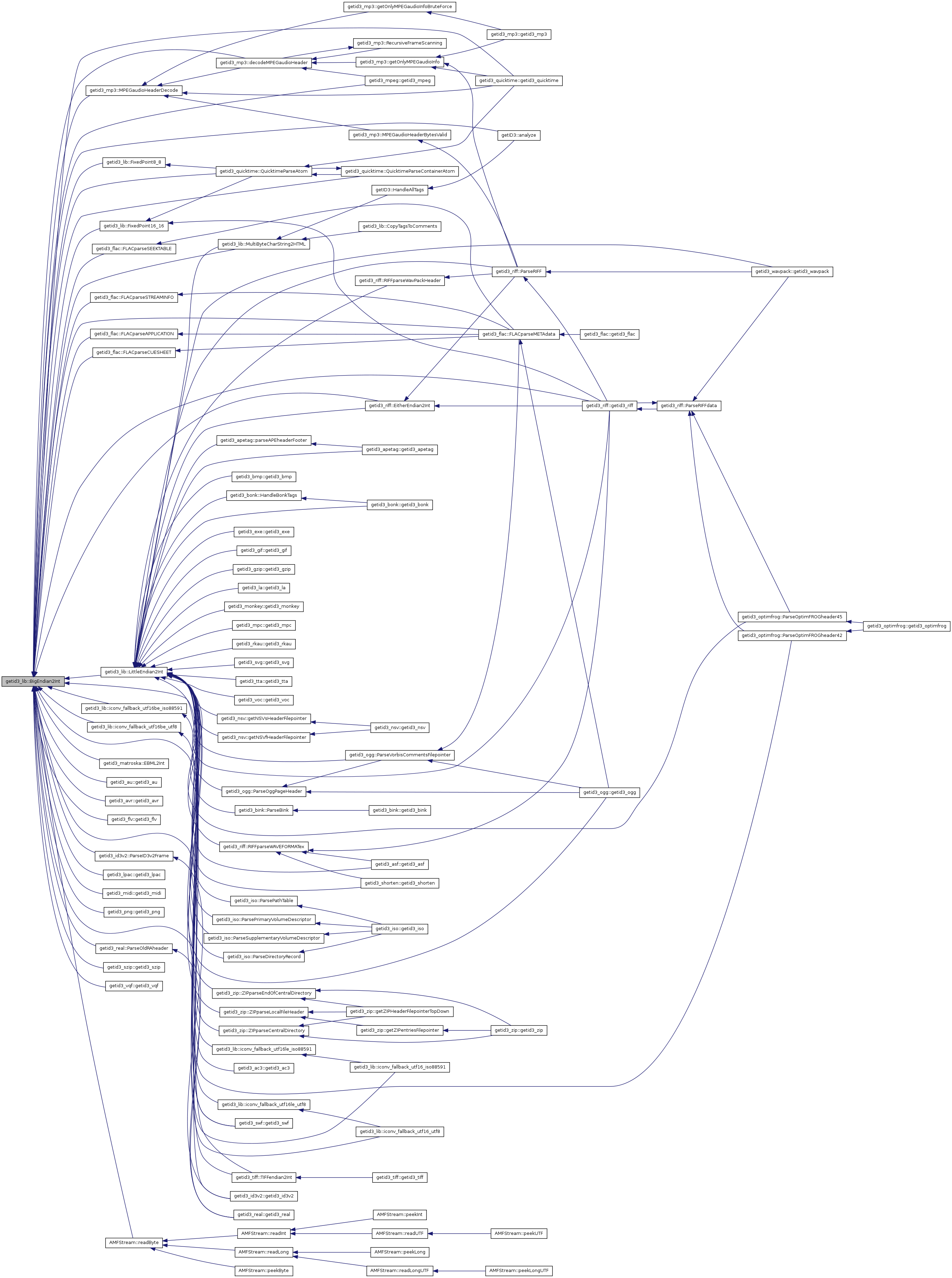
| getid3_lib::BigEndian2String | ( | $ | number, | |
| $ | minbytes = 1, |
|||
| $ | synchsafe = false, |
|||
| $ | signed = false | |||
| ) |
Definition at line 281 of file getid3.lib.php.
Referenced by Float2String(), getid3_write_real::GenerateCONTchunk(), getid3_write_id3v2::GenerateID3v2FrameData(), getid3_write_id3v2::GenerateID3v2Tag(), getid3_write_real::GeneratePROPchunk(), getid3_write_real::GenerateRMFchunk(), and iconv_fallback_utf8_utf16be().
                                                                                         {
                if ($number < 0) {
                        return false;
                }
                $maskbyte = (($synchsafe || $signed) ? 0x7F : 0xFF);
                $intstring = '';
                if ($signed) {
                        if ($minbytes > 4) {
                                die('ERROR: Cannot have signed integers larger than 32-bits in getid3_lib::BigEndian2String()');
                        }
                        $number = $number & (0x80 << (8 * ($minbytes - 1)));
                }
                while ($number != 0) {
                        $quotient = ($number / ($maskbyte + 1));
                        $intstring = chr(ceil(($quotient - floor($quotient)) * $maskbyte)).$intstring;
                        $number = floor($quotient);
                }
                return str_pad($intstring, $minbytes, "\x00", STR_PAD_LEFT);
        }
Here is the caller graph for this function: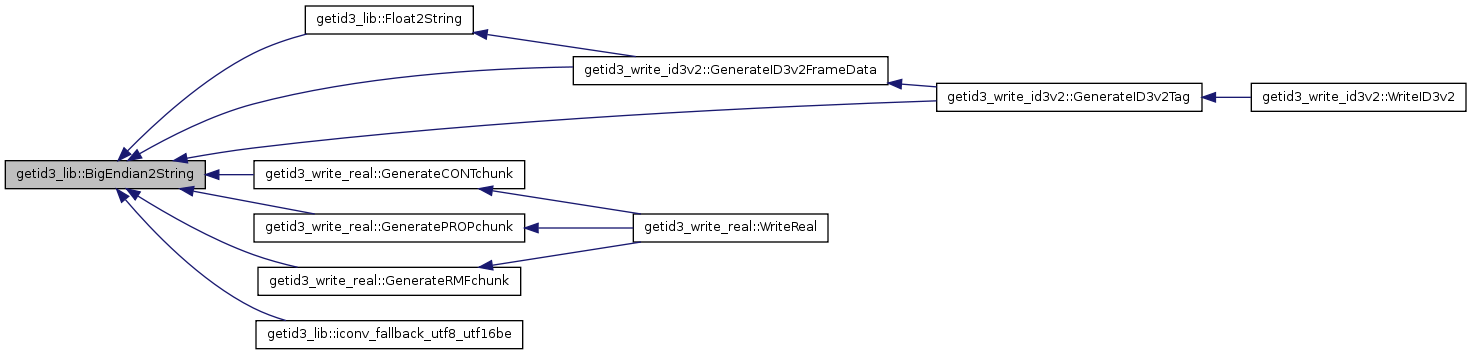
| getid3_lib::Bin2Dec | ( | $ | binstring, | |
| $ | signed = false | |||
| ) |
Definition at line 316 of file getid3.lib.php.
References CastAsInt().
Referenced by BigEndian2Float(), Bin2String(), DecimalBinary2Float(), FixedPoint2_30(), getid3_flac::FLACparseSTREAMINFO(), Float2String(), getid3_aac::getAACADIFheaderFilepointer(), getid3_aac::getAACADTSheaderFilepointer(), getid3_mpeg::getid3_mpeg(), getid3_riff::getid3_riff(), getid3_swf::getid3_swf(), and getid3_id3v2::ParseID3v2Frame().
                                                    {
                $signmult = 1;
                if ($signed) {
                        if ($binstring{0} == '1') {
                                $signmult = -1;
                        }
                        $binstring = substr($binstring, 1);
                }
                $decvalue = 0;
                for ($i = 0; $i < strlen($binstring); $i++) {
                        $decvalue += ((int) substr($binstring, strlen($binstring) - $i - 1, 1)) * pow(2, $i);
                }
                return getid3_lib::CastAsInt($decvalue * $signmult);
        }
Here is the call graph for this function: Here is the caller graph for this function: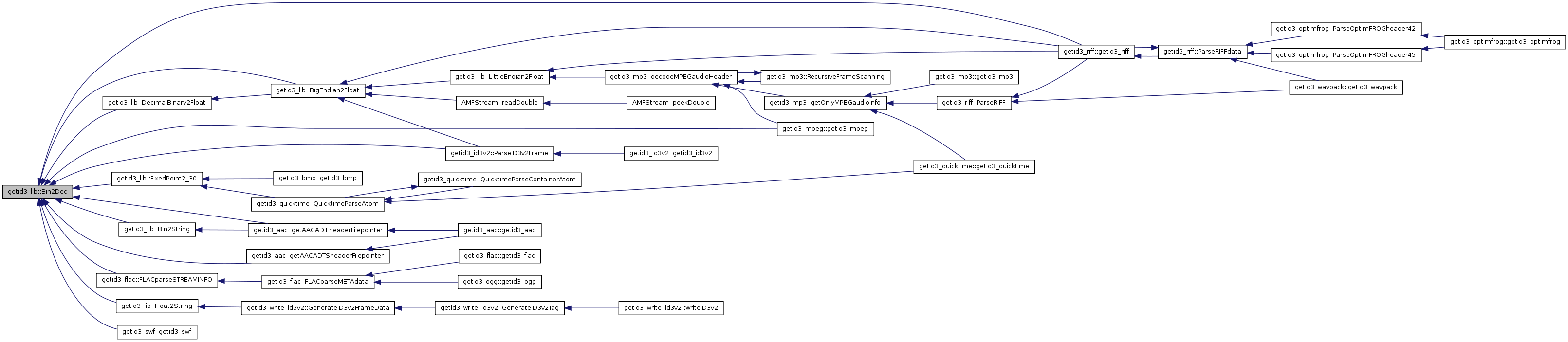
| getid3_lib::Bin2String | ( | $ | binstring | ) |
Definition at line 332 of file getid3.lib.php.
References Bin2Dec().
Referenced by getid3_aac::getAACADIFheaderFilepointer().
                                        {
                // return 'hi' for input of '0110100001101001'
                $string = '';
                $binstringreversed = strrev($binstring);
                for ($i = 0; $i < strlen($binstringreversed); $i += 8) {
                        $string = chr(getid3_lib::Bin2Dec(strrev(substr($binstringreversed, $i, 8)))).$string;
                }
                return $string;
        }
Here is the call graph for this function: Here is the caller graph for this function:
| getid3_lib::CastAsInt | ( | $ | floatnum | ) |
Definition at line 60 of file getid3.lib.php.
References trunc().
Referenced by BigEndian2Int(), Bin2Dec(), DateMac2Unix(), getid3_id3v2::getid3_id3v2(), getid3_mpc::getid3_mpc(), getid3_riff::getid3_riff(), and getid3_voc::getid3_voc().
                                      {
                // convert to float if not already
                $floatnum = (float) $floatnum;

                // convert a float to type int, only if possible
                if (getid3_lib::trunc($floatnum) == $floatnum) {
                        // it's not floating point
                        if ($floatnum <= 1073741824) { // 2^30
                                // it's within int range
                                $floatnum = (int) $floatnum;
                        }
                }
                return $floatnum;
        }
Here is the call graph for this function: Here is the caller graph for this function: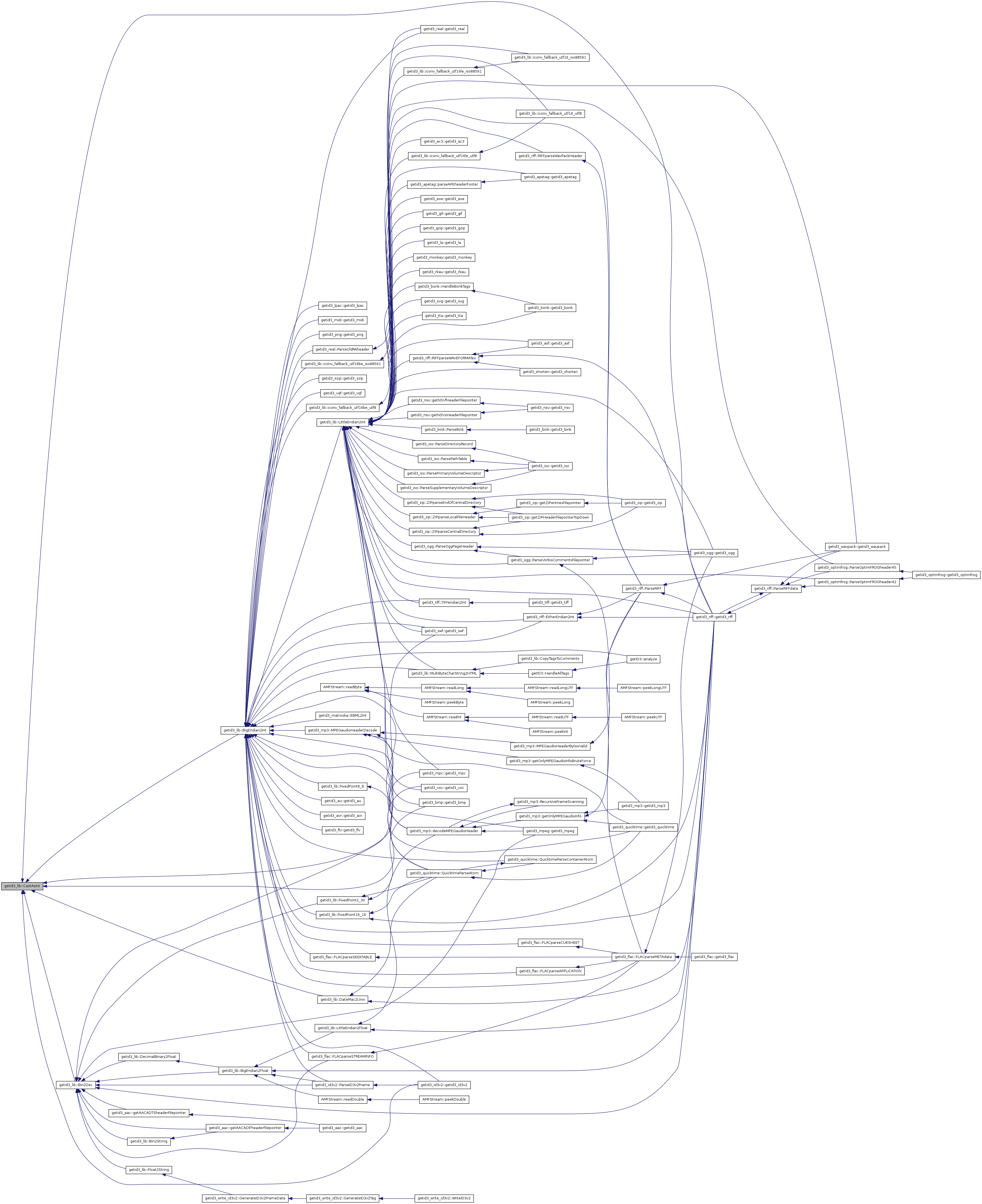
| getid3_lib::CopyTagsToComments | ( | &$ | ThisFileInfo | ) |
Definition at line 1204 of file getid3.lib.php.
References MultiByteCharString2HTML().
{
// Copy all entries from ['tags'] into common ['comments']
if (!empty($ThisFileInfo['tags'])) {
foreach ($ThisFileInfo['tags'] as $tagtype => $tagarray) {
foreach ($tagarray as $tagname => $tagdata) {
foreach ($tagdata as $key => $value) {
if (!empty($value)) {
if (empty($ThisFileInfo['comments'][$tagname])) {
// fall through and append value
} elseif ($tagtype == 'id3v1') {
$newvaluelength = strlen(trim($value));
foreach ($ThisFileInfo['comments'][$tagname] as $existingkey => $existingvalue) {
$oldvaluelength = strlen(trim($existingvalue));
if (($newvaluelength <= $oldvaluelength) && (substr($existingvalue, 0, $newvaluelength) == trim($value))) {
// new value is identical but shorter-than (or equal-length to) one already in comments - skip
break 2;
}
}
} else {
$newvaluelength = strlen(trim($value));
foreach ($ThisFileInfo['comments'][$tagname] as $existingkey => $existingvalue) {
$oldvaluelength = strlen(trim($existingvalue));
if (($newvaluelength > $oldvaluelength) && (substr(trim($value), 0, strlen($existingvalue)) == $existingvalue)) {
$ThisFileInfo['comments'][$tagname][$existingkey] = trim($value);
break 2;
}
}
}
if (empty($ThisFileInfo['comments'][$tagname]) || !in_array(trim($value), $ThisFileInfo['comments'][$tagname])) {
$ThisFileInfo['comments'][$tagname][] = trim($value);
}
}
}
}
}
// Copy to ['comments_html']
foreach ($ThisFileInfo['comments'] as $field => $values) {
foreach ($values as $index => $value) {
$ThisFileInfo['comments_html'][$field][$index] = str_replace('�', '', getid3_lib::MultiByteCharString2HTML($value, $ThisFileInfo['encoding']));
}
}
}
}
Here is the call graph for this function:
| getid3_lib::CreateDeepArray | ( | $ | ArrayPath, | |
| $ | Separator, | |||
| $ | Value | |||
| ) |
Definition at line 465 of file getid3.lib.php.
Referenced by getid3_gzip::getid3_gzip(), getid3_tar::getid3_tar(), getid3_zip::getid3_zip(), and getid3_iso::ParseDirectoryRecord().
                                                                 {
                // assigns $Value to a nested array path:
                //   $foo = getid3_lib::CreateDeepArray('/path/to/my', '/', 'file.txt')
                // is the same as:
                //   $foo = array('path'=>array('to'=>'array('my'=>array('file.txt'))));
                // or
                //   $foo['path']['to']['my'] = 'file.txt';
                while ($ArrayPath && ($ArrayPath{0} == $Separator)) {
                        $ArrayPath = substr($ArrayPath, 1);
                }
                if (($pos = strpos($ArrayPath, $Separator)) !== false) {
                        $ReturnedArray[substr($ArrayPath, 0, $pos)] = getid3_lib::CreateDeepArray(substr($ArrayPath, $pos + 1), $Separator, $Value);
                } else {
                        $ReturnedArray[$ArrayPath] = $Value;
                }
                return $ReturnedArray;
        }
Here is the caller graph for this function: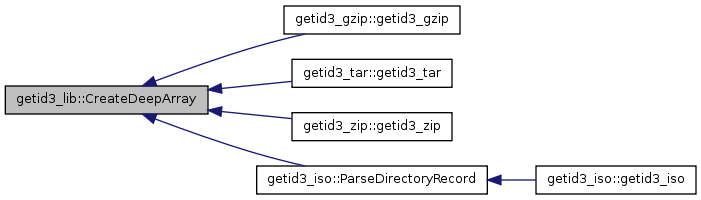
| getid3_lib::DateMac2Unix | ( | $ | macdate | ) |
Definition at line 442 of file getid3.lib.php.
References CastAsInt().
Referenced by getid3_riff::getid3_riff(), and getid3_quicktime::QuicktimeParseAtom().
                                        {
                // Macintosh timestamp: seconds since 00:00h January 1, 1904
                // UNIX timestamp:      seconds since 00:00h January 1, 1970
                return getid3_lib::CastAsInt($macdate - 2082844800);
        }
Here is the call graph for this function: Here is the caller graph for this function:
| getid3_lib::Dec2Bin | ( | $ | number | ) |
Definition at line 302 of file getid3.lib.php.
Referenced by getid3_write_id3v2::GenerateID3v2FrameData(), getid3_riff::getid3_riff(), and getid3_id3v2::ParseID3v2Frame().
                                  {
                while ($number >= 256) {
                        $bytes[] = (($number / 256) - (floor($number / 256))) * 256;
                        $number = floor($number / 256);
                }
                $bytes[] = $number;
                $binstring = '';
                for ($i = 0; $i < count($bytes); $i++) {
                        $binstring = (($i == count($bytes) - 1) ? decbin($bytes[$i]) : str_pad(decbin($bytes[$i]), 8, '0', STR_PAD_LEFT)).$binstring;
                }
                return $binstring;
        }
Here is the caller graph for this function:
| getid3_lib::DecimalBinary2Float | ( | $ | binarynumerator | ) |
Definition at line 76 of file getid3.lib.php.
References Bin2Dec().
Referenced by BigEndian2Float().
                                                       {
                $numerator   = getid3_lib::Bin2Dec($binarynumerator);
                $denominator = getid3_lib::Bin2Dec('1'.str_repeat('0', strlen($binarynumerator)));
                return ($numerator / $denominator);
        }
Here is the call graph for this function: Here is the caller graph for this function:
| getid3_lib::EmbeddedLookup | ( | $ | key, | |
| $ | begin, | |||
| $ | end, | |||
| $ | file, | |||
| $ | name | |||
| ) |
Definition at line 1257 of file getid3.lib.php.
References $file.
Referenced by getid3_id3v2::FrameNameLongLookup(), getid3_id3v2::FrameNameShortLookup(), getid3_midi::GeneralMIDIinstrumentLookup(), getid3_midi::GeneralMIDIpercussionLookup(), getid3_id3v2::LanguageLookup(), getid3_id3v2::LookupCurrencyCountry(), getid3_id3v2::LookupCurrencyUnits(), getid3_riff::RIFFfourccLookup(), and getid3_riff::RIFFwFormatTagLookup().
                                                                  {

                // Cached
                static $cache;
                if (isset($cache[$file][$name])) {
                        return @$cache[$file][$name][$key];
                }

                // Init
                $keylength  = strlen($key);
                $line_count = $end - $begin - 7;

                // Open php file
                $fp = fopen($file, 'r');

                // Discard $begin lines
                for ($i = 0; $i < ($begin + 3); $i++) {
                        fgets($fp, 1024);
                }

                // Loop thru line
                while (0 < $line_count--) {

                        // Read line
                        $line = ltrim(fgets($fp, 1024), "\t ");

                        // METHOD A: only cache the matching key - less memory but slower on next lookup of not-previously-looked-up key
                        //$keycheck = substr($line, 0, $keylength);
                        //if ($key == $keycheck)  {
                        //      $cache[$file][$name][$keycheck] = substr($line, $keylength + 1);
                        //      break;
                        //}

                        // METHOD B: cache all keys in this lookup - more memory but faster on next lookup of not-previously-looked-up key
                        //$cache[$file][$name][substr($line, 0, $keylength)] = trim(substr($line, $keylength + 1));
                        @list($ThisKey, $ThisValue) = explode("\t", $line, 2);
                        $cache[$file][$name][$ThisKey] = trim($ThisValue);
                }

                // Close and return
                fclose($fp);
                return @$cache[$file][$name][$key];
        }
Here is the caller graph for this function: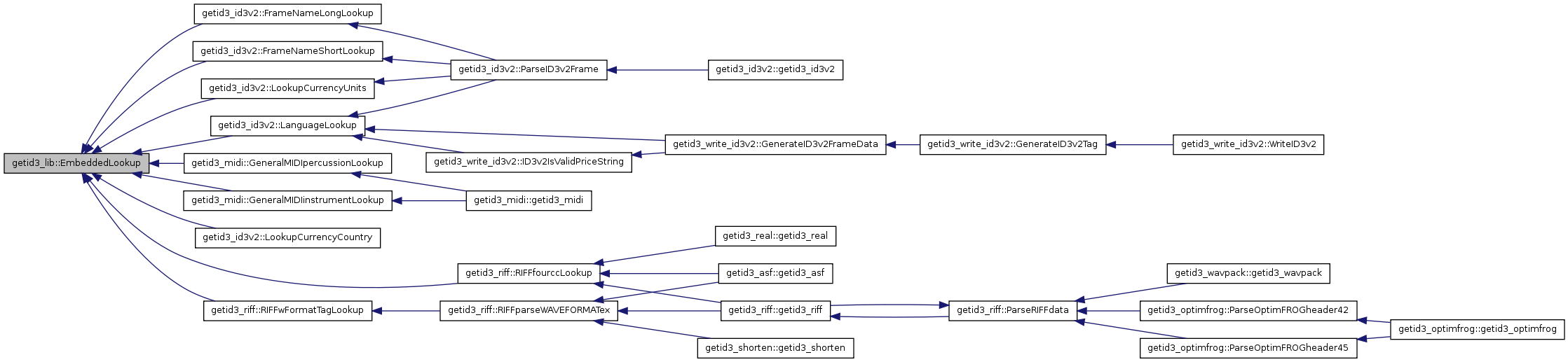
| getid3_lib::fileextension | ( | $ | filename, | |
| $ | numextensions = 1 | |||
| ) |
Definition at line 392 of file getid3.lib.php.
References $filename.
Referenced by getid3_optimfrog::ParseOptimFROGheader45().
                                                            {
                if (strstr($filename, '.')) {
                        $reversedfilename = strrev($filename);
                        $offset = 0;
                        for ($i = 0; $i < $numextensions; $i++) {
                                $offset = strpos($reversedfilename, '.', $offset + 1);
                                if ($offset === false) {
                                        return '';
                                }
                        }
                        return strrev(substr($reversedfilename, 0, $offset));
                }
                return '';
        }
Here is the caller graph for this function:
| getid3_lib::FixedPoint16_16 | ( | $ | rawdata | ) |
Definition at line 454 of file getid3.lib.php.
References BigEndian2Int().
Referenced by getid3_riff::getid3_riff(), and getid3_quicktime::QuicktimeParseAtom().
                                           {
                return getid3_lib::BigEndian2Int(substr($rawdata, 0, 2)) + (float) (getid3_lib::BigEndian2Int(substr($rawdata, 2, 2)) / pow(2, 16));
        }
Here is the call graph for this function: Here is the caller graph for this function:
| getid3_lib::FixedPoint2_30 | ( | $ | rawdata | ) |
Definition at line 459 of file getid3.lib.php.
References BigEndian2Bin(), and Bin2Dec().
Referenced by getid3_bmp::getid3_bmp(), and getid3_quicktime::QuicktimeParseAtom().
                                          {
                $binarystring = getid3_lib::BigEndian2Bin($rawdata);
                return getid3_lib::Bin2Dec(substr($binarystring, 0, 2)) + (float) (getid3_lib::Bin2Dec(substr($binarystring, 2, 30)) / 1073741824);
        }
Here is the call graph for this function: Here is the caller graph for this function:
| getid3_lib::FixedPoint8_8 | ( | $ | rawdata | ) |
Definition at line 449 of file getid3.lib.php.
References BigEndian2Int().
Referenced by getid3_quicktime::QuicktimeParseAtom().
                                         {
                return getid3_lib::BigEndian2Int(substr($rawdata, 0, 1)) + (float) (getid3_lib::BigEndian2Int(substr($rawdata, 1, 1)) / pow(2, 8));
        }
Here is the call graph for this function: Here is the caller graph for this function:
| getid3_lib::Float2BinaryDecimal | ( | $ | floatvalue | ) |
Definition at line 107 of file getid3.lib.php.
References trunc().
Referenced by Float2String().
                                                  {
                // http://www.scri.fsu.edu/~jac/MAD3401/Backgrnd/binary.html
                $maxbits = 128; // to how many bits of precision should the calculations be taken?
                $intpart   = getid3_lib::trunc($floatvalue);
                $floatpart = abs($floatvalue - $intpart);
                $pointbitstring = '';
                while (($floatpart != 0) && (strlen($pointbitstring) < $maxbits)) {
                        $floatpart *= 2;
                        $pointbitstring .= (string) getid3_lib::trunc($floatpart);
                        $floatpart -= getid3_lib::trunc($floatpart);
                }
                $binarypointnumber = decbin($intpart).'.'.$pointbitstring;
                return $binarypointnumber;
        }
Here is the call graph for this function: Here is the caller graph for this function:
| getid3_lib::Float2String | ( | $ | floatvalue, | |
| $ | bits | |||
| ) |
Definition at line 123 of file getid3.lib.php.
References BigEndian2String(), Bin2Dec(), Float2BinaryDecimal(), and NormalizeBinaryPoint().
Referenced by getid3_write_id3v2::GenerateID3v2FrameData().
                                                  {
                // http://www.scri.fsu.edu/~jac/MAD3401/Backgrnd/ieee-expl.html
                switch ($bits) {
                        case 32:
                                $exponentbits = 8;
                                $fractionbits = 23;
                                break;

                        case 64:
                                $exponentbits = 11;
                                $fractionbits = 52;
                                break;

                        default:
                                return false;
                                break;
                }
                if ($floatvalue >= 0) {
                        $signbit = '0';
                } else {
                        $signbit = '1';
                }
                $normalizedbinary  = getid3_lib::NormalizeBinaryPoint(getid3_lib::Float2BinaryDecimal($floatvalue), $fractionbits);
                $biasedexponent    = pow(2, $exponentbits - 1) - 1 + $normalizedbinary['exponent']; // (127 or 1023) +/- exponent
                $exponentbitstring = str_pad(decbin($biasedexponent), $exponentbits, '0', STR_PAD_LEFT);
                $fractionbitstring = str_pad(substr($normalizedbinary['normalized'], 2), $fractionbits, '0', STR_PAD_RIGHT);

                return getid3_lib::BigEndian2String(getid3_lib::Bin2Dec($signbit.$exponentbitstring.$fractionbitstring), $bits % 8, false);
        }
Here is the call graph for this function: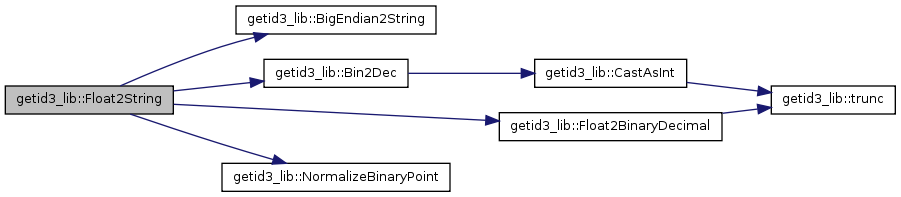 Here is the caller graph for this function:
| getid3_lib::GetDataImageSize | ( | $ | imgData | ) |
Definition at line 1170 of file getid3.lib.php.
Referenced by getid3_jpg::getid3_jpg(), getid3_id3v2::ParseID3v2Frame(), and getid3_ogg::ParseVorbisCommentsFilepointer().
                                            {
                $GetDataImageSize = false;
                if ($tempfilename = tempnam('*', 'getID3')) {
                        if ($tmp = @fopen($tempfilename, 'wb')) {
                                fwrite($tmp, $imgData);
                                fclose($tmp);
                                $GetDataImageSize = @GetImageSize($tempfilename);
                        }
                        unlink($tempfilename);
                }
                return $GetDataImageSize;
        }
Here is the caller graph for this function:
| getid3_lib::hash_data | ( | $ | file, | |
| $ | offset, | |||
| $ | end, | |||
| $ | algorithm | |||
| ) |
Definition at line 582 of file getid3.lib.php.
References $file.
Referenced by getID3::getHashdata().
                                                             {

                switch ($algorithm) {
                        case 'md5':
                                $hash_function = 'md5_file';
                                $unix_call     = 'md5sum';
                                $windows_call  = 'md5sum.exe';
                                $hash_length   = 32;
                                break;

                        case 'sha1':
                                $hash_function = 'sha1_file';
                                $unix_call     = 'sha1sum';
                                $windows_call  = 'sha1sum.exe';
                                $hash_length   = 40;
                                break;

                        default:
                                die('Invalid algorithm ('.$algorithm.') in getid3_lib::hash_data()');
                                break;
                }
                $size = $end - $offset;
                while (true) {
                        if (GETID3_OS_ISWINDOWS) {

                                // It seems that sha1sum.exe for Windows only works on physical files, does not accept piped data
                                // Fall back to create-temp-file method:
                                if ($algorithm == 'sha1') {
                                        break;
                                }

                                $RequiredFiles = array('cygwin1.dll', 'head.exe', 'tail.exe', $windows_call);
                                foreach ($RequiredFiles as $required_file) {
                                        if (!is_readable(GETID3_HELPERAPPSDIR.$required_file)) {
                                                // helper apps not available - fall back to old method
                                                break;
                                        }
                                }
                                $commandline  = GETID3_HELPERAPPSDIR.'head.exe -c '.$end.' "'.escapeshellarg(str_replace('/', DIRECTORY_SEPARATOR, $file)).'" | ';
                                $commandline .= GETID3_HELPERAPPSDIR.'tail.exe -c '.$size.' | ';
                                $commandline .= GETID3_HELPERAPPSDIR.$windows_call;

                        } else {

                                $commandline  = 'head -c'.$end.' '.escapeshellarg($file).' | ';
                                $commandline .= 'tail -c'.$size.' | ';
                                $commandline .= $unix_call;

                        }
                        if ((bool) ini_get('safe_mode')) {
                                $ThisFileInfo['warning'][] = 'PHP running in Safe Mode - backtick operator not available, using slower non-system-call '.$algorithm.' algorithm';
                                break;
                        }
                        return substr(`$commandline`, 0, $hash_length);
                }

                // try to create a temporary file in the system temp directory - invalid dirname should force to system temp dir
                if (($data_filename = tempnam('*', 'getID3')) === false) {
                        // can't find anywhere to create a temp file, just die
                        return false;
                }

                // Init
                $result = false;

                // copy parts of file
                if ($fp = @fopen($file, 'rb')) {

                        if ($fp_data = @fopen($data_filename, 'wb')) {

                                fseek($fp, $offset, SEEK_SET);
                                $byteslefttowrite = $end - $offset;
                                while (($byteslefttowrite > 0) && ($buffer = fread($fp, GETID3_FREAD_BUFFER_SIZE))) {
                                        $byteswritten = fwrite($fp_data, $buffer, $byteslefttowrite);
                                        $byteslefttowrite -= $byteswritten;
                                }
                                fclose($fp_data);
                                $result = getid3_lib::$hash_function($data_filename);

                        }
                        fclose($fp);
                }
                unlink($data_filename);
                return $result;
        }
Here is the caller graph for this function:
| getid3_lib::iconv_fallback | ( | $ | in_charset, | |
| $ | out_charset, | |||
| $ | string | |||
| ) |
Definition at line 951 of file getid3.lib.php.
Referenced by getID3::CharConvert(), getid3_writetags::FormatDataForAPE(), getid3_writetags::FormatDataForID3v1(), getid3_writetags::FormatDataForID3v2(), getid3_writetags::FormatDataForReal(), getid3_writetags::FormatDataForVorbisComment(), getid3_iso::ParseDirectoryRecord(), getid3_id3v2::ParseID3v2Frame(), getid3_iso::ParsePathTable(), getid3_asf::TrimConvert(), and getid3_asf::WMpictureTypeLookup().
{
if ($in_charset == $out_charset) {
return $string;
}
static $iconv_broken_or_unavailable = array();
if (is_null(@$iconv_broken_or_unavailable[$in_charset.'_'.$out_charset])) {
$GETID3_ICONV_TEST_STRING = ' !"#$%&\'()*+,-./0123456789:;<=>?@ABCDEFGHIJKLMNOPQRSTUVWXYZ[\\]^_`abcdefghijklmnopqrstuvwxyz{|}~€�‚�„…†‡�‰Š‹ŚŤŽŹ�‘’“”•–—�™š›śťžź ˇ˘Ł¤Ą¦§¨©Ş«¬®Ż°±˛ł´µ¶·¸ąş»Ľ˝ľżŔÁÂĂÄĹĆÇČÉĘËĚÍÎĎĐŃŇÓÔŐÖ×ŘŮÚŰÜÝŢßŕáâăäĺćçčéęëěíîďđńňóôőö÷řůúűüýţ˙';
// Check iconv()
if (function_exists('iconv')) {
if (@iconv($in_charset, 'ISO-8859-1', @iconv('ISO-8859-1', $in_charset, $GETID3_ICONV_TEST_STRING)) == $GETID3_ICONV_TEST_STRING) {
if (@iconv($out_charset, 'ISO-8859-1', @iconv('ISO-8859-1', $out_charset, $GETID3_ICONV_TEST_STRING)) == $GETID3_ICONV_TEST_STRING) {
// everything works, use iconv()
$iconv_broken_or_unavailable[$in_charset.'_'.$out_charset] = false;
} else {
// iconv() available, but broken. Use getID3()'s iconv_fallback() conversions instead
// known issue in PHP v4.1.x
$iconv_broken_or_unavailable[$in_charset.'_'.$out_charset] = true;
}
} else {
// iconv() available, but broken. Use getID3()'s iconv_fallback() conversions instead
// known issue in PHP v4.1.x
$iconv_broken_or_unavailable[$in_charset.'_'.$out_charset] = true;
}
} else {
// iconv() unavailable, use getID3()'s iconv_fallback() conversions
$iconv_broken_or_unavailable[$in_charset.'_'.$out_charset] = true;
}
}
if ($iconv_broken_or_unavailable[$in_charset.'_'.$out_charset]) {
static $ConversionFunctionList = array();
if (empty($ConversionFunctionList)) {
$ConversionFunctionList['ISO-8859-1']['UTF-8'] = 'iconv_fallback_iso88591_utf8';
$ConversionFunctionList['ISO-8859-1']['UTF-16'] = 'iconv_fallback_iso88591_utf16';
$ConversionFunctionList['ISO-8859-1']['UTF-16BE'] = 'iconv_fallback_iso88591_utf16be';
$ConversionFunctionList['ISO-8859-1']['UTF-16LE'] = 'iconv_fallback_iso88591_utf16le';
$ConversionFunctionList['UTF-8']['ISO-8859-1'] = 'iconv_fallback_utf8_iso88591';
$ConversionFunctionList['UTF-8']['UTF-16'] = 'iconv_fallback_utf8_utf16';
$ConversionFunctionList['UTF-8']['UTF-16BE'] = 'iconv_fallback_utf8_utf16be';
$ConversionFunctionList['UTF-8']['UTF-16LE'] = 'iconv_fallback_utf8_utf16le';
$ConversionFunctionList['UTF-16']['ISO-8859-1'] = 'iconv_fallback_utf16_iso88591';
$ConversionFunctionList['UTF-16']['UTF-8'] = 'iconv_fallback_utf16_utf8';
$ConversionFunctionList['UTF-16LE']['ISO-8859-1'] = 'iconv_fallback_utf16le_iso88591';
$ConversionFunctionList['UTF-16LE']['UTF-8'] = 'iconv_fallback_utf16le_utf8';
$ConversionFunctionList['UTF-16BE']['ISO-8859-1'] = 'iconv_fallback_utf16be_iso88591';
$ConversionFunctionList['UTF-16BE']['UTF-8'] = 'iconv_fallback_utf16be_utf8';
}
if (isset($ConversionFunctionList[strtoupper($in_charset)][strtoupper($out_charset)])) {
$ConversionFunction = $ConversionFunctionList[strtoupper($in_charset)][strtoupper($out_charset)];
return getid3_lib::$ConversionFunction($string);
}
die('PHP does not have iconv() support - cannot convert from '.$in_charset.' to '.$out_charset);
}
if ($converted_string = @iconv($in_charset, $out_charset.'//TRANSLIT', $string)) {
switch ($out_charset) {
case 'ISO-8859-1':
$converted_string = rtrim($converted_string, "\x00");
break;
}
return $converted_string;
}
// iconv() may sometimes fail with "illegal character in input string" error message
// and return an empty string, but returning the unconverted string is more useful
return $string;
}
Here is the caller graph for this function: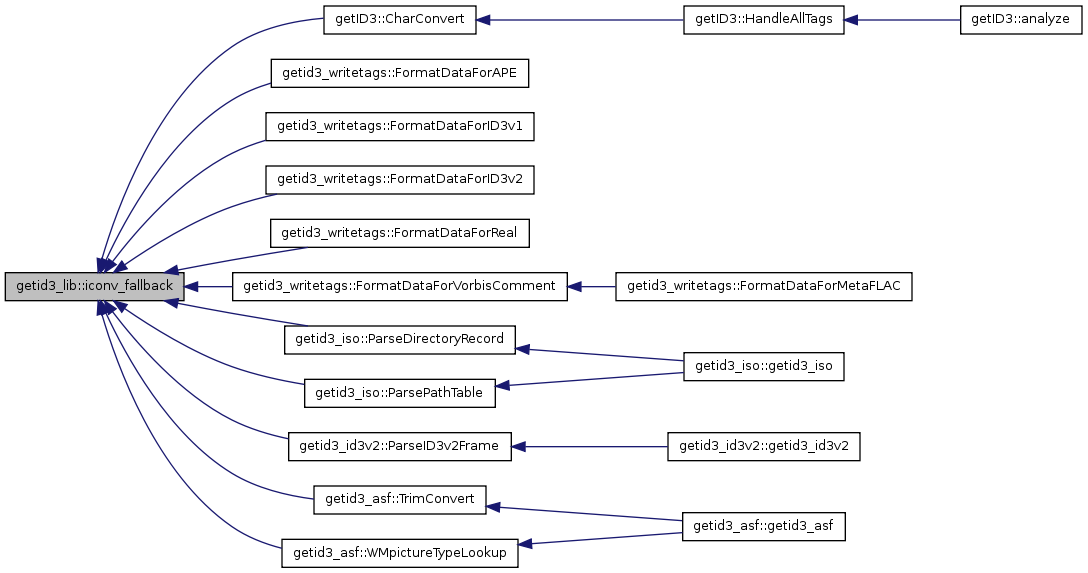
| getid3_lib::iconv_fallback_int_utf8 | ( | $ | charval | ) |
Definition at line 669 of file getid3.lib.php.
Referenced by iconv_fallback_iso88591_utf8(), iconv_fallback_utf16be_utf8(), and iconv_fallback_utf16le_utf8().
                                                   {
                if ($charval < 128) {
                        // 0bbbbbbb
                        $newcharstring = chr($charval);
                } elseif ($charval < 2048) {
                        // 110bbbbb 10bbbbbb
                        $newcharstring  = chr(($charval >> 6) | 0xC0);
                        $newcharstring .= chr(($charval & 0x3F) | 0x80);
                } elseif ($charval < 65536) {
                        // 1110bbbb 10bbbbbb 10bbbbbb
                        $newcharstring  = chr(($charval >> 12) | 0xE0);
                        $newcharstring .= chr(($charval >>  6) | 0xC0);
                        $newcharstring .= chr(($charval & 0x3F) | 0x80);
                } else {
                        // 11110bbb 10bbbbbb 10bbbbbb 10bbbbbb
                        $newcharstring  = chr(($charval >> 18) | 0xF0);
                        $newcharstring .= chr(($charval >> 12) | 0xC0);
                        $newcharstring .= chr(($charval >>  6) | 0xC0);
                        $newcharstring .= chr(($charval & 0x3F) | 0x80);
                }
                return $newcharstring;
        }
Here is the caller graph for this function:
| getid3_lib::iconv_fallback_iso88591_utf16 | ( | $ | string | ) |
Definition at line 734 of file getid3.lib.php.
References iconv_fallback_iso88591_utf16le().
                                                        {
                return getid3_lib::iconv_fallback_iso88591_utf16le($string, true);
        }
Here is the call graph for this function:
| getid3_lib::iconv_fallback_iso88591_utf16be | ( | $ | string, | |
| $ | bom = false | |||
| ) |
Definition at line 710 of file getid3.lib.php.
                                                                      {
                $newcharstring = '';
                if ($bom) {
                        $newcharstring .= "\xFE\xFF";
                }
                for ($i = 0; $i < strlen($string); $i++) {
                        $newcharstring .= "\x00".$string{$i};
                }
                return $newcharstring;
        }
| getid3_lib::iconv_fallback_iso88591_utf16le | ( | $ | string, | |
| $ | bom = false | |||
| ) |
Definition at line 722 of file getid3.lib.php.
Referenced by iconv_fallback_iso88591_utf16().
                                                                      {
                $newcharstring = '';
                if ($bom) {
                        $newcharstring .= "\xFF\xFE";
                }
                for ($i = 0; $i < strlen($string); $i++) {
                        $newcharstring .= $string{$i}."\x00";
                }
                return $newcharstring;
        }
Here is the caller graph for this function:
| getid3_lib::iconv_fallback_iso88591_utf8 | ( | $ | string, | |
| $ | bom = false | |||
| ) |
Definition at line 693 of file getid3.lib.php.
References iconv_fallback_int_utf8().
                                                                   {
                if (function_exists('utf8_encode')) {
                        return utf8_encode($string);
                }
                // utf8_encode() unavailable, use getID3()'s iconv_fallback() conversions (possibly PHP is compiled without XML support)
                $newcharstring = '';
                if ($bom) {
                        $newcharstring .= "\xEF\xBB\xBF";
                }
                for ($i = 0; $i < strlen($string); $i++) {
                        $charval = ord($string{$i});
                        $newcharstring .= getid3_lib::iconv_fallback_int_utf8($charval);
                }
                return $newcharstring;
        }
Here is the call graph for this function:
| getid3_lib::iconv_fallback_utf16_iso88591 | ( | $ | string | ) |
Definition at line 930 of file getid3.lib.php.
References iconv_fallback_utf16be_iso88591(), and iconv_fallback_utf16le_iso88591().
                                                        {
                $bom = substr($string, 0, 2);
                if ($bom == "\xFE\xFF") {
                        return getid3_lib::iconv_fallback_utf16be_iso88591(substr($string, 2));
                } elseif ($bom == "\xFF\xFE") {
                        return getid3_lib::iconv_fallback_utf16le_iso88591(substr($string, 2));
                }
                return $string;
        }
Here is the call graph for this function:
| getid3_lib::iconv_fallback_utf16_utf8 | ( | $ | string | ) |
Definition at line 941 of file getid3.lib.php.
References iconv_fallback_utf16be_utf8(), and iconv_fallback_utf16le_utf8().
                                                    {
                $bom = substr($string, 0, 2);
                if ($bom == "\xFE\xFF") {
                        return getid3_lib::iconv_fallback_utf16be_utf8(substr($string, 2));
                } elseif ($bom == "\xFF\xFE") {
                        return getid3_lib::iconv_fallback_utf16le_utf8(substr($string, 2));
                }
                return $string;
        }
Here is the call graph for this function:
| getid3_lib::iconv_fallback_utf16be_iso88591 | ( | $ | string | ) |
Definition at line 902 of file getid3.lib.php.
References BigEndian2Int().
Referenced by iconv_fallback_utf16_iso88591().
                                                          {
                if (substr($string, 0, 2) == "\xFE\xFF") {
                        // strip BOM
                        $string = substr($string, 2);
                }
                $newcharstring = '';
                for ($i = 0; $i < strlen($string); $i += 2) {
                        $charval = getid3_lib::BigEndian2Int(substr($string, $i, 2));
                        $newcharstring .= (($charval < 256) ? chr($charval) : '?');
                }
                return $newcharstring;
        }
Here is the call graph for this function: Here is the caller graph for this function:
| getid3_lib::iconv_fallback_utf16be_utf8 | ( | $ | string | ) |
Definition at line 874 of file getid3.lib.php.
References BigEndian2Int(), and iconv_fallback_int_utf8().
Referenced by iconv_fallback_utf16_utf8().
                                                      {
                if (substr($string, 0, 2) == "\xFE\xFF") {
                        // strip BOM
                        $string = substr($string, 2);
                }
                $newcharstring = '';
                for ($i = 0; $i < strlen($string); $i += 2) {
                        $charval = getid3_lib::BigEndian2Int(substr($string, $i, 2));
                        $newcharstring .= getid3_lib::iconv_fallback_int_utf8($charval);
                }
                return $newcharstring;
        }
Here is the call graph for this function: Here is the caller graph for this function:
| getid3_lib::iconv_fallback_utf16le_iso88591 | ( | $ | string | ) |
Definition at line 916 of file getid3.lib.php.
References LittleEndian2Int().
Referenced by iconv_fallback_utf16_iso88591().
                                                          {
                if (substr($string, 0, 2) == "\xFF\xFE") {
                        // strip BOM
                        $string = substr($string, 2);
                }
                $newcharstring = '';
                for ($i = 0; $i < strlen($string); $i += 2) {
                        $charval = getid3_lib::LittleEndian2Int(substr($string, $i, 2));
                        $newcharstring .= (($charval < 256) ? chr($charval) : '?');
                }
                return $newcharstring;
        }
Here is the call graph for this function: Here is the caller graph for this function:
| getid3_lib::iconv_fallback_utf16le_utf8 | ( | $ | string | ) |
Definition at line 888 of file getid3.lib.php.
References iconv_fallback_int_utf8(), and LittleEndian2Int().
Referenced by iconv_fallback_utf16_utf8().
                                                      {
                if (substr($string, 0, 2) == "\xFF\xFE") {
                        // strip BOM
                        $string = substr($string, 2);
                }
                $newcharstring = '';
                for ($i = 0; $i < strlen($string); $i += 2) {
                        $charval = getid3_lib::LittleEndian2Int(substr($string, $i, 2));
                        $newcharstring .= getid3_lib::iconv_fallback_int_utf8($charval);
                }
                return $newcharstring;
        }
Here is the call graph for this function: Here is the caller graph for this function:
| getid3_lib::iconv_fallback_utf8_iso88591 | ( | $ | string | ) |
Definition at line 739 of file getid3.lib.php.
                                                       {
                if (function_exists('utf8_decode')) {
                        return utf8_decode($string);
                }
                // utf8_decode() unavailable, use getID3()'s iconv_fallback() conversions (possibly PHP is compiled without XML support)
                $newcharstring = '';
                $offset = 0;
                $stringlength = strlen($string);
                while ($offset < $stringlength) {
                        if ((ord($string{$offset}) | 0x07) == 0xF7) {
                                // 11110bbb 10bbbbbb 10bbbbbb 10bbbbbb
                                $charval = ((ord($string{($offset + 0)}) & 0x07) << 18) &
                                           ((ord($string{($offset + 1)}) & 0x3F) << 12) &
                                           ((ord($string{($offset + 2)}) & 0x3F) <<  6) &
                                            (ord($string{($offset + 3)}) & 0x3F);
                                $offset += 4;
                        } elseif ((ord($string{$offset}) | 0x0F) == 0xEF) {
                                // 1110bbbb 10bbbbbb 10bbbbbb
                                $charval = ((ord($string{($offset + 0)}) & 0x0F) << 12) &
                                           ((ord($string{($offset + 1)}) & 0x3F) <<  6) &
                                            (ord($string{($offset + 2)}) & 0x3F);
                                $offset += 3;
                        } elseif ((ord($string{$offset}) | 0x1F) == 0xDF) {
                                // 110bbbbb 10bbbbbb
                                $charval = ((ord($string{($offset + 0)}) & 0x1F) <<  6) &
                                            (ord($string{($offset + 1)}) & 0x3F);
                                $offset += 2;
                        } elseif ((ord($string{$offset}) | 0x7F) == 0x7F) {
                                // 0bbbbbbb
                                $charval = ord($string{$offset});
                                $offset += 1;
                        } else {
                                // error? throw some kind of warning here?
                                $charval = false;
                                $offset += 1;
                        }
                        if ($charval !== false) {
                                $newcharstring .= (($charval < 256) ? chr($charval) : '?');
                        }
                }
                return $newcharstring;
        }
| getid3_lib::iconv_fallback_utf8_utf16 | ( | $ | string | ) |
Definition at line 869 of file getid3.lib.php.
References iconv_fallback_utf8_utf16le().
                                                    {
                return getid3_lib::iconv_fallback_utf8_utf16le($string, true);
        }
Here is the call graph for this function:
| getid3_lib::iconv_fallback_utf8_utf16be | ( | $ | string, | |
| $ | bom = false | |||
| ) |
Definition at line 783 of file getid3.lib.php.
References BigEndian2String().
                                                                  {
                $newcharstring = '';
                if ($bom) {
                        $newcharstring .= "\xFE\xFF";
                }
                $offset = 0;
                $stringlength = strlen($string);
                while ($offset < $stringlength) {
                        if ((ord($string{$offset}) | 0x07) == 0xF7) {
                                // 11110bbb 10bbbbbb 10bbbbbb 10bbbbbb
                                $charval = ((ord($string{($offset + 0)}) & 0x07) << 18) &
                                           ((ord($string{($offset + 1)}) & 0x3F) << 12) &
                                           ((ord($string{($offset + 2)}) & 0x3F) <<  6) &
                                            (ord($string{($offset + 3)}) & 0x3F);
                                $offset += 4;
                        } elseif ((ord($string{$offset}) | 0x0F) == 0xEF) {
                                // 1110bbbb 10bbbbbb 10bbbbbb
                                $charval = ((ord($string{($offset + 0)}) & 0x0F) << 12) &
                                           ((ord($string{($offset + 1)}) & 0x3F) <<  6) &
                                            (ord($string{($offset + 2)}) & 0x3F);
                                $offset += 3;
                        } elseif ((ord($string{$offset}) | 0x1F) == 0xDF) {
                                // 110bbbbb 10bbbbbb
                                $charval = ((ord($string{($offset + 0)}) & 0x1F) <<  6) &
                                            (ord($string{($offset + 1)}) & 0x3F);
                                $offset += 2;
                        } elseif ((ord($string{$offset}) | 0x7F) == 0x7F) {
                                // 0bbbbbbb
                                $charval = ord($string{$offset});
                                $offset += 1;
                        } else {
                                // error? throw some kind of warning here?
                                $charval = false;
                                $offset += 1;
                        }
                        if ($charval !== false) {
                                $newcharstring .= (($charval < 65536) ? getid3_lib::BigEndian2String($charval, 2) : "\x00".'?');
                        }
                }
                return $newcharstring;
        }
Here is the call graph for this function:
| getid3_lib::iconv_fallback_utf8_utf16le | ( | $ | string, | |
| $ | bom = false | |||
| ) |
Definition at line 826 of file getid3.lib.php.
References LittleEndian2String().
Referenced by iconv_fallback_utf8_utf16().
                                                                  {
                $newcharstring = '';
                if ($bom) {
                        $newcharstring .= "\xFF\xFE";
                }
                $offset = 0;
                $stringlength = strlen($string);
                while ($offset < $stringlength) {
                        if ((ord($string{$offset}) | 0x07) == 0xF7) {
                                // 11110bbb 10bbbbbb 10bbbbbb 10bbbbbb
                                $charval = ((ord($string{($offset + 0)}) & 0x07) << 18) &
                                           ((ord($string{($offset + 1)}) & 0x3F) << 12) &
                                           ((ord($string{($offset + 2)}) & 0x3F) <<  6) &
                                            (ord($string{($offset + 3)}) & 0x3F);
                                $offset += 4;
                        } elseif ((ord($string{$offset}) | 0x0F) == 0xEF) {
                                // 1110bbbb 10bbbbbb 10bbbbbb
                                $charval = ((ord($string{($offset + 0)}) & 0x0F) << 12) &
                                           ((ord($string{($offset + 1)}) & 0x3F) <<  6) &
                                            (ord($string{($offset + 2)}) & 0x3F);
                                $offset += 3;
                        } elseif ((ord($string{$offset}) | 0x1F) == 0xDF) {
                                // 110bbbbb 10bbbbbb
                                $charval = ((ord($string{($offset + 0)}) & 0x1F) <<  6) &
                                            (ord($string{($offset + 1)}) & 0x3F);
                                $offset += 2;
                        } elseif ((ord($string{$offset}) | 0x7F) == 0x7F) {
                                // 0bbbbbbb
                                $charval = ord($string{$offset});
                                $offset += 1;
                        } else {
                                // error? maybe throw some warning here?
                                $charval = false;
                                $offset += 1;
                        }
                        if ($charval !== false) {
                                $newcharstring .= (($charval < 65536) ? getid3_lib::LittleEndian2String($charval, 2) : '?'."\x00");
                        }
                }
                return $newcharstring;
        }
Here is the call graph for this function: Here is the caller graph for this function:
| getid3_lib::image_type_to_mime_type | ( | $ | imagetypeid | ) |
Definition at line 419 of file getid3.lib.php.
Referenced by getid3_ogg::ParseVorbisCommentsFilepointer().
                                                       {
                // only available in PHP v4.3.0+
                static $image_type_to_mime_type = array();
                if (empty($image_type_to_mime_type)) {
                        $image_type_to_mime_type[1]  = 'image/gif';                     // GIF
                        $image_type_to_mime_type[2]  = 'image/jpeg';                    // JPEG
                        $image_type_to_mime_type[3]  = 'image/png';                     // PNG
                        $image_type_to_mime_type[4]  = 'application/x-shockwave-flash'; // Flash
                        $image_type_to_mime_type[5]  = 'image/psd';                     // PSD
                        $image_type_to_mime_type[6]  = 'image/bmp';                     // BMP
                        $image_type_to_mime_type[7]  = 'image/tiff';                    // TIFF: little-endian (Intel)
                        $image_type_to_mime_type[8]  = 'image/tiff';                    // TIFF: big-endian (Motorola)
                        //$image_type_to_mime_type[9]  = 'image/jpc';                   // JPC
                        //$image_type_to_mime_type[10] = 'image/jp2';                   // JPC
                        //$image_type_to_mime_type[11] = 'image/jpx';                   // JPC
                        //$image_type_to_mime_type[12] = 'image/jb2';                   // JPC
                        $image_type_to_mime_type[13] = 'application/x-shockwave-flash'; // Shockwave
                        $image_type_to_mime_type[14] = 'image/iff';                     // IFF
                }
                return (isset($image_type_to_mime_type[$imagetypeid]) ? $image_type_to_mime_type[$imagetypeid] : 'application/octet-stream');
        }
Here is the caller graph for this function:
| getid3_lib::ImageTypesLookup | ( | $ | imagetypeid | ) |
Definition at line 1183 of file getid3.lib.php.
                                                {
                static $ImageTypesLookup = array();
                if (empty($ImageTypesLookup)) {
                        $ImageTypesLookup[1]  = 'gif';
                        $ImageTypesLookup[2]  = 'jpeg';
                        $ImageTypesLookup[3]  = 'png';
                        $ImageTypesLookup[4]  = 'swf';
                        $ImageTypesLookup[5]  = 'psd';
                        $ImageTypesLookup[6]  = 'bmp';
                        $ImageTypesLookup[7]  = 'tiff (little-endian)';
                        $ImageTypesLookup[8]  = 'tiff (big-endian)';
                        $ImageTypesLookup[9]  = 'jpc';
                        $ImageTypesLookup[10] = 'jp2';
                        $ImageTypesLookup[11] = 'jpx';
                        $ImageTypesLookup[12] = 'jb2';
                        $ImageTypesLookup[13] = 'swc';
                        $ImageTypesLookup[14] = 'iff';
                }
                return (isset($ImageTypesLookup[$imagetypeid]) ? $ImageTypesLookup[$imagetypeid] : '');
        }
| getid3_lib::IncludeDependency | ( | $ | filename, | |
| $ | sourcefile, | |||
| $ | DieOnFailure = false | |||
| ) |
Definition at line 1301 of file getid3.lib.php.
References $filename.
Referenced by getID3::analyze(), getid3_lyrics3::getid3_lyrics3(), getid3_riff::getid3_riff(), getid3_shorten::getid3_shorten(), getid3_wavpack::getid3_wavpack(), getid3_riff::ParseRIFF(), and getid3_writetags::WriteTags().
                                                                                {
                global $GETID3_ERRORARRAY;

                if (file_exists($filename)) {
                        if (@include_once($filename)) {
                                return true;
                        } else {
                                $diemessage = basename($sourcefile).' depends on '.$filename.', which has errors';
                        }
                } else {
                        $diemessage = basename($sourcefile).' depends on '.$filename.', which is missing';
                }
                if ($DieOnFailure) {
                        die($diemessage);
                } else {
                        $GETID3_ERRORARRAY[] = $diemessage;
                }
                return false;
        }
Here is the caller graph for this function: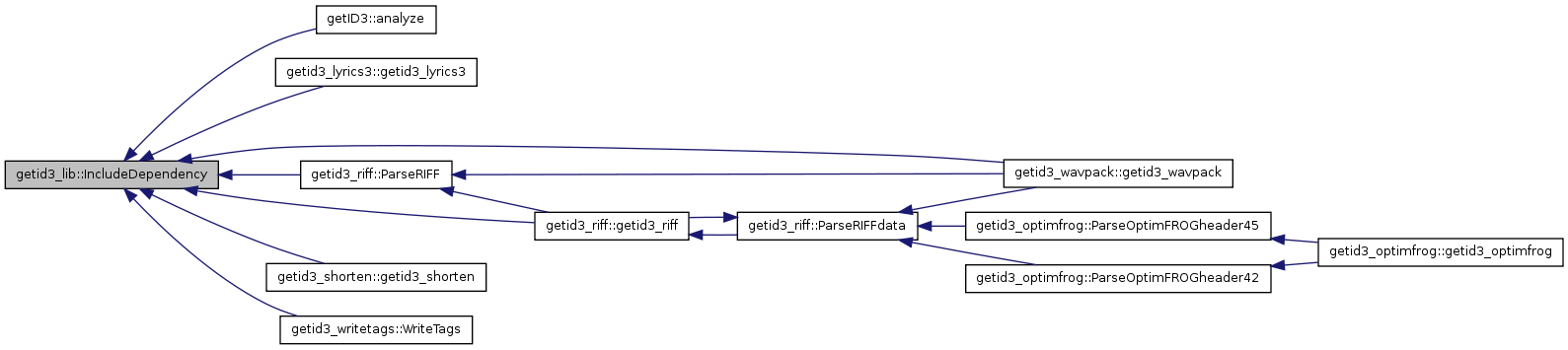
| getid3_lib::LittleEndian2Float | ( | $ | byteword | ) |
Definition at line 154 of file getid3.lib.php.
References BigEndian2Float().
Referenced by getid3_mp3::decodeMPEGaudioHeader(), and getid3_riff::getid3_riff().
                                               {
                return getid3_lib::BigEndian2Float(strrev($byteword));
        }
Here is the call graph for this function: Here is the caller graph for this function:
| getid3_lib::LittleEndian2Int | ( | $ | byteword, | |
| $ | signed = false | |||
| ) |
Definition at line 266 of file getid3.lib.php.
References BigEndian2Int().
Referenced by getid3_riff::EitherEndian2Int(), getid3_ac3::getid3_ac3(), getid3_apetag::getid3_apetag(), getid3_asf::getid3_asf(), getid3_bmp::getid3_bmp(), getid3_bonk::getid3_bonk(), getid3_exe::getid3_exe(), getid3_gif::getid3_gif(), getid3_gzip::getid3_gzip(), getid3_la::getid3_la(), getid3_monkey::getid3_monkey(), getid3_mpc::getid3_mpc(), getid3_ogg::getid3_ogg(), getid3_riff::getid3_riff(), getid3_rkau::getid3_rkau(), getid3_shorten::getid3_shorten(), getid3_svg::getid3_svg(), getid3_swf::getid3_swf(), getid3_tta::getid3_tta(), getid3_voc::getid3_voc(), getid3_wavpack::getid3_wavpack(), getid3_nsv::getNSVfHeaderFilepointer(), getid3_nsv::getNSVsHeaderFilepointer(), getid3_bonk::HandleBonkTags(), iconv_fallback_utf16le_iso88591(), iconv_fallback_utf16le_utf8(), MultiByteCharString2HTML(), getid3_apetag::parseAPEheaderFooter(), getid3_bink::ParseBink(), getid3_iso::ParseDirectoryRecord(), getid3_ogg::ParseOggPageHeader(), getid3_optimfrog::ParseOptimFROGheader42(), getid3_optimfrog::ParseOptimFROGheader45(), getid3_iso::ParsePathTable(), getid3_iso::ParsePrimaryVolumeDescriptor(), getid3_riff::ParseRIFF(), getid3_iso::ParseSupplementaryVolumeDescriptor(), getid3_ogg::ParseVorbisCommentsFilepointer(), getid3_riff::RIFFparseWAVEFORMATex(), getid3_riff::RIFFparseWavPackHeader(), getid3_tiff::TIFFendian2Int(), getid3_zip::ZIPparseCentralDirectory(), getid3_zip::ZIPparseEndOfCentralDirectory(), and getid3_zip::ZIPparseLocalFileHeader().
                                                            {
                return getid3_lib::BigEndian2Int(strrev($byteword), false, $signed);
        }
Here is the call graph for this function: Here is the caller graph for this function: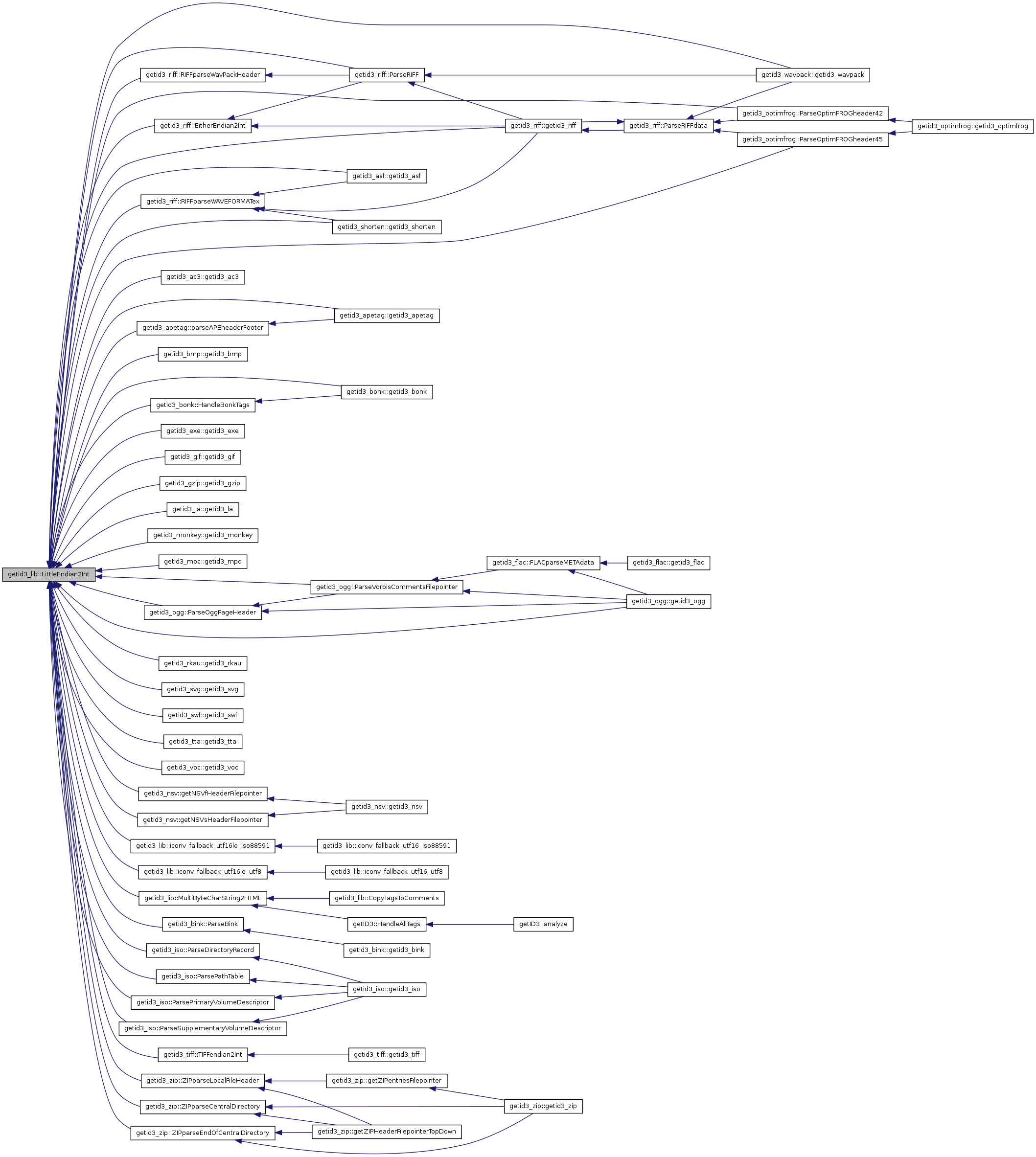
| getid3_lib::LittleEndian2String | ( | $ | number, | |
| $ | minbytes = 1, |
|||
| $ | synchsafe = false | |||
| ) |
Definition at line 343 of file getid3.lib.php.
Referenced by getid3_write_apetag::GenerateAPEtag(), getid3_write_apetag::GenerateAPEtagHeaderFooter(), iconv_fallback_utf8_utf16le(), and getid3_riff::ParseRIFFdata().
                                                                             {
                $intstring = '';
                while ($number > 0) {
                        if ($synchsafe) {
                                $intstring = $intstring.chr($number & 127);
                                $number >>= 7;
                        } else {
                                $intstring = $intstring.chr($number & 255);
                                $number >>= 8;
                        }
                }
                return str_pad($intstring, $minbytes, "\x00", STR_PAD_RIGHT);
        }
Here is the caller graph for this function: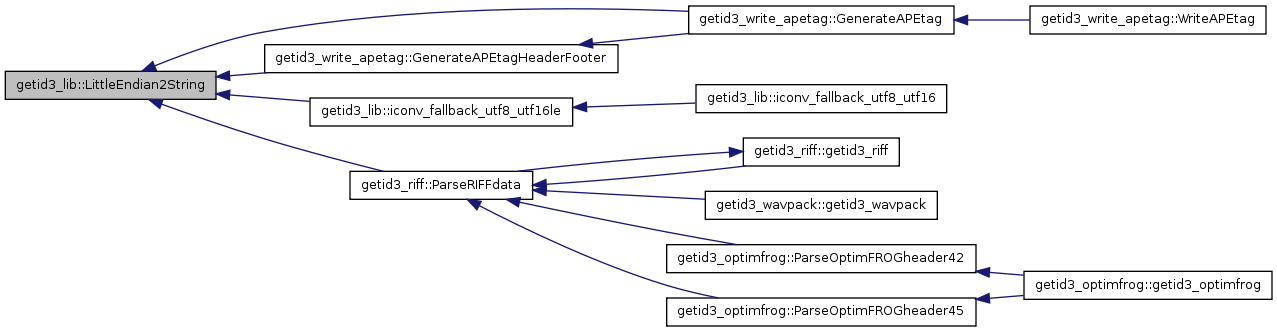
| getid3_lib::md5_file | ( | $ | file | ) |
Definition at line 512 of file getid3.lib.php.
References $file.
Referenced by getID3::getHashdata().
                                 {

                // md5_file() exists in PHP 4.2.0+.
                if (function_exists('md5_file')) {
                        return md5_file($file);
                }

                if (GETID3_OS_ISWINDOWS) {

                        $RequiredFiles = array('cygwin1.dll', 'md5sum.exe');
                        foreach ($RequiredFiles as $required_file) {
                                if (!is_readable(GETID3_HELPERAPPSDIR.$required_file)) {
                                        die(implode(' and ', $RequiredFiles).' are required in '.GETID3_HELPERAPPSDIR.' for getid3_lib::md5_file() to function under Windows in PHP < v4.2.0');
                                }
                        }
                        $commandline = GETID3_HELPERAPPSDIR.'md5sum.exe "'.str_replace('/', DIRECTORY_SEPARATOR, $file).'"';
                        if (ereg("^[\\]?([0-9a-f]{32})", strtolower(`$commandline`), $r)) {
                                return $r[1];
                        }

                } else {

                        // The following works under UNIX only
                        $file = str_replace('`', '\\`', $file);
                        if (ereg("^([0-9a-f]{32})[ \t\n\r]", `md5sum "$file"`, $r)) {
                                return $r[1];
                        }

                }
                return false;
        }
Here is the caller graph for this function:
| getid3_lib::MultiByteCharString2HTML | ( | $ | string, | |
| $ | charset = 'ISO-8859-1' | |||
| ) |
Definition at line 1023 of file getid3.lib.php.
References BigEndian2Int(), and LittleEndian2Int().
Referenced by CopyTagsToComments(), and getID3::HandleAllTags().
                                                                          {
                $HTMLstring = '';

                switch ($charset) {
                        case 'ISO-8859-1':
                        case 'ISO8859-1':
                        case 'ISO-8859-15':
                        case 'ISO8859-15':
                        case 'cp866':
                        case 'ibm866':
                        case '866':
                        case 'cp1251':
                        case 'Windows-1251':
                        case 'win-1251':
                        case '1251':
                        case 'cp1252':
                        case 'Windows-1252':
                        case '1252':
                        case 'KOI8-R':
                        case 'koi8-ru':
                        case 'koi8r':
                        case 'BIG5':
                        case '950':
                        case 'GB2312':
                        case '936':
                        case 'BIG5-HKSCS':
                        case 'Shift_JIS':
                        case 'SJIS':
                        case '932':
                        case 'EUC-JP':
                        case 'EUCJP':
                                $HTMLstring = htmlentities($string, ENT_COMPAT, $charset);
                                break;

                        case 'UTF-8':
                                $strlen = strlen($string);
                                for ($i = 0; $i < $strlen; $i++) {
                                        $char_ord_val = ord($string{$i});
                                        $charval = 0;
                                        if ($char_ord_val < 0x80) {
                                                $charval = $char_ord_val;
                                        } elseif ((($char_ord_val & 0xF0) >> 4) == 0x0F) {
                                                $charval  = (($char_ord_val & 0x07) << 18);
                                                $charval += ((ord($string{++$i}) & 0x3F) << 12);
                                                $charval += ((ord($string{++$i}) & 0x3F) << 6);
                                                $charval +=  (ord($string{++$i}) & 0x3F);
                                        } elseif ((($char_ord_val & 0xE0) >> 5) == 0x07) {
                                                $charval  = (($char_ord_val & 0x0F) << 12);
                                                $charval += ((ord($string{++$i}) & 0x3F) << 6);
                                                $charval +=  (ord($string{++$i}) & 0x3F);
                                        } elseif ((($char_ord_val & 0xC0) >> 6) == 0x03) {
                                                $charval  = (($char_ord_val & 0x1F) << 6);
                                                $charval += (ord($string{++$i}) & 0x3F);
                                        }
                                        if (($charval >= 32) && ($charval <= 127)) {
                                                $HTMLstring .= chr($charval);
                                        } else {
                                                $HTMLstring .= '&#'.$charval.';';
                                        }
                                }
                                break;

                        case 'UTF-16LE':
                                for ($i = 0; $i < strlen($string); $i += 2) {
                                        $charval = getid3_lib::LittleEndian2Int(substr($string, $i, 2));
                                        if (($charval >= 32) && ($charval <= 127)) {
                                                $HTMLstring .= chr($charval);
                                        } else {
                                                $HTMLstring .= '&#'.$charval.';';
                                        }
                                }
                                break;

                        case 'UTF-16BE':
                                for ($i = 0; $i < strlen($string); $i += 2) {
                                        $charval = getid3_lib::BigEndian2Int(substr($string, $i, 2));
                                        if (($charval >= 32) && ($charval <= 127)) {
                                                $HTMLstring .= chr($charval);
                                        } else {
                                                $HTMLstring .= '&#'.$charval.';';
                                        }
                                }
                                break;

                        default:
                                $HTMLstring = 'ERROR: Character set "'.$charset.'" not supported in MultiByteCharString2HTML()';
                                break;
                }
                return $HTMLstring;
        }
Here is the call graph for this function: Here is the caller graph for this function:
| getid3_lib::NormalizeBinaryPoint | ( | $ | binarypointnumber, | |
| $ | maxbits = 52 | |||
| ) |
Definition at line 83 of file getid3.lib.php.
Referenced by Float2String().
                                                                       {
                // http://www.scri.fsu.edu/~jac/MAD3401/Backgrnd/binary.html
                if (strpos($binarypointnumber, '.') === false) {
                        $binarypointnumber = '0.'.$binarypointnumber;
                } elseif ($binarypointnumber{0} == '.') {
                        $binarypointnumber = '0'.$binarypointnumber;
                }
                $exponent = 0;
                while (($binarypointnumber{0} != '1') || (substr($binarypointnumber, 1, 1) != '.')) {
                        if (substr($binarypointnumber, 1, 1) == '.') {
                                $exponent--;
                                $binarypointnumber = substr($binarypointnumber, 2, 1).'.'.substr($binarypointnumber, 3);
                        } else {
                                $pointpos = strpos($binarypointnumber, '.');
                                $exponent += ($pointpos - 1);
                                $binarypointnumber = str_replace('.', '', $binarypointnumber);
                                $binarypointnumber = $binarypointnumber{0}.'.'.substr($binarypointnumber, 1);
                        }
                }
                $binarypointnumber = str_pad(substr($binarypointnumber, 0, $maxbits + 2), $maxbits + 2, '0', STR_PAD_RIGHT);
                return array('normalized'=>$binarypointnumber, 'exponent'=>(int) $exponent);
        }
Here is the caller graph for this function:
| getid3_lib::PlaytimeString | ( | $ | playtimeseconds | ) |
Definition at line 408 of file getid3.lib.php.
Referenced by getID3::ChannelsBitratePlaytimeCalculations().
                                                  {
                $contentseconds = round((($playtimeseconds / 60) - floor($playtimeseconds / 60)) * 60);
                $contentminutes = floor($playtimeseconds / 60);
                if ($contentseconds >= 60) {
                        $contentseconds -= 60;
                        $contentminutes++;
                }
                return intval($contentminutes).':'.str_pad($contentseconds, 2, 0, STR_PAD_LEFT);
        }
Here is the caller graph for this function:
| getid3_lib::PrintHexBytes | ( | $ | string, | |
| $ | hex = true, |
|||
| $ | spaces = true, |
|||
| $ | htmlsafe = true | |||
| ) |
Definition at line 17 of file getid3.lib.php.
Referenced by getid3_mp3::FreeFormatFrameLength(), getid3_la::getid3_la(), getid3_wavpack::getid3_wavpack(), and getid3_optimfrog::ParseOptimFROGheader45().
                                                                                 {
                $returnstring = '';
                for ($i = 0; $i < strlen($string); $i++) {
                        if ($hex) {
                                $returnstring .= str_pad(dechex(ord($string{$i})), 2, '0', STR_PAD_LEFT);
                        } else {
                                $returnstring .= ' '.(ereg("[\x20-\x7E]", $string{$i}) ? $string{$i} : '¤');
                        }
                        if ($spaces) {
                                $returnstring .= ' ';
                        }
                }
                if ($htmlsafe) {
                        $returnstring = htmlentities($returnstring);
                }
                return $returnstring;
        }
Here is the caller graph for this function:
| getid3_lib::RGADadjustmentLookup | ( | $ | rawadjustment, | |
| $ | signbit | |||
| ) |
Definition at line 1141 of file getid3.lib.php.
Referenced by getid3_mp3::decodeMPEGaudioHeader(), getid3_riff::getid3_riff(), and getid3_id3v2::ParseID3v2Frame().
                                                                {
                $adjustment = $rawadjustment / 10;
                if ($signbit == 1) {
                        $adjustment *= -1;
                }
                return (float) $adjustment;
        }
Here is the caller graph for this function:
| getid3_lib::RGADamplitude2dB | ( | $ | amplitude | ) |
Definition at line 1165 of file getid3.lib.php.
Referenced by getid3_ac3::AC3heavyCompression(), getID3::CalculateReplayGain(), and getid3_mp3::decodeMPEGaudioHeader().
                                              {
                return 20 * log10($amplitude);
        }
Here is the caller graph for this function:
| getid3_lib::RGADgainString | ( | $ | namecode, | |
| $ | originatorcode, | |||
| $ | replaygain | |||
| ) |
Definition at line 1150 of file getid3.lib.php.
Referenced by getid3_write_id3v2::GenerateID3v2FrameData().
                                                                         {
                if ($replaygain < 0) {
                        $signbit = '1';
                } else {
                        $signbit = '0';
                }
                $storedreplaygain = intval(round($replaygain * 10));
                $gainstring  = str_pad(decbin($namecode), 3, '0', STR_PAD_LEFT);
                $gainstring .= str_pad(decbin($originatorcode), 3, '0', STR_PAD_LEFT);
                $gainstring .= $signbit;
                $gainstring .= str_pad(decbin($storedreplaygain), 9, '0', STR_PAD_LEFT);

                return $gainstring;
        }
Here is the caller graph for this function:
| getid3_lib::RGADnameLookup | ( | $ | namecode | ) |
Definition at line 1116 of file getid3.lib.php.
Referenced by getid3_mp3::decodeMPEGaudioHeader(), getid3_riff::getid3_riff(), and getid3_id3v2::ParseID3v2Frame().
                                           {
                static $RGADname = array();
                if (empty($RGADname)) {
                        $RGADname[0] = 'not set';
                        $RGADname[1] = 'Track Gain Adjustment';
                        $RGADname[2] = 'Album Gain Adjustment';
                }

                return (isset($RGADname[$namecode]) ? $RGADname[$namecode] : '');
        }
Here is the caller graph for this function:
| getid3_lib::RGADoriginatorLookup | ( | $ | originatorcode | ) |
Definition at line 1128 of file getid3.lib.php.
Referenced by getid3_mp3::decodeMPEGaudioHeader(), getid3_riff::getid3_riff(), and getid3_id3v2::ParseID3v2Frame().
                                                       {
                static $RGADoriginator = array();
                if (empty($RGADoriginator)) {
                        $RGADoriginator[0] = 'unspecified';
                        $RGADoriginator[1] = 'pre-set by artist/producer/mastering engineer';
                        $RGADoriginator[2] = 'set by user';
                        $RGADoriginator[3] = 'determined automatically';
                }

                return (isset($RGADoriginator[$originatorcode]) ? $RGADoriginator[$originatorcode] : '');
        }
Here is the caller graph for this function:
| getid3_lib::SafeStripSlashes | ( | $ | text | ) |
Definition at line 35 of file getid3.lib.php.
                                         {
                if (get_magic_quotes_gpc()) {
                        return stripslashes($text);
                }
                return $text;
        }
| getid3_lib::sha1_file | ( | $ | file | ) |
Definition at line 545 of file getid3.lib.php.
References $file.
Referenced by getID3::getHashdata().
                                  {

                // sha1_file() exists in PHP 4.3.0+.
                if (function_exists('sha1_file')) {
                        return sha1_file($file);
                }

                $file = str_replace('`', '\\`', $file);

                if (GETID3_OS_ISWINDOWS) {

                        $RequiredFiles = array('cygwin1.dll', 'sha1sum.exe');
                        foreach ($RequiredFiles as $required_file) {
                                if (!is_readable(GETID3_HELPERAPPSDIR.$required_file)) {
                                        die(implode(' and ', $RequiredFiles).' are required in '.GETID3_HELPERAPPSDIR.' for getid3_lib::sha1_file() to function under Windows in PHP < v4.3.0');
                                }
                        }
                        $commandline = GETID3_HELPERAPPSDIR.'sha1sum.exe "'.str_replace('/', DIRECTORY_SEPARATOR, $file).'"';
                        if (ereg("^sha1=([0-9a-f]{40})", strtolower(`$commandline`), $r)) {
                                return $r[1];
                        }

                } else {

                        $commandline = 'sha1sum '.escapeshellarg($file).'';
                        if (ereg("^([0-9a-f]{40})[ \t\n\r]", strtolower(`$commandline`), $r)) {
                                return $r[1];
                        }

                }

                return false;
        }
Here is the caller graph for this function:
| getid3_lib::trunc | ( | $ | floatnumber | ) |
Definition at line 43 of file getid3.lib.php.
Referenced by CastAsInt(), Float2BinaryDecimal(), and getid3_voc::getid3_voc().
                                     {
                // truncates a floating-point number at the decimal point
                // returns int (if possible, otherwise float)
                if ($floatnumber >= 1) {
                        $truncatednumber = floor($floatnumber);
                } elseif ($floatnumber <= -1) {
                        $truncatednumber = ceil($floatnumber);
                } else {
                        $truncatednumber = 0;
                }
                if ($truncatednumber <= 1073741824) { // 2^30
                        $truncatednumber = (int) $truncatednumber;
                }
                return $truncatednumber;
        }
Here is the caller graph for this function: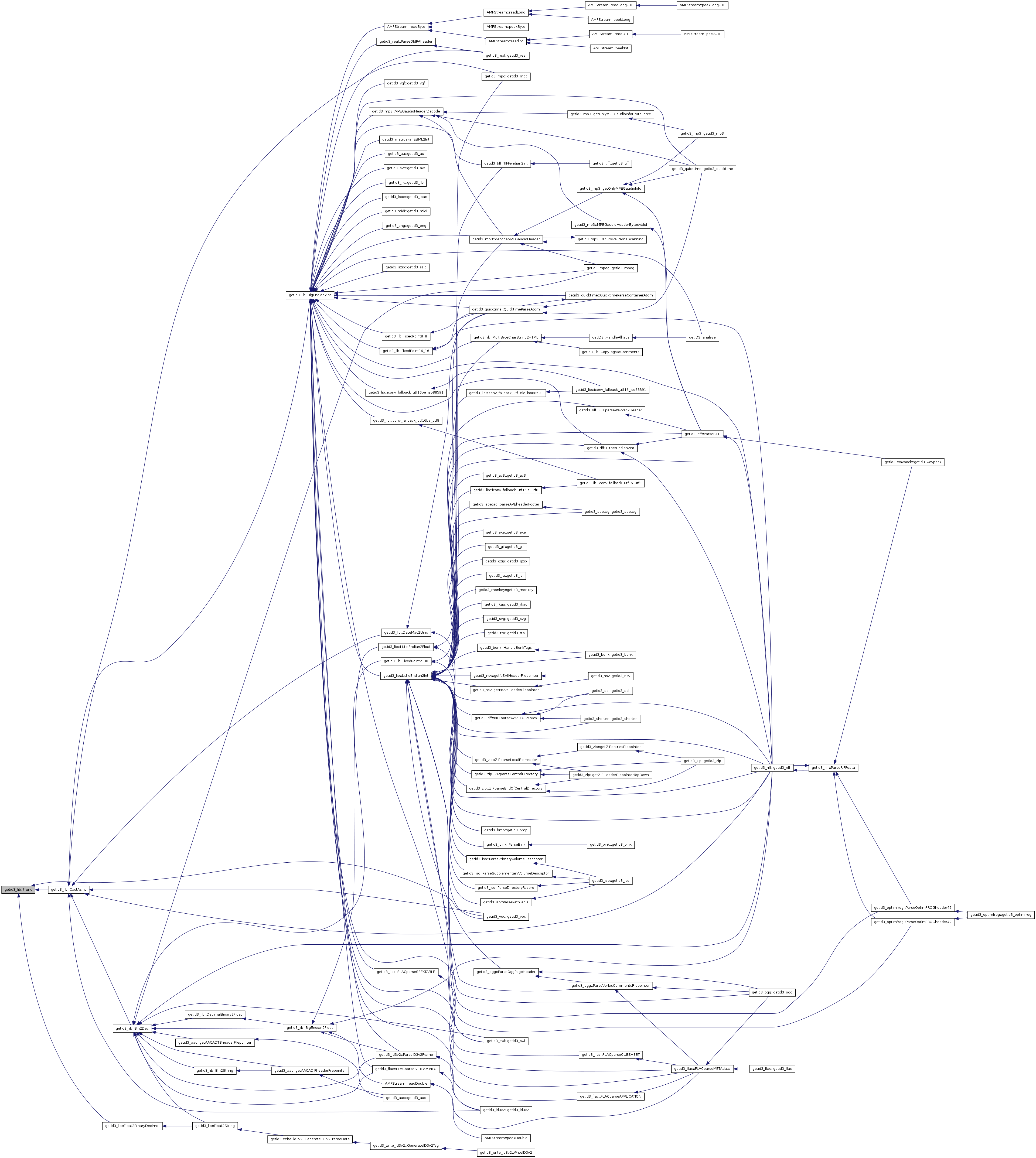
The documentation for this class was generated from the following file:
- Services/MediaObjects/getid3/getid3/getid3.lib.php