Go to the source code of this file.
Functions | |
| navigation ($timestamp) | |
| Functions for day.php. | |
| getDateForDay ($timestamp) | |
| void function getDateForDay($timestamp) This function generates the day string for the day view and passes it to the GUI | |
| getWholeDay ($timestamp, $DB) | |
| void function getWholeDay($timestamp) | |
| generateDay ($timestamp, $DB) | |
| void function generateDay($timestamp) | |
| initTS ($timestamp, &$startshow, &$endshow) | |
| void function initTS($timestamp, &$startshow, &$endshow) | |
| initDisplayTime (&$startDisplayTimeInMinutes, &$endDisplayTimeInMinutes, $dates, $intervall) | |
| void function initDisplayTime(&$startDisplayTimeInMinutes, &$endDisplayTimeInMinutes, $dates) | |
| turnToMinutes (&$dateList, $startshow) | |
| void function turnToMinutes($dateList, $startshow) | |
| testOutput ($dim3) | |
| void function testoutput($dim3) | |
| testOutput2 ($dim2) | |
| void function testOutput2($dim2) | |
| padFront ($dateList, $stream, &$arrayPadded, $intervall, $startDisplayTimeInMinutes) | |
| void function padFront($dateList, $stream, $arrayPadded, $intervall, $startDisplayTimeInMinutes) | |
| padMiddle ($dateList, $counter, $stream, &$arrayPadded, $intervall) | |
| void function padMiddle($dateList, $counter, $stream, $arrayPadded, $intervall) | |
| padBack ($stream, &$arrayPadded, $intervall, $endDisplayTimeInMinutes) | |
| void function padBack($stream, $arrayPadded, $intervall, $endDisplayTimeInMinutes) | |
| generateOutput ($arrayPadded, $intervall, $startDisplayTimeInMinutes, $endDisplayTimeInMinutes, $startshow, $timestamp) | |
| void function generateOutput($arrayPadded, $intervall, $startDisplayTimeInMinutes, $endDisplayTimeInMinutes, $startshow) | |
| parseDataForOutput ($DateValues) | |
| void function parseData (Array DateValues) | |
Function Documentation
| generateDay | ( | $ | timestamp, | |
| $ | DB | |||
| ) |
void function generateDay($timestamp)
this funktion calls the other relevant funktions to fetch dates, reformat them and to generate
- Parameters:
-
$timestamp,a required timestamp of sometime during the current day. $DB,a DB class object. $DP_UId , Session Variable of the User ID $_SESSION ( $DP_Keywords, array containing selected Keywords, time $DP_Endtime, user set display end time and time $DP_Starttime, user set display start time)
- Returns:
- $dayString output in HTML format
Definition at line 173 of file inc.day.php.
References $_SESSION, $DB, $DP_UId, $timestamp, generateOutput(), getDayList(), initDisplayTime(), initTS(), padBack(), padFront(), padMiddle(), and turnToMinutes().
                                     {
        global  $DP_UId, $_SESSION ;
        $startDisplayTimeInMinutes = 60 * $_SESSION[DP_Starttime]; // convert to minutes, cast time to int
        $endDisplayTimeInMinutes = 60 * $_SESSION[DP_Endtime]; // convert to minutes, cast time to int

        $intervall = 15; // intervall of dividers, e.g 15 (min)
        initTS($timestamp, $startshow, $endshow); // get start and end time for the day
        $table_sorted  = getDayList($DP_UId,$startshow , $endshow, $_SESSION[DP_Keywords], $DB); // get streamed dates
        if($table_sorted){ // check for existance of dates
                for($stream=0; $stream<count($table_sorted); $stream++){
                        turnToMinutes   ($table_sorted[$stream], $startshow); // convert timestamps to minutes and format date

                }
                for($stream=0; $stream<count($table_sorted); $stream++){
                        initDisplayTime ($startDisplayTimeInMinutes, $endDisplayTimeInMinutes, $table_sorted[$stream], $intervall); //check if user set display time is sufficient

                }
                for($stream=0; $stream<count($table_sorted); $stream++){
                        //$counter = 0;
                        padFront($table_sorted[$stream], $stream, $arrayPadded, $intervall, $startDisplayTimeInMinutes); // generate fields in $arrayPadded, that resemble the free time before the first date.
                        for($counter=1; $counter<count($table_sorted[$stream]); $counter++){
                                padMiddle($table_sorted[$stream], $counter, $stream, $arrayPadded, $intervall); // generate fields in $arrayPadded, that resemble the free time during dates.
                        }
                        padBack ($stream, $arrayPadded, $intervall, $endDisplayTimeInMinutes);// generate fields in $arrayPadded, that resemble the free time after the last date.
                }
                $dayString = generateOutput($arrayPadded, $intervall, $startDisplayTimeInMinutes, $endDisplayTimeInMinutes, $startshow, $timestamp);

        }
        else{   // in case that table_sorted is empty, create an NULL array_padded for blank rows
                $arrayPadded[0][0][0]="NULL";
                $arrayPadded[0][0][1]=$startDisplayTimeInMinutes;
                $arrayPadded[0][0][2]=$startDisplayTimeInMinutes+$intervall;
                $arrayPadded[0][0][5]=$intervall;
                $arrayPadded[0][0][6]=1;
                padBack(0, $arrayPadded, $intervall, $endDisplayTimeInMinutes);
                $dayString = generateOutput($arrayPadded, $intervall, $startDisplayTimeInMinutes, $endDisplayTimeInMinutes, $startshow, $timestamp);

        }
        return $dayString;

}// end func
 Here is the call graph for this function: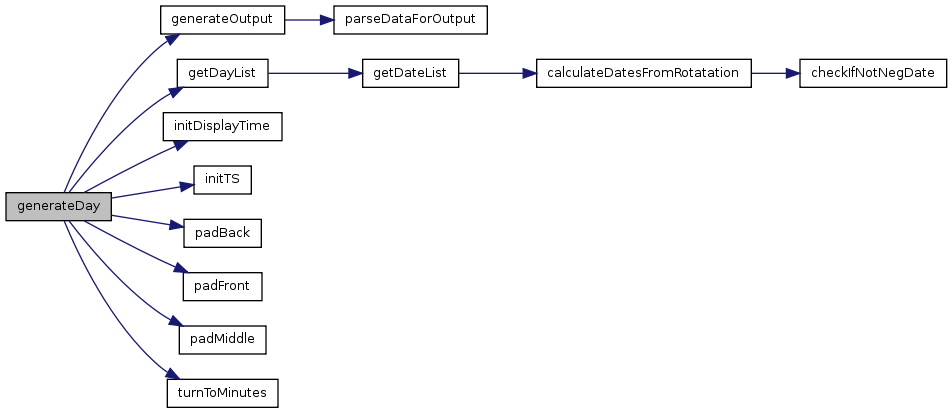
| generateOutput | ( | $ | arrayPadded, | |
| $ | intervall, | |||
| $ | startDisplayTimeInMinutes, | |||
| $ | endDisplayTimeInMinutes, | |||
| $ | startshow, | |||
| $ | timestamp | |||
| ) |
void function generateOutput($arrayPadded, $intervall, $startDisplayTimeInMinutes, $endDisplayTimeInMinutes, $startshow)
This function generates a HTML string. Basically it counts up the minutes from $startDisplayTime to $endDisplayTime. For each minute a new
is created. The starting times of dates and blanks in $arrayPadded are compared to the current time and if they match, a new
with a blank or a date is insterted. With dates, the date information is displayed and a link to date.php is provided as a javascript pop up.
- Parameters:
-
array[][][] $arrayPadded , a 3-dimensional array holding the dates formated for output. The first dimension is used for distinguishing colliding dates. The second dimension holds a single date. The third dimesion holds the attributes of the date, which are ordered as followed: 0=> ID or NULL; 1=> startTimeInMinutes; 2=> endTimeInMinutes; 3=> shortText; 4=> longText; 5=> rowspan; 6=> colspan(not used); 7=> formated date&time of start for output; 8=> formated date&time of end for output; int $startDisplayTimeInMinutes , start of display time int $endDisplayTimeInMinutes , end of display time int $intervall , the displayed subdivisions (i.e. 15) int $startshow , a timestamp of the start of the day (00:00 hours)
string $templatefolder , holds the variable to the folder containing template files string $actualtemplate , defines the used template array[] $DP_CSS, an array containing CSS information $_SESSION ( bol $DP_JSscript is 1 if JavaScript disabled)
- Returns:
- $dayString , the output variable of the Gui
Definition at line 512 of file inc.day.php.
References $_SESSION, $actualtemplate, $DateValues, $DP_CSS, $DP_language, $templatefolder, $timestamp, and parseDataForOutput().
Referenced by generateDay().
{
global $DP_CSS,$DP_language, $templatefolder, $actualtemplate, $_SESSION;
$ttd = new TimestampToDate;
$stream=count($arrayPadded)-1;
for($i=0; $i<=$stream; $i++){
$streamCounter[$i]=0;
}
for($time=$startDisplayTimeInMinutes; $time< $endDisplayTimeInMinutes; $time++){
$dayString=$dayString. "<TR >";
if($time%15==0) {
$dayString=$dayString. "<TD valign='top' width='10' rowspan='".$intervall."' ".$DP_CSS[tblrow2]." style='border-style: solid; border-width: 1' ".$DP_CSS[small]." ><span ".$DP_CSS[small]." >";
$Stunde = ($time-$time%60)/60 ;
$Viertel= $time%60;
if ($Viertel==0) $Viertel="00";
$ttd->ttd($timestamp);
$new_ts = mktime ( $Stunde , $Viertel , 0, $ttd->monthnumber_long , $ttd->day_of_month, $ttd->year_long );
$dayString=$dayString."<a href=\"javascript:popup('dateplaner.php?app=date×tamp=".$new_ts."&PHPSESSID=$PHPSESSID','Date','width=600,height=650,directories=no,toolbar=no,location=no,menubar=no,scrollbars=yes,status=yes,resizable=yes,dependent=no')\" TITLE=\"".$DP_language[new_doc]."\" >".$Stunde.":".$Viertel."
</a>";
$dayString=$dayString. "</span></TD>";
}
for($i=0; $i<=$stream; $i++){
if($arrayPadded[$i][$streamCounter[$i]][1]==$time){
while($arrayPadded[$i][$streamCounter[$i]][1]==$time){
if($arrayPadded[$i][$streamCounter[$i]][0]!="NULL"){
$dayString=$dayString."<TD valign='top' rowspan=".$arrayPadded[$i][$streamCounter[$i]][5]." ".$DP_CSS[tblrow2]." style='border-style: solid; border-width: 1' ".$DP_CSS[small]." ><span ".$DP_CSS[small]." >";
if($_SESSION[DP_JSscript] != 1) {
$dayString=$dayString."<a href=\"dateplaner.php?app=date&date_id=";
$dayString=$dayString.$arrayPadded[$i][$streamCounter[$i]][0];
$dayString=$dayString."&PHPSESSID=".$session_id."×tamp=".$startshow."\" target=\"_blank\" >";
}else {
$dayString=$dayString."<a href=\"javascript:popup('dateplaner.php?app=date&date_id=";
$dayString=$dayString.$arrayPadded[$i][$streamCounter[$i]][0];
$dayString=$dayString."&PHPSESSID=".$session_id."×tamp=".$startshow."','Date','width=600,height=600,directories=no,toolbar=no,location=no,menubar=no,scrollbars=yes,status=yes,resizable=yes,dependent=no')\" >";
}
$dayString=$dayString.$arrayPadded[$i][$streamCounter[$i]][7];
if($arrayPadded[$i][$streamCounter[$i]][7] != $arrayPadded[$i][$streamCounter[$i]][8] )
{
$dayString=$dayString." - ".$arrayPadded[$i][$streamCounter[$i]][8];
}
$DateValues[shorttext] = $arrayPadded[$i][$streamCounter[$i]][3] ;
$DateValues[text] = $arrayPadded[$i][$streamCounter[$i]][4];
$DateValues = parseDataForOutput ($DateValues);
$dayString=$dayString."</a> - <b>".$DateValues[shorttext]."</b>";
$dayString=$dayString."<BR>".$DateValues[text];
$dayString=$dayString."</span></TD>";
$streamCounter[$i]++;
}else{
$dayString=$dayString."<TD rowspan=".$arrayPadded[$i][$streamCounter[$i]][5]." ".$DP_CSS[tblrow4]."style='border-style: solid; border-width: 1' ><span ".$DP_CSS[small]. " >";
$dayString=$dayString."<img src='".$templatefolder."/".$actualtemplate."/images/blind.gif' height='1' width='1'>";
$dayString=$dayString."</span></TD>";
$streamCounter[$i]++;
}
}
}
}
$dayString=$dayString. "</TR> \n";
}
return $dayString;
}// end func
Here is the call graph for this function: Here is the caller graph for this function:
| getDateForDay | ( | $ | timestamp | ) |
void function getDateForDay($timestamp) This function generates the day string for the day view and passes it to the GUI
- Parameters:
-
$timestamp,a required timestamp of sometime during the current day. $DP_language , used by the Gui to determine the language of "today" as set in the language file.
- Returns:
- $showdate , the output variable of the Gui,
Definition at line 102 of file inc.day.php.
References $DP_language, and $timestamp.
                                  {
        global $DP_language;
        $Date = new TimestampToDate();
        $Date->ttd($timestamp);
        $showdate = $Date->shorttime;

        Return $showdate;


}// end func
| getWholeDay | ( | $ | timestamp, | |
| $ | DB | |||
| ) |
void function getWholeDay($timestamp)
This function queries for whole day dates and generates html code which is passed to the Gui
- Parameters:
-
$timestamp,a required timestamp of sometime during the current day. $DB,a DB class object. $DP_UId reads the User ID from the session array[] $DP_Keywords array containing selected Keywords $_SESSION ( bol $DP_JSscript is 1 if JavaScript disabled)
- Returns:
- $wholeDayDayDates , contains dates from 00:00:00 to 23:59:59 for the selected day as html, evaluated by the Gui.
Definition at line 129 of file inc.day.php.
References $_SESSION, $DB, $DP_UId, $timestamp, and getWholeDayDateList().
                                     {
        global $DP_UId, $_SESSION;
        $startshow = mktime(0, 0, 0, date("m", $timestamp), date ("d", $timestamp), date("Y", $timestamp));// don't edit
        $endshow   = mktime(23,59,59, date("m", $timestamp), date ("d", $timestamp), date("Y", $timestamp));// don't edit
        $dates = getWholeDayDateList($DP_UId, $startshow, $endshow, $_SESSION[DP_Keywords], $DB);
        if($dates){
                foreach($dates as $date){
                        if($_SESSION[DP_JSscript] != 1) {
                                $wholeDayDayDates=$wholeDayDayDates."<a href=\"dateplaner.php?app=date&date_id=";
                                $wholeDayDayDates=$wholeDayDayDates.$date[0];
                                $wholeDayDayDates=$wholeDayDayDates."&PHPSESSID=".$PHPSESSID."\" target=\"_blank\" >";

                        }else {
                                $wholeDayDayDates=$wholeDayDayDates."<a href=\"javascript:popup('dateplaner.php?app=date&date_id=";
                                $wholeDayDayDates=$wholeDayDayDates.$date[0];
                                $wholeDayDayDates=$wholeDayDayDates."&PHPSESSID=".$PHPSESSID."','Date','width=600,height=600,directories=no,toolbar=no,location=no,menubar=no,scrollbars=yes,status=yes,resizable=yes,dependent=no')\" >";
                        }
                        $wholeDayDayDates=$wholeDayDayDates.$date[5]."</a> ";
                        $wholeDayDayDates=$wholeDayDayDates.$date[6]."<BR>";
                }
        }
        return $wholeDayDayDates;


}// end func
Here is the call graph for this function:
| initDisplayTime | ( | &$ | startDisplayTimeInMinutes, | |
| &$ | endDisplayTimeInMinutes, | |||
| $ | dates, | |||
| $ | intervall | |||
| ) |
void function initDisplayTime(&$startDisplayTimeInMinutes, &$endDisplayTimeInMinutes, $dates)
this funktion goes through an 2dim array of dates and checks, if the passed start and end display time suffice, if not, they are ajusted
- Parameters:
-
&$startDisplayTimeInMinutes,a required timestamp of sometime during the current day. &$endDisplayTimeInMinutes,a required timestamp of sometime during the current day. $dates,a 2-dimensional array of dates.
Definition at line 248 of file inc.day.php.
Referenced by generateDay().
                                                                                                    {
                foreach($dates as $dim1){
                        if( $dim1[1]< $startDisplayTimeInMinutes){
                                $startDisplayTimeInMinutes = $dim1[1] - $dim1[1]%$intervall;

                        }

                        if( $dim1[2] > $endDisplayTimeInMinutes){
                                $endDisplayTimeInMinutes = $dim1[2] + $dim1[2]%$intervall;
                                if($endDisplayTimeInMinutes > 1440) $endDisplayTimeInMinutes  = 1440;
                        }

                }

}// end func
Here is the caller graph for this function:
| initTS | ( | $ | timestamp, | |
| &$ | startshow, | |||
| &$ | endshow | |||
| ) |
void function initTS($timestamp, &$startshow, &$endshow)
This function generates the timestamps for the start and endtime of the day. using references (i.e &$var) the result is directly stored in the passed variables.
- Parameters:
-
$timestamp,a required timestamp of sometime during the current day. &$startshow,a required timestamp of the starttime of the day, will be generated an written to the variable. &$endshow,a required timestamp of the end of the day, will be generated an written to the variable.
Definition at line 229 of file inc.day.php.
References $timestamp.
Referenced by generateDay().
                                                   {
        $startshow = mktime(0, 0, 0, date("m", $timestamp), date ("d", $timestamp), date("Y", $timestamp));// don't edit
        $endshow   = mktime(23,59,59, date("m", $timestamp), date ("d", $timestamp), date("Y", $timestamp)); //don't edit
}// end func
Here is the caller graph for this function:
| navigation | ( | $ | timestamp | ) |
Functions for day.php.
Description: These Functions are concerned with the Day view of Dates. They fetch data from the functions in inc.sortdates.php or do basic calculations of timestamps to provide links to other dates or to configure the display size.
Version History: 1.0 - release
0.8 - removed most global variables
0.7 - fixed a problem with dates with the same start and end time (moments).
0.6 - added navigation() and getDateForDay(), these provide links for navigation (lastday, nextday, today) and the date of the day shown.
- added getWholeDay(). It fetches Whole Day Dates for a given day.
0.5 - added initTS and initDisplayTime. InitTS calculates the timestamps for datarequests , initDisplaytime compares the user-set displaytime against the requirements of a given dataset and adjusts it, so that all dates of a day can be shown.
- DisplayTimes are now read from the Session.
- Changed Sequences in generateDay to accomodate initDisplayTime()
0.4 - Refactored the whole Code, modularized the padding into padFront(), padMiddle(), padBack(), fixed padding problems. Output is now called for by generateDay().
0.3 - Added table colorings and time column
0.2 - Removed debug code
0.1 - Creation of first code with padding and a basic table, debug code for evaluation
- Version:
- Id:
- inc.day.php 12811 2006-12-08 18:37:44Z akill
void function navigation($timestamp) This function generates the timestamps for the day navigation and passes them to the template day_navigation
- Parameters:
-
$timestamp,a required timestamp of sometime during the current day. $DP_language , used by the Gui to determine the language of "today" as set in the language file.
- Returns:
- $day_navigation , the output variable of the Gui,
Definition at line 78 of file inc.day.php.
References $DP_language, $Gui, and $timestamp.
                               {
                        global $DP_language;
                        $Gui                            = new Gui();

                        $today          = mktime(0,0,0);
                        $lastday        = strtotime ("-1 day" , $timestamp) ;
                        $nextday        = strtotime ("+1 day" , $timestamp) ;

                        eval ("\$day_navigation = \"".$Gui->getTemplate("day_navigation")."\";");

                        return $day_navigation;

} // end func
| padBack | ( | $ | stream, | |
| &$ | arrayPadded, | |||
| $ | intervall, | |||
| $ | endDisplayTimeInMinutes | |||
| ) |
void function padBack($stream, $arrayPadded, $intervall, $endDisplayTimeInMinutes)
This funktion inserts what will be displayed as blank "<TD></TD>" into $arrayPadded, starting from the last date untill $endDisplayTimeInMinutes is reached
- Parameters:
-
int $stream , used to determine, in which part of the first dimension of $arrayPadded dates are inserted. array[][][] $arrayPadded , it is the result array, which contains all data used for displaying and formating, to be passed as a reference int $endDisplayTimeInMinutes , time when the padding has to stop int $intervall , this value holds the size of the subdivisions (i.e. 15)
Definition at line 465 of file inc.day.php.
Referenced by generateDay().
                                                                              {
        $lastElement=count($arrayPadded[$stream])-1;
        $lastEnd=$arrayPadded[$stream][$lastElement][2]; // start padding here
        $nextStart=$lastEnd;
        $nextEnd = ($nextStart - $nextStart%$intervall)+$intervall;
        while($endDisplayTimeInMinutes+15>=$nextEnd){
                $lastElement++;
                $arrayPadded[$stream][$lastElement][0]="NULL";
                $arrayPadded[$stream][$lastElement][1]=$nextStart;
                $arrayPadded[$stream][$lastElement][2]=$nextEnd;
                $arrayPadded[$stream][$lastElement][5]=$nextEnd-$nextStart;
                $arrayPadded[$stream][$lastElement][6]=1;
                $nextStart=$nextEnd;
                $nextEnd=$nextEnd+$intervall;
        }
}// end func
Here is the caller graph for this function:
| padFront | ( | $ | dateList, | |
| $ | stream, | |||
| &$ | arrayPadded, | |||
| $ | intervall, | |||
| $ | startDisplayTimeInMinutes | |||
| ) |
void function padFront($dateList, $stream, $arrayPadded, $intervall, $startDisplayTimeInMinutes)
This funktion inserts what will be displayed as blank "<TD></TD>" into $arrayPadded, until the first date is reached.
- Parameters:
-
array[][] $dateList , a two dimensional array with ascending dates. int $stream , used to determine, in which part of the first dimension of $arrayPadded dates are inserted. array[][][] $arrayPadded , it is the result array, which contains all data used for displaying and formating, to be passed as a reference string $intervall , this value holds the size of the subdivisions (i.e. 15) $startDisplayTimeInMinutes,the display starting time in minutes
Definition at line 353 of file inc.day.php.
Referenced by generateDay().
                                                                                            {
        $padStart= $startDisplayTimeInMinutes;
        $padEnd = $startDisplayTimeInMinutes + $intervall;
        $start=$dateList[0][1];
        $end=$dateList[0][2];
        $row=0;
        while($padEnd<=$start){ //while the padding of one subdivision (i.e length of $intervall) does not overlap a date, keep padding
                $arrayPadded[$stream][$row][0]="NULL";
                $arrayPadded[$stream][$row][1]=$padStart;
                $arrayPadded[$stream][$row][2]=$padEnd;
                $arrayPadded[$stream][$row][5]=$intervall;
                $arrayPadded[$stream][$row][6]=1;
                $padStart=$padEnd;
                $padEnd=$padEnd+$intervall;
                $row++;
        }
        if($padStart < $start){ //try to fit part of an intervall as padding in front of the date.
                $arrayPadded[$stream][$row][0]="NULL";
                $arrayPadded[$stream][$row][1]=$padStart;
                $arrayPadded[$stream][$row][2]=$start;
                $arrayPadded[$stream][$row][5]=$start - $padStart;
                $arrayPadded[$stream][$row][6]=1;
                $padEnd=$padEnd+$intervall;
                $row++;
        }
        //add the date itself
        $arrayPadded[$stream][$row][0]=$dateList[0][0];
        $arrayPadded[$stream][$row][1]=$dateList[0][1];
        $arrayPadded[$stream][$row][2]=$dateList[0][2];
        if($arrayPadded[$stream][$row][2]==$arrayPadded[$stream][$row][1])$arrayPadded[$stream][$row][2]++; // adjust dates with no length, otherwise HTML gets crazy
        $arrayPadded[$stream][$row][3]=$dateList[0][3];
        $arrayPadded[$stream][$row][4]=$dateList[0][4];
        $arrayPadded[$stream][$row][5]=$end - $start;
        $arrayPadded[$stream][$row][6]=1;
        $arrayPadded[$stream][$row][7]=$dateList[0][7];
        $arrayPadded[$stream][$row][8]=$dateList[0][8];
        $row++;
}// end func
Here is the caller graph for this function:
| padMiddle | ( | $ | dateList, | |
| $ | counter, | |||
| $ | stream, | |||
| &$ | arrayPadded, | |||
| $ | intervall | |||
| ) |
void function padMiddle($dateList, $counter, $stream, $arrayPadded, $intervall)
This funktion inserts what will be displayed as blank "<TD></TD>" into $arrayPadded, by trying to fill up untill the next intervall and consecutive intervalls untill and/or the next date.
- Parameters:
-
array[][] $dateList , a two dimensional array with ascending dates. int $counter , points at the current to be padded date in $dateList. int $stream , used to determine, in which part of the first dimension of $arrayPadded dates are inserted. array[][][] $arrayPadded , it is the result array, which contains all data used for displaying and formating, to be passed as a reference int $intervall , this value holds the size of the subdivisions (i.e. 15)
Definition at line 409 of file inc.day.php.
Referenced by generateDay().
                                                                           {
        $lastElement=count($arrayPadded[$stream])-1;
        $lastEnd=$arrayPadded[$stream][$lastElement][2];
        if($dateList[$counter]){ // is not last date
                $nextStart = $dateList[$counter][1]; //start time in minutes
                $nextIntervall=$lastEnd+$intervall-$lastEnd%$intervall; // calculate next interval
                while($nextIntervall < $nextStart){ // insert blank until next interval
                        $lastElement++;
                        $arrayPadded[$stream][$lastElement][0]="NULL";
                        $arrayPadded[$stream][$lastElement][1]=$lastEnd;
                        $arrayPadded[$stream][$lastElement][2]=$nextIntervall;
                        $arrayPadded[$stream][$lastElement][5]=$nextIntervall-$lastEnd;
                        $arrayPadded[$stream][$lastElement][6]=1;
                        $lastEnd = $nextIntervall; // inc $lastEnd
                        $nextIntervall = $nextIntervall + $intervall; // inc $nextInterval
                }
                if($nextStart-$lastEnd>0){ // pad between intervalls
                        $lastElement++;
                        $arrayPadded[$stream][$lastElement][0]="NULL";
                        $arrayPadded[$stream][$lastElement][1]=$lastEnd;
                        $arrayPadded[$stream][$lastElement][2]=$nextStart;
                        $arrayPadded[$stream][$lastElement][5]=$nextStart-$lastEnd;
                        $arrayPadded[$stream][$lastElement][6]=1;
                }
                $lastElement++; // insert date
                $arrayPadded[$stream][$lastElement][0]=$dateList[$counter][0];
                $arrayPadded[$stream][$lastElement][1]=$dateList[$counter][1];
                $arrayPadded[$stream][$lastElement][2]=$dateList[$counter][2];
                if($arrayPadded[$stream][$lastElement][1]==$arrayPadded[$stream][$lastElement][2])$arrayPadded[$stream][$lastElement][2]++; // adjust dates with no length,  otherwise HTML gets crazy
                $arrayPadded[$stream][$lastElement][3]=$dateList[$counter][3];
                $arrayPadded[$stream][$lastElement][4]=$dateList[$counter][4];
                $arrayPadded[$stream][$lastElement][5]=$dateList[$counter][2] - $nextStart;
                $arrayPadded[$stream][$lastElement][6]=1;
                $arrayPadded[$stream][$lastElement][7]=$dateList[$counter][7];
                $arrayPadded[$stream][$lastElement][8]=$dateList[$counter][8];

        }
}// end func back to loop
Here is the caller graph for this function:
| parseDataForOutput | ( | $ | DateValues | ) |
void function parseData (Array DateValues)
Formate the user Date Date for the html Output.
- Parameters:
-
array $DateValues
- Returns:
- string $Valid
Definition at line 585 of file inc.day.php.
References $DateValues.
                                           {

        // parse text for html links and e-mail adresses
        $text = $DateValues[text];
        $urlsearch[]="/([^]_a-z0-9-=\"'\/])((https?|ftp):\/\/|www\.)([^ \r\n\(\)\*\^\$!`\"'\|\[\]\{\};<>]*)/si";
        $urlsearch[]="/^((https?|ftp):\/\/|www\.)([^ \r\n\(\)\*\^\$!`\"'\|\[\]\{\};<>]*)/si";
        $urlreplace[]="\\1<A HREF='\\2\\4' target='_blank'>\\2\\4</A>";
        $urlreplace[]="<A HREF='\\1\\3' target='_blank'>\\1\\3</A>";
        $emailsearch[]="/([\s])([_a-zA-Z0-9-]+(\.[_a-zA-Z0-9-]+)*@[a-zA-Z0-9-]+(\.[a-zA-Z0-9-]+)*(\.[a-zA-Z]{2,}))/si";
        $emailsearch[]="/^([_a-zA-Z0-9-]+(\.[_a-zA-Z0-9-]+)*@[a-zA-Z0-9-]+(\.[a-zA-Z0-9-]+)*(\.[a-zA-Z]{2,}))/si";
        $emailreplace[]="\\1<a href='mailto:\\2'>\\2</a>";
        $emailreplace[]="<a href='mailto:\\0'>\\0</a>";
        $text = preg_replace($urlsearch, $urlreplace, $text);
        if (strpos($text, "@")) $text = preg_replace($emailsearch, $emailreplace, $text);
        // parse text for line breaks
        $text = str_replace("\r\n","<br>" , $text);
        // parse text for images links
        $text = preg_replace("!\[img\](.*)\[/img\]!U","<img alt='\\1' src='\\1'>",$text);
        $DateValues[text] = $text;
        // parse text for html links and e-mail adresses

        $text = $DateValues[shorttext];
        // parse shorttext for html links and e-mail adresses
        $urlsearch[]="/([^]_a-z0-9-=\"'\/])((https?|ftp):\/\/|www\.)([^ \r\n\(\)\*\^\$!`\"'\|\[\]\{\};<>]*)/si";
        $urlsearch[]="/^((https?|ftp):\/\/|www\.)([^ \r\n\(\)\*\^\$!`\"'\|\[\]\{\};<>]*)/si";
        $urlreplace[]="\\1<A HREF='\\2\\4' target='_blank'>\\2\\4</A>";
        $urlreplace[]="<A HREF='\\1\\3' target='_blank'>\\1\\3</A>";
        $emailsearch[]="/([\s])([_a-zA-Z0-9-]+(\.[_a-zA-Z0-9-]+)*@[a-zA-Z0-9-]+(\.[a-zA-Z0-9-]+)*(\.[a-zA-Z]{2,}))/si";
        $emailsearch[]="/^([_a-zA-Z0-9-]+(\.[_a-zA-Z0-9-]+)*@[a-zA-Z0-9-]+(\.[a-zA-Z0-9-]+)*(\.[a-zA-Z]{2,}))/si";
        $emailreplace[]="\\1<a href='mailto:\\2'>\\2</a>";
        $emailreplace[]="<a href='mailto:\\0'>\\0</a>";
        $text = preg_replace($urlsearch, $urlreplace, $text);
        if (strpos($text, "@")) $text = preg_replace($emailsearch, $emailreplace, $text);
        $text = str_replace("\r\n","<br>" , $text);
        $DateValues[shorttext] = $text;

        Return $DateValues;

}// end func
| testOutput | ( | $ | dim3 | ) |
void function testoutput($dim3)
echos a 3 dimensional array to the screen, used for debug purposes, might distort normal table output if existent
- Parameters:
-
array[][][] $dim3 , a 3 dimensional array with data
Definition at line 302 of file inc.day.php.
                          {
        foreach($dim3 as $key => $dim2){
                echo "Stream: ".$key."<br>";
                foreach($dim2 as $dim1){
                        foreach($dim1 as $v){
                                echo ":".$v." ";
                        }
                echo "<br>";
                }
                echo "<br>";
        }
}// end func
| testOutput2 | ( | $ | dim2 | ) |
void function testOutput2($dim2)
echos a 2 dimensional array to the screen, used for debug purposes, might distort normal table output if existent
- Parameters:
-
array[][] $dim2 , a 2 dimensional array with data
Definition at line 326 of file inc.day.php.
                           {
                foreach($dim2 as $dim1){
                        foreach($dim1 as $v){
                                echo ":".$v." ";
                        }
                echo "<br>";
                }
                echo "<br>";
}// end func
| turnToMinutes | ( | &$ | dateList, | |
| $ | startshow | |||
| ) |
void function turnToMinutes($dateList, $startshow)
This function reformats the timestamps of start and end to minutes of the day. Additionally, the timestamps are formated as a date string, as to prepare data for output
- Parameters:
-
array[][] $dateList , a 2-dimensional array of dates int $startshow , timestamp of the start of the day
array[] $DP_language , an array containung language dependant information
Definition at line 278 of file inc.day.php.
References $DP_language.
Referenced by generateDay().
                                              {
        global $DP_language;
        $format = $DP_language[date_format];
        for($date=0; $date<count($dateList); $date++){
                $dateList[$date][7]= date($format, $dateList[$date][1]); // save the date and start time readeable
                $dateList[$date][8]= date($format, $dateList[$date][2]); // save the date and end time readeable
                $dateList[$date][1]= ($dateList[$date][1]-$startshow)/60; // (1)calculate timelength of beginning of from start of day in seconds and divide my 60 to acquire minutes
                if($dateList[$date][1]< 0){$dateList[$date][1]=0;}        // (2) if date started previous to this day, set start display time to start of day
                $dateList[$date][2]= ($dateList[$date][2]-$startshow)/60; // analogous to (1) for end of date
                if($dateList[$date][2]> 1440){$dateList[$date][2]=1440;} // analogous to (2) for subsequent end of date, set to end of day
        }
}// end func
Here is the caller graph for this function: