Public Member Functions | |
| EvalMath () | |
| e ($expr) | |
| evaluate ($expr) | |
| vars () | |
| funcs () | |
| nfx ($expr) | |
| pfx ($tokens, $vars=array()) | |
| trigger ($msg) | |
| from_hexbin ($token) | |
Data Fields | |
| $suppress_errors = false | |
| $last_error = null | |
| $v = array('e'=>2.71,'pi'=>3.14) | |
| $f = array() | |
| $vb = array('e', 'pi') | |
| $fb | |
Detailed Description
Definition at line 89 of file class.EvalMath.php.
Member Function Documentation
| EvalMath::e | ( | $ | expr | ) |
Definition at line 109 of file class.EvalMath.php.
References evaluate().
                      {
        return $this->evaluate($expr);
    }
 Here is the call graph for this function: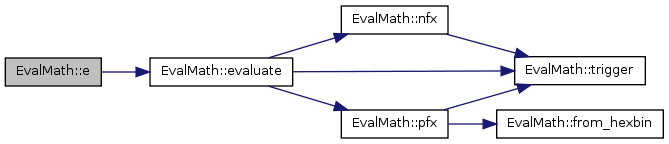
| EvalMath::EvalMath | ( | ) |
Definition at line 103 of file class.EvalMath.php.
                        {
        // make the variables a little more accurate
        $this->v['pi'] = pi();
        $this->v['e'] = exp(1);
    }
| EvalMath::evaluate | ( | $ | expr | ) |
Definition at line 113 of file class.EvalMath.php.
References nfx(), pfx(), and trigger().
Referenced by e().
                             {
        $this->last_error = null;
        $expr = trim($expr);
        if (substr($expr, -1, 1) == ';') $expr = substr($expr, 0, strlen($expr)-1); // strip semicolons at the end
        //===============
        // is it a variable assignment?
        if (preg_match('/^\s*([a-z]\w*)\s*=\s*(.+)$/', $expr, $matches)) {
            if (in_array($matches[1], $this->vb)) { // make sure we're not assigning to a constant
                return $this->trigger("cannot assign to constant '$matches[1]'");
            }
            if (($tmp = $this->pfx($this->nfx($matches[2]))) === false) return false; // get the result and make sure it's good
            $this->v[$matches[1]] = $tmp; // if so, stick it in the variable array
            return $this->v[$matches[1]]; // and return the resulting value
        //===============
        // is it a function assignment?
        } elseif (preg_match('/^\s*([a-z]\w*)\s*\(\s*([a-z]\w*(?:\s*,\s*[a-z]\w*)*)\s*\)\s*=\s*(.+)$/', $expr, $matches)) {
            $fnn = $matches[1]; // get the function name
            if (in_array($matches[1], $this->fb)) { // make sure it isn't built in
                return $this->trigger("cannot redefine built-in function '$matches[1]()'");
            }
            $args = explode(",", preg_replace("/\s+/", "", $matches[2])); // get the arguments
            if (($stack = $this->nfx($matches[3])) === false) return false; // see if it can be converted to postfix
            for ($i = 0; $i<count($stack); $i++) { // freeze the state of the non-argument variables
                $token = $stack[$i];
                if (preg_match('/^[a-z]\w*$/', $token) and !in_array($token, $args)) {
                    if (array_key_exists($token, $this->v)) {
                        $stack[$i] = $this->v[$token];
                    } else {
                        return $this->trigger("undefined variable '$token' in function definition");
                    }
                }
            }
            $this->f[$fnn] = array('args'=>$args, 'func'=>$stack);
            return true;
        //===============
        } else {
            return $this->pfx($this->nfx($expr)); // straight up evaluation, woo
        }
    }
Here is the call graph for this function: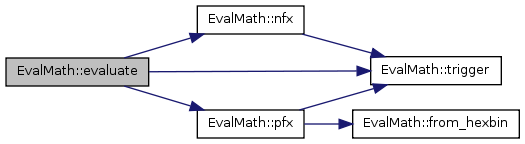 Here is the caller graph for this function:
| EvalMath::from_hexbin | ( | $ | token | ) |
Definition at line 368 of file class.EvalMath.php.
Referenced by pfx().
                                 {
      if (strtoupper(substr($token, -1, 1))=='H')  return hexdec($token);
      if (strtoupper(substr($token, -1, 1))=='B')  return bindec($token);
      return FALSE;
    }
Here is the caller graph for this function:
| EvalMath::funcs | ( | ) |
Definition at line 160 of file class.EvalMath.php.
                     {
        $output = array();
        foreach ($this->f as $fnn=>$dat)
            $output[] = $fnn . '(' . implode(',', $dat['args']) . ')';
        return $output;
    }
| EvalMath::nfx | ( | $ | expr | ) |
Definition at line 170 of file class.EvalMath.php.
References trigger().
Referenced by evaluate().
                        {

        $index = 0;
        $stack = new EvalMathStack;
        $output = array(); // postfix form of expression, to be passed to pfx()
        $expr = trim(strtolower($expr));

        $ops   = array('+', '-', '*', '/', '^', '_');
        $ops_r = array('+'=>0,'-'=>0,'*'=>0,'/'=>0,'^'=>1); // right-associative operator?
        $ops_p = array('+'=>0,'-'=>0,'*'=>1,'/'=>1,'_'=>1,'^'=>2); // operator precedence

        $expecting_op = false; // we use this in syntax-checking the expression
                               // and determining when a - is a negation

        if (preg_match("/[^\w\s+*^\/()\.,-]/", $expr, $matches)) { // make sure the characters are all good
            return $this->trigger("illegal character '{$matches[0]}'");
        }

        while(1) { // 1 Infinite Loop ;)
            $op = substr($expr, $index, 1); // get the first character at the current index
            // find out if we're currently at the beginning of a number/variable/function/parenthesis/operand
            $ex = preg_match('/^([01]+[bB]|[\da-fA-F]+[hH]|[a-z]\w*\(?|\d+(?:\.\d*)?|\.\d+|\()/', substr($expr, $index), $match);
            //===============
            if ($op == '-' and !$expecting_op) { // is it a negation instead of a minus?
                $stack->push('_'); // put a negation on the stack
                $index++;
            } elseif ($op == '_') { // we have to explicitly deny this, because it's legal on the stack
                return $this->trigger("illegal character '_'"); // but not in the input expression
            //===============
            } elseif ((in_array($op, $ops) or $ex) and $expecting_op) { // are we putting an operator on the stack?
                if ($ex) { // are we expecting an operator but have a number/variable/function/opening parethesis?
                    $op = '*'; $index--; // it's an implicit multiplication
                }
                // heart of the algorithm:
                while($stack->count > 0 and ($o2 = $stack->last()) and in_array($o2, $ops) and ($ops_r[$op] ? $ops_p[$op] < $ops_p[$o2] : $ops_p[$op] <= $ops_p[$o2])) {
                    $output[] = $stack->pop(); // pop stuff off the stack into the output
                }
                // many thanks: http://en.wikipedia.org/wiki/Reverse_Polish_notation#The_algorithm_in_detail
                $stack->push($op); // finally put OUR operator onto the stack
                $index++;
                $expecting_op = false;
            //===============
            } elseif ($op == ')' and $expecting_op) { // ready to close a parenthesis?
                while (($o2 = $stack->pop()) != '(') { // pop off the stack back to the last (
                    if (is_null($o2)) return $this->trigger("unexpected ')'");
                    else $output[] = $o2;
                }
                if (preg_match("/^([a-z]\w*)\($/", $stack->last(2), $matches)) { // did we just close a function?
                    $fnn = $matches[1]; // get the function name
                    $arg_count = $stack->pop(); // see how many arguments there were (cleverly stored on the stack, thank you)
                    $output[] = $stack->pop(); // pop the function and push onto the output
                    if (in_array($fnn, $this->fb)) { // check the argument count
                        if($arg_count > 1)
                            return $this->trigger("too many arguments ($arg_count given, 1 expected)");
                    } elseif (array_key_exists($fnn, $this->f)) {
                        if ($arg_count != count($this->f[$fnn]['args']))
                            return $this->trigger("wrong number of arguments ($arg_count given, " . count($this->f[$fnn]['args']) . " expected)");
                    } else { // did we somehow push a non-function on the stack? this should never happen
                        return $this->trigger("internal error");
                    }
                }
                $index++;
            //===============
            } elseif ($op == ',' and $expecting_op) { // did we just finish a function argument?
                while (($o2 = $stack->pop()) != '(') {
                    if (is_null($o2)) return $this->trigger("unexpected ','"); // oops, never had a (
                    else $output[] = $o2; // pop the argument expression stuff and push onto the output
                }
                // make sure there was a function
                if (!preg_match("/^([a-z]\w*)\($/", $stack->last(2), $matches))
                    return $this->trigger("unexpected ','");
                $stack->push($stack->pop()+1); // increment the argument count
                $stack->push('('); // put the ( back on, we'll need to pop back to it again
                $index++;
                $expecting_op = false;
            //===============
            } elseif ($op == '(' and !$expecting_op) {
                $stack->push('('); // that was easy
                $index++;
                $allow_neg = true;
            //===============
            } elseif ($ex and !$expecting_op) { // do we now have a function/variable/number?
                $expecting_op = true;
                $val = $match[1];
                if (preg_match("/^([a-z]\w*)\($/", $val, $matches)) { // may be func, or variable w/ implicit multiplication against parentheses...
                    if (in_array($matches[1], $this->fb) or array_key_exists($matches[1], $this->f)) { // it's a func
                        $stack->push($val);
                        $stack->push(1);
                        $stack->push('(');
                        $expecting_op = false;
                    } else { // it's a var w/ implicit multiplication
                        $val = $matches[1];
                        $output[] = $val;
                    }
                } else { // it's a plain old var or num
                    $output[] = $val;
                }
                $index += strlen($val);
            //===============
            } elseif ($op == ')') { // miscellaneous error checking
                return $this->trigger("unexpected ')'");
            } elseif (in_array($op, $ops) and !$expecting_op) {
                return $this->trigger("unexpected operator '$op'");
            } else { // I don't even want to know what you did to get here
                return $this->trigger("an unexpected error occured");
            }
            if ($index == strlen($expr)) {
                if (in_array($op, $ops)) { // did we end with an operator? bad.
                    return $this->trigger("operator '$op' lacks operand");
                } else {
                    break;
                }
            }
            while (substr($expr, $index, 1) == ' ') { // step the index past whitespace (pretty much turns whitespace
                $index++;                             // into implicit multiplication if no operator is there)
            }

        }
        while (!is_null($op = $stack->pop())) { // pop everything off the stack and push onto output
            if ($op == '(') return $this->trigger("expecting ')'"); // if there are (s on the stack, ()s were unbalanced
            $output[] = $op;
        }
        return $output;
    }
Here is the call graph for this function: Here is the caller graph for this function:
| EvalMath::pfx | ( | $ | tokens, | |
| $ | vars = array() | |||
| ) |
Definition at line 296 of file class.EvalMath.php.
References from_hexbin(), and trigger().
Referenced by evaluate().
                                           {

        if ($tokens == false) return false;

        $stack = new EvalMathStack;

        foreach ($tokens as $token) { // nice and easy
            // if the token is a binary operator, pop two values off the stack, do the operation, and push the result back on
            if (in_array($token, array('+', '-', '*', '/', '^'))) {
                if (is_null($op2 = $stack->pop())) return $this->trigger("internal error");
                if (is_null($op1 = $stack->pop())) return $this->trigger("internal error");
                switch ($token) {
                    case '+':
                        $stack->push($op1+$op2); break;
                    case '-':
                        $stack->push($op1-$op2); break;
                    case '*':
                        $stack->push($op1*$op2); break;
                    case '/':
                        if ($op2 == 0) return $this->trigger("division by zero");
                        $stack->push($op1/$op2); break;
                    case '^':
                        $stack->push(pow($op1, $op2)); break;
                }
            // if the token is a unary operator, pop one value off the stack, do the operation, and push it back on
            } elseif ($token == "_") {
                $stack->push(-1*$stack->pop());
            // if the token is a function, pop arguments off the stack, hand them to the function, and push the result back on
            } elseif (preg_match("/^([a-z]\w*)\($/", $token, $matches)) { // it's a function!
                $fnn = $matches[1];
                if (in_array($fnn, $this->fb)) { // built-in function:
                    if (is_null($op1 = $stack->pop())) return $this->trigger("internal error");
                    $fnn = preg_replace("/^arc/", "a", $fnn); // for the 'arc' trig synonyms
                    if ($fnn == 'ln') $fnn = 'log';
                    eval('$stack->push(' . $fnn . '($op1));'); // perfectly safe eval()
                } elseif (array_key_exists($fnn, $this->f)) { // user function
                    // get args
                    $args = array();
                    for ($i = count($this->f[$fnn]['args'])-1; $i >= 0; $i--) {
                        if (is_null($args[$this->f[$fnn]['args'][$i]] = $stack->pop())) return $this->trigger("internal error");
                    }
                    $stack->push($this->pfx($this->f[$fnn]['func'], $args)); // yay... recursion!!!!
                }
            // if the token is a number or variable, push it on the stack
            } else {
                if (is_numeric($token)) {
                    $stack->push($token);
                } elseif (($hex=$this->from_hexbin($token))!==FALSE) {
                    $stack->push($hex);
                } elseif (array_key_exists($token, $this->v)) {
                    $stack->push($this->v[$token]);
                } elseif (array_key_exists($token, $vars)) {
                    $stack->push($vars[$token]);
                } else {
                    return $this->trigger("undefined variable '$token'");
                }
            }
        }
        // when we're out of tokens, the stack should have a single element, the final result
        if ($stack->count != 1) return $this->trigger("internal error");
        return $stack->pop();
    }
Here is the call graph for this function: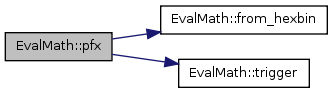 Here is the caller graph for this function:
| EvalMath::trigger | ( | $ | msg | ) |
Definition at line 360 of file class.EvalMath.php.
Referenced by evaluate(), nfx(), and pfx().
                           {
        $this->last_error = $msg;
        if (!$this->suppress_errors) trigger_error($msg, E_USER_WARNING);
        return false;
    }
Here is the caller graph for this function:
| EvalMath::vars | ( | ) |
Definition at line 153 of file class.EvalMath.php.
                    {
        $output = $this->v;
        unset($output['pi']);
        unset($output['e']);
        return $output;
    }
Field Documentation
| EvalMath::$f = array() |
Definition at line 95 of file class.EvalMath.php.
| EvalMath::$fb |
 array(
        'sin','sinh','arcsin','asin','arcsinh','asinh',
        'cos','cosh','arccos','acos','arccosh','acosh',
        'tan','tanh','arctan','atan','arctanh','atanh',
        'sqrt','abs','ln','log')
Definition at line 97 of file class.EvalMath.php.
| EvalMath::$last_error = null |
Definition at line 92 of file class.EvalMath.php.
| EvalMath::$suppress_errors = false |
Definition at line 91 of file class.EvalMath.php.
| EvalMath::$v = array('e'=>2.71,'pi'=>3.14) |
Definition at line 94 of file class.EvalMath.php.
| EvalMath::$vb = array('e', 'pi') |
Definition at line 96 of file class.EvalMath.php.
The documentation for this class was generated from the following file:
- Services/Math/classes/class.EvalMath.php