CronJob Class Reference
Inheritance diagram for CronJob:
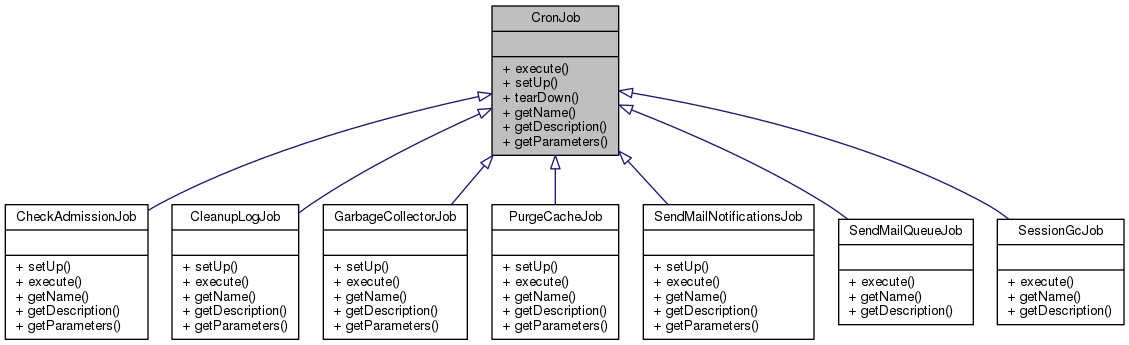
Collaboration diagram for CronJob:

Public Member Functions | |
| execute ($last_result, $parameters=array()) | |
| setUp () | |
| tearDown () | |
Static Public Member Functions | |
| static | getName () |
| static | getDescription () |
| static | getParameters () |
Member Function Documentation
◆ execute()
|
abstract |
Execute the cronjob.
- Parameters
-
mixed $last_result What the last execution of this cronjob returned. Array $parameters Parameters for this cronjob instance which were defined during scheduling.
◆ getDescription()
|
staticabstract |
Return the description of the cronjob.
◆ getName()
|
staticabstract |
Return the name of the cronjob.
◆ getParameters()
|
static |
Returns a list of available parameters for this cronjob.
Each parameter is an entry in the resulting with a unique identifier with the following array fields:
- "type" which is one of the following:
- boolean, a simple binary option
- string, a single line of text
- text, a multiline chunk of text
- integer, a number
- select, a defined set of values (define in the field "values" as an array)
- "default" provides a default value for this field (optional)
- "status" is either "optional" or "mandatory" (optional, defaults to optional)
- "description" provides a decription for this parameter
Example:
return array( 'area' => array( 'type' => 'select', 'values' => array('seminar', 'institute', 'user'), 'description' => 'Example parameter #1', ), 'verbose' => array( 'type' => 'boolean', 'default' => false, 'status' => 'optional', 'description' => 'Example parameter #2', ), );
- Parameters
-
Array List of paramters in the format described above.
◆ setUp()
| setUp | ( | ) |
Setup method.
◆ tearDown()
| tearDown | ( | ) |
Teardown method.
The documentation for this class was generated from the following file:
- lib/classes/CronJob.class.php