The CASClient class is a client interface that provides CAS authentication to PHP applications. More...
Public Member Functions | |
| setHTMLHeader ($header) | |
| This method set the HTML header used for all outputs. | |
| setHTMLFooter ($footer) | |
| This method set the HTML footer used for all outputs. | |
| setLang ($lang) | |
| This method is used to set the language used by phpCAS. | |
| CASClient ($server_version, $proxy, $server_hostname, $server_port, $server_uri, $start_session=true) | |
| CASClient constructor. | |
| getUser () | |
| This method returns the CAS user's login name. | |
| forceAuthentication () | |
| This method is called to be sure that the user is authenticated. | |
| checkAuthentication () | |
| This method is called to check whether the ser is authenticated or not. | |
| isAuthenticated () | |
| This method is called to check if the user is authenticated (previously or by tickets given in the URL. | |
| redirectToCas ($gateway) | |
| This method is used to redirect the client to the CAS server. | |
| logout ($url="") | |
| This method is used to logout from CAS. | |
| setPGTStorageFile ($format='', $path='') | |
| This method is used to tell phpCAS to store the response of the CAS server to PGT requests onto the filesystem. | |
| setPGTStorageDB ($user, $password, $database_type, $hostname, $port, $database, $table) | |
| This method is used to tell phpCAS to store the response of the CAS server to PGT requests into a database. | |
| serviceWeb ($url, &$err_code, &$output) | |
| This method is used to access an HTTP[S] service. | |
| serviceMail ($url, $flags, &$err_code, &$err_msg, &$pt) | |
| This method is used to access an IMAP/POP3/NNTP service. | |
| setHTMLHeader ($header) | |
| This method set the HTML header used for all outputs. | |
| setHTMLFooter ($footer) | |
| This method set the HTML footer used for all outputs. | |
| setLang ($lang) | |
| This method is used to set the language used by phpCAS. | |
| CASClient ($server_version, $proxy, $server_hostname, $server_port, $server_uri, $start_session=true) | |
| CASClient constructor. | |
| getUser () | |
| This method returns the CAS user's login name. | |
| forceAuthentication () | |
| This method is called to be sure that the user is authenticated. | |
| checkAuthentication () | |
| This method is called to check whether the ser is authenticated or not. | |
| isAuthenticated () | |
| This method is called to check if the user is authenticated (previously or by tickets given in the URL. | |
| redirectToCas ($gateway) | |
| This method is used to redirect the client to the CAS server. | |
| logout ($url="") | |
| This method is used to logout from CAS. | |
| setPGTStorageFile ($format='', $path='') | |
| This method is used to tell phpCAS to store the response of the CAS server to PGT requests onto the filesystem. | |
| setPGTStorageDB ($user, $password, $database_type, $hostname, $port, $database, $table) | |
| This method is used to tell phpCAS to store the response of the CAS server to PGT requests into a database. | |
| serviceWeb ($url, &$err_code, &$output) | |
| This method is used to access an HTTP[S] service. | |
| serviceMail ($url, $flags, &$err_code, &$err_msg, &$pt) | |
| This method is used to access an IMAP/POP3/NNTP service. | |
Private Member Functions | |
| HTMLFilterOutput ($str) | |
| This method filters a string by replacing special tokens by appropriate values and prints it. | |
| printHTMLHeader ($title) | |
| This method prints the header of the HTML output (after filtering). | |
| printHTMLFooter () | |
| This method prints the footer of the HTML output (after filtering). | |
| getLang () | |
| This method returns the language used by phpCAS. | |
| getString ($str) | |
| This method returns a string depending on the language. | |
| getServerVersion () | |
| This method is used to retrieve the version of the CAS server. | |
| getServerHostname () | |
| This method is used to retrieve the hostname of the CAS server. | |
| getServerPort () | |
| This method is used to retrieve the port of the CAS server. | |
| getServerURI () | |
| This method is used to retrieve the URI of the CAS server. | |
| getServerBaseURL () | |
| This method is used to retrieve the base URL of the CAS server. | |
| getServerLoginURL ($gateway) | |
| This method is used to retrieve the login URL of the CAS server. | |
| getServerServiceValidateURL () | |
| This method is used to retrieve the service validating URL of the CAS server. | |
| getServerProxyValidateURL () | |
| This method is used to retrieve the proxy validating URL of the CAS server. | |
| getServerProxyURL () | |
| This method is used to retrieve the proxy URL of the CAS server. | |
| getServerLogoutURL () | |
| This method is used to retrieve the logout URL of the CAS server. | |
| setUser ($user) | |
| This method sets the CAS user's login name. | |
| wasPreviouslyAuthenticated () | |
| This method tells if the user has already been (previously) authenticated by looking into the session variables. | |
| getST () | |
| This method returns the Service Ticket provided in the URL of the request. | |
| setST ($st) | |
| This method stores the Service Ticket. | |
| hasST () | |
| This method tells if a Service Ticket was stored. | |
| validateST ($validate_url, &$text_response, &$tree_response) | |
| This method is used to validate a ST; halt on failure, and sets $validate_url, $text_reponse and $tree_response on success. | |
| isProxy () | |
| Tells if a CAS client is a CAS proxy or not. | |
| getPGT () | |
| This method returns the Proxy Granting Ticket given by the CAS server. | |
| setPGT ($pgt) | |
| This method stores the Proxy Granting Ticket. | |
| hasPGT () | |
| This method tells if a Proxy Granting Ticket was stored. | |
| setCallbackMode ($callback_mode) | |
| This method sets/unsets callback mode. | |
| isCallbackMode () | |
| This method returns TRUE when the CAs client is running i callback mode, FALSE otherwise. | |
| getCallbackURL () | |
| This method returns the URL that should be used for the PGT callback (in fact the URL of the current request without any CGI parameter, except if phpCAS::setFixedCallbackURL() was used). | |
| setCallbackURL ($url) | |
| This method sets the callback url. | |
| callback () | |
| This method is called by CASClient::CASClient() when running in callback mode. | |
| initPGTStorage () | |
| This method is used to initialize the storage of PGT's. | |
| storePGT ($pgt, $pgt_iou) | |
| This method stores a PGT. | |
| loadPGT ($pgt_iou) | |
| This method reads a PGT from its Iou and deletes the corresponding storage entry. | |
| validatePGT (&$validate_url, $text_response, $tree_response) | |
| This method is used to validate a PGT; halt on failure. | |
| retrievePT ($target_service, &$err_code, &$err_msg) | |
| This method is used to retrieve PT's from the CAS server thanks to a PGT. | |
| readURL ($url, $cookies, &$headers, &$body, &$err_msg) | |
| This method is used to acces a remote URL. | |
| getPT () | |
| This method returns the Proxy Ticket provided in the URL of the request. | |
| setPT ($pt) | |
| This method stores the Proxy Ticket. | |
| hasPT () | |
| This method tells if a Proxy Ticket was stored. | |
| validatePT (&$validate_url, &$text_response, &$tree_response) | |
| This method is used to validate a PT; halt on failure. | |
| getURL () | |
| This method returns the URL of the current request (without any ticket CGI parameter). | |
| setURL ($url) | |
| This method sets the URL of the current request. | |
| authError ($failure, $cas_url, $no_response, $bad_response='', $cas_response='', $err_code='', $err_msg='') | |
| This method is used to print the HTML output when the user was not authenticated. | |
| HTMLFilterOutput ($str) | |
| This method filters a string by replacing special tokens by appropriate values and prints it. | |
| printHTMLHeader ($title) | |
| This method prints the header of the HTML output (after filtering). | |
| printHTMLFooter () | |
| This method prints the footer of the HTML output (after filtering). | |
| getLang () | |
| This method returns the language used by phpCAS. | |
| getString ($str) | |
| This method returns a string depending on the language. | |
| getServerVersion () | |
| This method is used to retrieve the version of the CAS server. | |
| getServerHostname () | |
| This method is used to retrieve the hostname of the CAS server. | |
| getServerPort () | |
| This method is used to retrieve the port of the CAS server. | |
| getServerURI () | |
| This method is used to retrieve the URI of the CAS server. | |
| getServerBaseURL () | |
| This method is used to retrieve the base URL of the CAS server. | |
| getServerLoginURL ($gateway) | |
| This method is used to retrieve the login URL of the CAS server. | |
| getServerServiceValidateURL () | |
| This method is used to retrieve the service validating URL of the CAS server. | |
| getServerProxyValidateURL () | |
| This method is used to retrieve the proxy validating URL of the CAS server. | |
| getServerProxyURL () | |
| This method is used to retrieve the proxy URL of the CAS server. | |
| getServerLogoutURL () | |
| This method is used to retrieve the logout URL of the CAS server. | |
| setUser ($user) | |
| This method sets the CAS user's login name. | |
| wasPreviouslyAuthenticated () | |
| This method tells if the user has already been (previously) authenticated by looking into the session variables. | |
| getST () | |
| This method returns the Service Ticket provided in the URL of the request. | |
| setST ($st) | |
| This method stores the Service Ticket. | |
| hasST () | |
| This method tells if a Service Ticket was stored. | |
| validateST ($validate_url, &$text_response, &$tree_response) | |
| This method is used to validate a ST; halt on failure, and sets $validate_url, $text_reponse and $tree_response on success. | |
| isProxy () | |
| Tells if a CAS client is a CAS proxy or not. | |
| getPGT () | |
| This method returns the Proxy Granting Ticket given by the CAS server. | |
| setPGT ($pgt) | |
| This method stores the Proxy Granting Ticket. | |
| hasPGT () | |
| This method tells if a Proxy Granting Ticket was stored. | |
| setCallbackMode ($callback_mode) | |
| This method sets/unsets callback mode. | |
| isCallbackMode () | |
| This method returns TRUE when the CAs client is running i callback mode, FALSE otherwise. | |
| getCallbackURL () | |
| This method returns the URL that should be used for the PGT callback (in fact the URL of the current request without any CGI parameter, except if phpCAS::setFixedCallbackURL() was used). | |
| setCallbackURL ($url) | |
| This method sets the callback url. | |
| callback () | |
| This method is called by CASClient::CASClient() when running in callback mode. | |
| initPGTStorage () | |
| This method is used to initialize the storage of PGT's. | |
| storePGT ($pgt, $pgt_iou) | |
| This method stores a PGT. | |
| loadPGT ($pgt_iou) | |
| This method reads a PGT from its Iou and deletes the corresponding storage entry. | |
| validatePGT (&$validate_url, $text_response, $tree_response) | |
| This method is used to validate a PGT; halt on failure. | |
| retrievePT ($target_service, &$err_code, &$err_msg) | |
| This method is used to retrieve PT's from the CAS server thanks to a PGT. | |
| readURL ($url, $cookies, &$headers, &$body, &$err_msg) | |
| This method is used to acces a remote URL. | |
| getPT () | |
| This method returns the Proxy Ticket provided in the URL of the request. | |
| setPT ($pt) | |
| This method stores the Proxy Ticket. | |
| hasPT () | |
| This method tells if a Proxy Ticket was stored. | |
| validatePT (&$validate_url, &$text_response, &$tree_response) | |
| This method is used to validate a PT; halt on failure. | |
| getURL () | |
| This method returns the URL of the current request (without any ticket CGI parameter). | |
| setURL ($url) | |
| This method sets the URL of the current request. | |
| authError ($failure, $cas_url, $no_response, $bad_response='', $cas_response='', $err_code='', $err_msg='') | |
| This method is used to print the HTML output when the user was not authenticated. | |
Private Attributes | |
| $_output_header | |
| A string used to print the header of HTML pages. | |
| $_output_footer | |
| A string used to print the footer of HTML pages. | |
| $_lang | |
| A string corresponding to the language used by phpCAS. | |
| $_strings | |
| array containing the strings used by phpCAS. | |
| $_server | |
| a record to store information about the CAS server. | |
| $_user | |
| The Authenticated user. | |
| $_st | |
| the Service Ticket provided in the URL of the request if present (empty otherwise). | |
| $_proxy | |
| A boolean telling if the client is a CAS proxy or not. | |
| $_pgt | |
| the Proxy Grnting Ticket given by the CAS server (empty otherwise). | |
| $_callback_mode | |
| each PHP script using phpCAS in proxy mode is its own callback to get the PGT back from the CAS server. | |
| $_callback_url | |
| the URL that should be used for the PGT callback (in fact the URL of the current request without any CGI parameter). | |
| $_pgt_storage | |
| an instance of a class inheriting of PGTStorage, used to deal with PGT storage. | |
| $_pt | |
| the Proxy Ticket provided in the URL of the request if present (empty otherwise). | |
| $_url | |
| the URL of the current request (without any ticket CGI parameter). | |
Detailed Description
The CASClient class is a client interface that provides CAS authentication to PHP applications.
Definition at line 22 of file client.php.
Member Function Documentation
| CASClient::authError | ( | $ | failure, | |
| $ | cas_url, | |||
| $ | no_response, | |||
| $ | bad_response = '', |
|||
| $ | cas_response = '', |
|||
| $ | err_code = '', |
|||
| $ | err_msg = '' | |||
| ) | [private] |
This method is used to print the HTML output when the user was not authenticated.
- Parameters:
-
$failure the failure that occured $cas_url the URL the CAS server was asked for $no_response the response from the CAS server (other parameters are ignored if TRUE) $bad_response bad response from the CAS server ($err_code and $err_msg ignored if TRUE) $cas_response the response of the CAS server $err_code the error code given by the CAS server $err_msg the error message given by the CAS server
Definition at line 1927 of file client4.php.
References exit.
    {
      phpCAS::traceBegin();

      $this->printHTMLHeader($this->getString(CAS_STR_AUTHENTICATION_FAILED));
      printf($this->getString(CAS_STR_YOU_WERE_NOT_AUTHENTICATED),$this->getURL(),$_SERVER['SERVER_ADMIN']);
      phpCAS::trace('CAS URL: '.$cas_url);
      phpCAS::trace('Authentication failure: '.$failure);
      if ( $no_response ) {
        phpCAS::trace('Reason: no response from the CAS server');
      } else {
        if ( $bad_response ) {
            phpCAS::trace('Reason: bad response from the CAS server');
        } else {
          switch ($this->getServerVersion()) {
          case CAS_VERSION_1_0:
            phpCAS::trace('Reason: CAS error');
            break;
          case CAS_VERSION_2_0:
            if ( empty($err_code) )
              phpCAS::trace('Reason: no CAS error');
            else
              phpCAS::trace('Reason: ['.$err_code.'] CAS error: '.$err_msg);
            break;
          }
        }
        phpCAS::trace('CAS response: '.$cas_response);
      }
      $this->printHTMLFooter();
      phpCAS::traceExit();
      exit();
    }
| CASClient::callback | ( | ) | [private] |
This method is called by CASClient::CASClient() when running in callback mode.
It stores the PGT and its PGT Iou, prints its output and halts.
Definition at line 1169 of file client4.php.
References $_GET.
    {
      phpCAS::traceBegin();
      $this->printHTMLHeader('phpCAS callback');
      $pgt_iou = $_GET['pgtIou'];
      $pgt = $_GET['pgtId'];
      phpCAS::trace('Storing PGT `'.$pgt.'\' (id=`'.$pgt_iou.'\')');
      echo '<p>Storing PGT `'.$pgt.'\' (id=`'.$pgt_iou.'\').</p>';
      $this->storePGT($pgt,$pgt_iou);
      $this->printHTMLFooter();
      phpCAS::traceExit();
    }
| CASClient::CASClient | ( | $ | server_version, | |
| $ | proxy, | |||
| $ | server_hostname, | |||
| $ | server_port, | |||
| $ | server_uri, | |||
| $ | start_session = true | |||
| ) |
CASClient constructor.
- Parameters:
-
$server_version the version of the CAS server $proxy TRUE if the CAS client is a CAS proxy, FALSE otherwise $server_hostname the hostname of the CAS server $server_port the port the CAS server is running on $server_uri the URI the CAS server is responding on $start_session Have phpCAS start PHP sessions (default true)
- Returns:
- a newly created CASClient object
Definition at line 444 of file client4.php.
References $_GET, isCallbackMode(), isProxy(), and setCallbackMode().
    {
      phpCAS::traceBegin();

      // activate session mechanism if desired
      if ($start_session) {
           session_start();
      }

      $this->_proxy = $proxy;

      // check version
      switch ($server_version) {
      case CAS_VERSION_1_0:
        if ( $this->isProxy() )
          phpCAS::error('CAS proxies are not supported in CAS '
                        .$server_version);
        break;
      case CAS_VERSION_2_0:
        break;
      default:
        phpCAS::error('this version of CAS (`'
                      .$server_version
                      .'\') is not supported by phpCAS '
                        .phpCAS::getVersion());
      }
      $this->_server['version'] = $server_version;

      // check hostname
      if ( empty($server_hostname)
           || !preg_match('/[\.\d\-abcdefghijklmnopqrstuvwxyz]*/',$server_hostname) ) {
        phpCAS::error('bad CAS server hostname (`'.$server_hostname.'\')');
      }
      $this->_server['hostname'] = $server_hostname;

      // check port
      if ( $server_port == 0
           || !is_int($server_port) ) {
        phpCAS::error('bad CAS server port (`'.$server_hostname.'\')');
      }
      $this->_server['port'] = $server_port;

      // check URI
      if ( !preg_match('/[\.\d\-_abcdefghijklmnopqrstuvwxyz\/]*/',$server_uri) ) {
        phpCAS::error('bad CAS server URI (`'.$server_uri.'\')');
      }
      // add leading and trailing `/' and remove doubles
      $server_uri = preg_replace('/\/\//','/','/'.$server_uri.'/');
      $this->_server['uri'] = $server_uri;

      // set to callback mode if PgtIou and PgtId CGI GET parameters are provided
      if ( $this->isProxy() ) {
        $this->setCallbackMode(!empty($_GET['pgtIou'])&&!empty($_GET['pgtId']));
      }

      if ( $this->isCallbackMode() ) {
        // callback mode: check that phpCAS is secured
        if ( $_SERVER['HTTPS'] != 'on' ) {
          phpCAS::error('CAS proxies must be secured to use phpCAS; PGT\'s will not be received from the CAS server');
        }
      } else {
        // normal mode: get ticket and remove it from CGI parameters for developpers
        $ticket = $_GET['ticket'];
        // at first check for a Service Ticket
        if( preg_match('/^ST-/',$ticket)) {
          phpCAS::trace('ST \''.$ticket.'\' found');
          // ST present
          $this->setST($ticket);
        }
        // in a second time check for a Proxy Ticket (CAS >= 2.0)
        else if( ($this->getServerVersion()!=CAS_VERSION_1_0) && preg_match('/^PT-/',$ticket) ) {
          phpCAS::trace('PT \''.$ticket.'\' found');
          $this->setPT($ticket);
        }
        // ill-formed ticket, halt
        else if ( !empty($ticket) ) {
          phpCAS::error('ill-formed ticket found in the URL (ticket=`'.htmlentities($ticket).'\')');
        }
        // ticket has been taken into account, unset it to hide it to applications
        unset($_GET['ticket']);
      }
      phpCAS::traceEnd();
    }
 Here is the call graph for this function: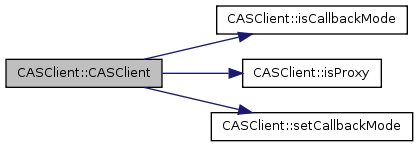
| CASClient::checkAuthentication | ( | ) |
This method is called to check whether the ser is authenticated or not.
- Returns:
- TRUE when the user is authenticated, FALSE otherwise.
Definition at line 612 of file client4.php.
References $_SESSION, $res, isAuthenticated(), and redirectToCas().
    {
      phpCAS::traceBegin();

      if ( $this->isAuthenticated() ) {
            phpCAS::trace('user is authenticated');
            $res = TRUE;
      } else if (isset($_SESSION['phpCAS']['auth_checked'])) {
        // the previous request has redirected the client to the CAS server with gateway=true
        unset($_SESSION['phpCAS']['auth_checked']);
        $res = FALSE;
      } else {
        $_SESSION['phpCAS']['auth_checked'] = true;
            $this->redirectToCas(TRUE/* gateway */);
            // never reached
            $res = FALSE;
      }
      phpCAS::traceEnd($res);
      return $res;
    }
Here is the call graph for this function: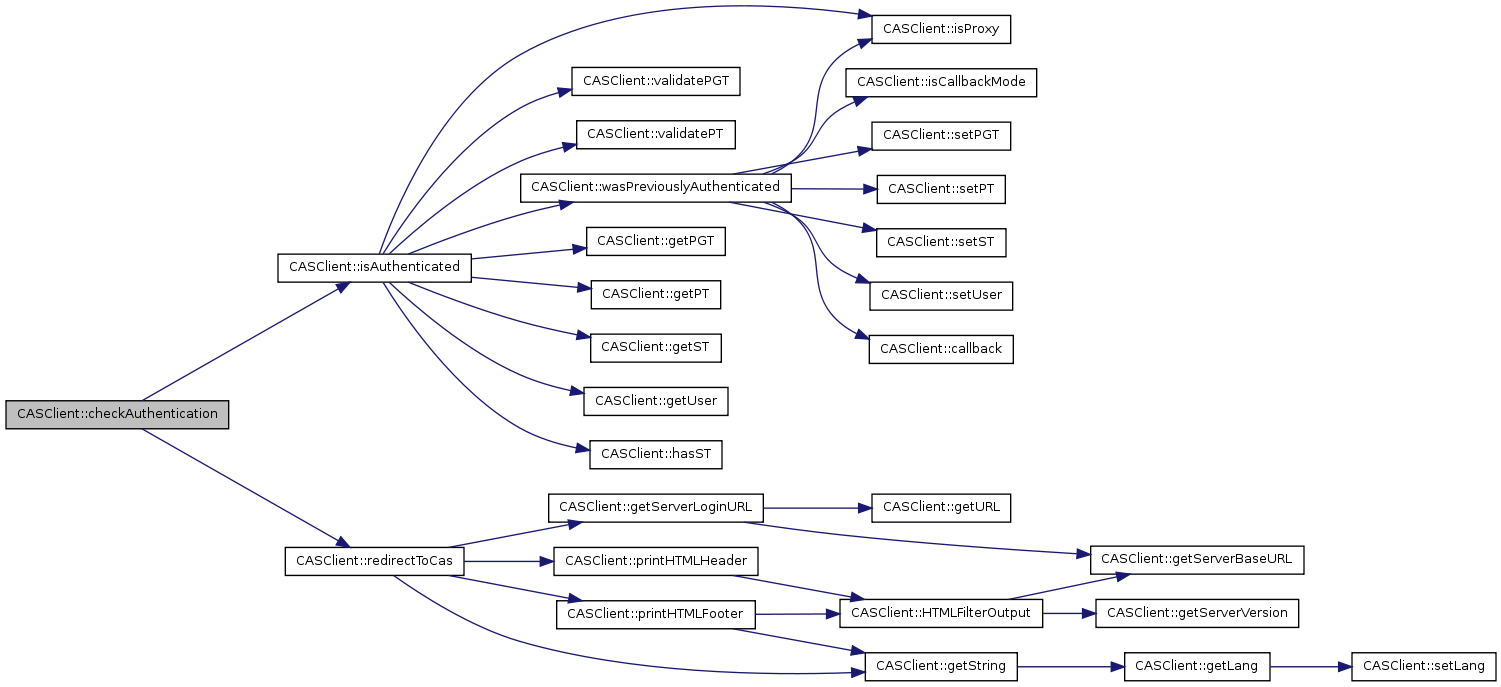
| CASClient::forceAuthentication | ( | ) |
This method is called to be sure that the user is authenticated.
When not authenticated, halt by redirecting to the CAS server; otherwise return TRUE.
- Returns:
- TRUE when the user is authenticated; otherwise halt.
Definition at line 588 of file client4.php.
References $_SESSION, $res, isAuthenticated(), and redirectToCas().
    {
      phpCAS::traceBegin();

      if ( $this->isAuthenticated() ) {
        // the user is authenticated, nothing to be done.
            phpCAS::trace('no need to authenticate');
            $res = TRUE;
      } else {
            // the user is not authenticated, redirect to the CAS server
        unset($_SESSION['phpCAS']['auth_checked']);
            $this->redirectToCas(FALSE/* no gateway */);
            // never reached
            $res = FALSE;
      }
      phpCAS::traceEnd($res);
      return $res;
    }
Here is the call graph for this function: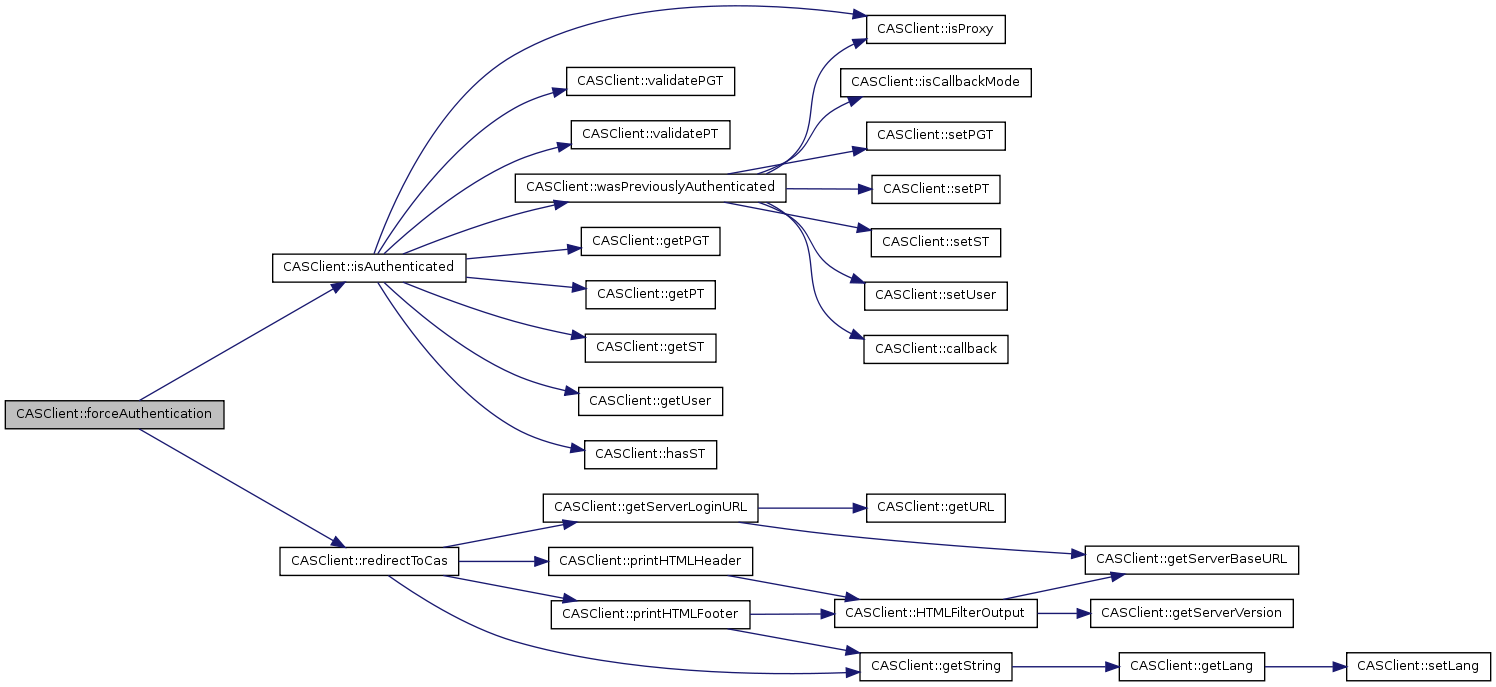
| CASClient::getCallbackURL | ( | ) | [private] |
This method returns the URL that should be used for the PGT callback (in fact the URL of the current request without any CGI parameter, except if phpCAS::setFixedCallbackURL() was used).
- Returns:
- The callback URL
Definition at line 1116 of file client4.php.
References $request_uri.
    {
      // the URL is built when needed only
      if ( empty($this->_callback_url) ) {
        $final_uri = '';
            // remove the ticket if present in the URL
            $final_uri = 'https://';
            /* replaced by Julien Marchal - v0.4.6
             * $this->uri .= $_SERVER['SERVER_NAME'];
             */
        if(empty($_SERVER['HTTP_X_FORWARDED_SERVER'])){
          /* replaced by teedog - v0.4.12
           * $final_uri .= $_SERVER['SERVER_NAME'];
           */
          if (empty($_SERVER['SERVER_NAME'])) {
            $final_uri .= $_SERVER['HTTP_HOST'];
          } else {
            $final_uri .= $_SERVER['SERVER_NAME'];
          }
        } else {
          $final_uri .= $_SERVER['HTTP_X_FORWARDED_SERVER'];
        }
            if ( ($_SERVER['HTTPS']=='on' && $_SERVER['SERVER_PORT']!=443)
               || ($_SERVER['HTTPS']!='on' && $_SERVER['SERVER_PORT']!=80) ) {
              $final_uri .= ':';
              $final_uri .= $_SERVER['SERVER_PORT'];
            }
            $request_uri = $_SERVER['REQUEST_URI'];
            $request_uri = preg_replace('/\?.*$/','',$request_uri);
            $final_uri .= $request_uri;
            $this->setCallbackURL($final_uri);
      }
      return $this->_callback_url;
    }
| CASClient::getLang | ( | ) | [private] |
This method returns the language used by phpCAS.
- Returns:
- a string representing the language
Definition at line 178 of file client4.php.
References setLang().
    {
      if ( empty($this->_lang) )
        $this->setLang(PHPCAS_LANG_DEFAULT);
      return $this->_lang;
    }
Here is the call graph for this function:
| CASClient::getPGT | ( | ) | [private] |
This method returns the Proxy Granting Ticket given by the CAS server.
- Returns:
- The Proxy Granting Ticket.
Definition at line 1029 of file client4.php.
{ return $this->_pgt; }
| CASClient::getPT | ( | ) | [private] |
This method returns the Proxy Ticket provided in the URL of the request.
- Returns:
- The proxy ticket.
Definition at line 1705 of file client4.php.
{ return $this->_pt; }
| CASClient::getServerBaseURL | ( | ) | [private] |
This method is used to retrieve the base URL of the CAS server.
- Returns:
- a URL.
Definition at line 315 of file client4.php.
    {
      // the URL is build only when needed
      if ( empty($this->_server['base_url']) ) {
        $this->_server['base_url'] = 'https://'
          .$this->getServerHostname()
          .':'
          .$this->getServerPort()
          .$this->getServerURI();
      }
      return $this->_server['base_url'];
    }
| CASClient::getServerHostname | ( | ) | [private] |
This method is used to retrieve the hostname of the CAS server.
- Returns:
- the hostname of the CAS server.
Definition at line 291 of file client4.php.
{ return $this->_server['hostname']; }
| CASClient::getServerLoginURL | ( | $ | gateway | ) | [private] |
This method is used to retrieve the login URL of the CAS server.
- Parameters:
-
$gateway true to check authentication, false to force it
- Returns:
- a URL.
Definition at line 334 of file client4.php.
References getServerBaseURL(), and getURL().
    {
      phpCAS::traceBegin();
      // the URL is build only when needed
      if ( empty($this->_server['login_url']) ) {
        $this->_server['login_url'] = $this->getServerBaseURL();
        $this->_server['login_url'] .= 'login?service=';
        $this->_server['login_url'] .= preg_replace('/&/','%26',$this->getURL());
        if ($gateway) {
          $this->_server['login_url'] .= '&gateway=true';
        }
      }
      phpCAS::traceEnd($this->_server['login_url']);
      return $this->_server['login_url'];
    }
Here is the call graph for this function:
| CASClient::getServerLogoutURL | ( | ) | [private] |
This method is used to retrieve the logout URL of the CAS server.
- Returns:
- a URL.
Definition at line 418 of file client4.php.
References getServerBaseURL().
    {
      // the URL is build only when needed
      if ( empty($this->_server['logout_url']) ) {
        $this->_server['logout_url'] = $this->getServerBaseURL().'logout';
      }
      return $this->_server['logout_url'];
    }
Here is the call graph for this function:
| CASClient::getServerPort | ( | ) | [private] |
This method is used to retrieve the port of the CAS server.
- Returns:
- the port of the CAS server.
Definition at line 299 of file client4.php.
{ return $this->_server['port']; }
| CASClient::getServerProxyURL | ( | ) | [private] |
This method is used to retrieve the proxy URL of the CAS server.
- Returns:
- a URL.
Definition at line 397 of file client4.php.
References getServerBaseURL(), and getServerVersion().
    {
      // the URL is build only when needed
      if ( empty($this->_server['proxy_url']) ) {
        switch ($this->getServerVersion()) {
        case CAS_VERSION_1_0:
          $this->_server['proxy_url'] = '';
          break;
        case CAS_VERSION_2_0:
          $this->_server['proxy_url'] = $this->getServerBaseURL().'proxy';
          break;
        }
      }
      return $this->_server['proxy_url'];
    }
Here is the call graph for this function:
| CASClient::getServerProxyValidateURL | ( | ) | [private] |
This method is used to retrieve the proxy validating URL of the CAS server.
- Returns:
- a URL.
Definition at line 376 of file client4.php.
References getServerBaseURL(), getServerVersion(), and getURL().
    {
      // the URL is build only when needed
      if ( empty($this->_server['proxy_validate_url']) ) {
        switch ($this->getServerVersion()) {
        case CAS_VERSION_1_0:
          $this->_server['proxy_validate_url'] = '';
          break;
        case CAS_VERSION_2_0:
          $this->_server['proxy_validate_url'] = $this->getServerBaseURL().'proxyValidate';
          break;
        }
      }
      return $this->_server['proxy_validate_url'].'?service='.preg_replace('/&/','%26',$this->getURL());
    }
Here is the call graph for this function: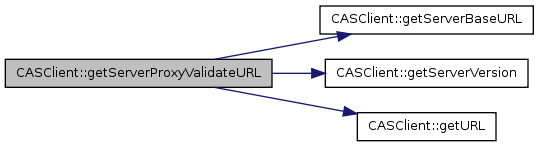
| CASClient::getServerServiceValidateURL | ( | ) | [private] |
This method is used to retrieve the service validating URL of the CAS server.
- Returns:
- a URL.
Definition at line 355 of file client4.php.
References getServerBaseURL(), getServerVersion(), and getURL().
    {
      // the URL is build only when needed
      if ( empty($this->_server['service_validate_url']) ) {
        switch ($this->getServerVersion()) {
        case CAS_VERSION_1_0:
          $this->_server['service_validate_url'] = $this->getServerBaseURL().'validate';
          break;
        case CAS_VERSION_2_0:
          $this->_server['service_validate_url'] = $this->getServerBaseURL().'serviceValidate';
          break;
        }
      }
      return $this->_server['service_validate_url'].'?service='.preg_replace('/&/','%26',$this->getURL());
    }
Here is the call graph for this function: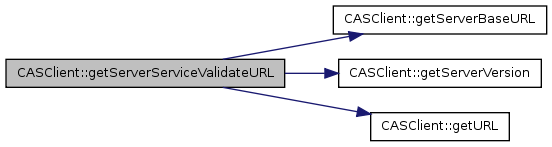
| CASClient::getServerURI | ( | ) | [private] |
This method is used to retrieve the URI of the CAS server.
- Returns:
- a URI.
Definition at line 307 of file client4.php.
{ return $this->_server['uri']; }
| CASClient::getServerVersion | ( | ) | [private] |
This method is used to retrieve the version of the CAS server.
- Returns:
- the version of the CAS server.
Definition at line 281 of file client4.php.
    {
      return $this->_server['version'];
    }
| CASClient::getST | ( | ) | [private] |
This method returns the Service Ticket provided in the URL of the request.
- Returns:
- The service ticket.
Definition at line 819 of file client4.php.
{ return $this->_st; }
| CASClient::getString | ( | $ | str | ) | [private] |
This method returns a string depending on the language.
- Parameters:
-
$str the index of the string in $_string.
- Returns:
- the string corresponding to $index in $string.
Definition at line 205 of file client4.php.
References _strings, and getLang().
    {
      // call CASclient::getLang() to be sure the language is initialized
      $this->getLang();

      if ( !isset($this->_strings[$str]) ) {
        trigger_error('string `'.$str.'\' not defined for language `'.$this->getLang().'\'',E_USER_ERROR);
      }
      return $this->_strings[$str];
    }
Here is the call graph for this function:
| CASClient::getURL | ( | ) | [private] |
This method returns the URL of the current request (without any ticket CGI parameter).
- Returns:
- The URL
Definition at line 1854 of file client4.php.
    {
      phpCAS::traceBegin();
      // the URL is built when needed only
      if ( empty($this->_url) ) {
            $final_uri = '';
            // remove the ticket if present in the URL
            $final_uri = ($_SERVER['HTTPS'] == 'on') ? 'https' : 'http';
            $final_uri .= '://';
            /* replaced by Julien Marchal - v0.4.6
             * $this->_url .= $_SERVER['SERVER_NAME'];
             */
        if(empty($_SERVER['HTTP_X_FORWARDED_SERVER'])){
          /* replaced by teedog - v0.4.12
           * $this->_url .= $_SERVER['SERVER_NAME'];
           */
          if (empty($_SERVER['SERVER_NAME'])) {
            $final_uri .= $_SERVER['HTTP_HOST'];
          } else {
            $final_uri .= $_SERVER['SERVER_NAME'];
          }
        } else {
          $final_uri .= $_SERVER['HTTP_X_FORWARDED_SERVER'];
        }
          if ( ($_SERVER['HTTPS']=='on' && $_SERVER['SERVER_PORT']!=443)
             || ($_SERVER['HTTPS']!='on' && $_SERVER['SERVER_PORT']!=80) ) {
            $final_uri .= ':';
            $final_uri .= $_SERVER['SERVER_PORT'];
          }

          $final_uri .= strtok($_SERVER['REQUEST_URI'],"?");
          $cgi_params = '?'.strtok("?");
          // remove the ticket if present in the CGI parameters
          $cgi_params = preg_replace('/&ticket=[^&]*/','',$cgi_params);
          $cgi_params = preg_replace('/\?ticket=[^&;]*/','?',$cgi_params);
          $cgi_params = preg_replace('/\?$/','',$cgi_params);
          $final_uri .= $cgi_params;
          $this->setURL($final_uri);
    }
    phpCAS::traceEnd($this->_url);
    return $this->_url;
  }
| CASClient::getUser | ( | ) |
This method returns the CAS user's login name.
- Warning:
- should be called only after CASClient::forceAuthentication() or CASClient::isAuthenticated(), otherwise halt with an error.
- Returns:
- the login name of the authenticated user
Definition at line 574 of file client4.php.
    {
      if ( empty($this->_user) ) {
        phpCAS::error('this method should be used only after '.__CLASS__.'::forceAuthentication() or '.__CLASS__.'::isAuthenticated()');
      }
      return $this->_user;
    }
| CASClient::hasPGT | ( | ) | [private] |
This method tells if a Proxy Granting Ticket was stored.
- Returns:
- TRUE if a Proxy Granting Ticket has been stored.
Definition at line 1045 of file client4.php.
{ return !empty($this->_pgt); }
| CASClient::hasPT | ( | ) | [private] |
This method tells if a Proxy Ticket was stored.
- Returns:
- TRUE if a Proxy Ticket has been stored.
Definition at line 1721 of file client4.php.
{ return !empty($this->_pt); }
| CASClient::hasST | ( | ) | [private] |
This method tells if a Service Ticket was stored.
- Returns:
- TRUE if a Service Ticket has been stored.
Definition at line 835 of file client4.php.
{ return !empty($this->_st); }
| CASClient::HTMLFilterOutput | ( | $ | str | ) | [private] |
This method filters a string by replacing special tokens by appropriate values and prints it.
The corresponding tokens are taken into account:
- __CAS_VERSION__
- __PHPCAS_VERSION__
- __SERVER_BASE_URL__
Used by CASClient::PrintHTMLHeader() and CASClient::printHTMLFooter().
- Parameters:
-
$str the string to filter and output
Definition at line 65 of file client4.php.
References getServerBaseURL(), and getServerVersion().
    {
      $str = str_replace('__CAS_VERSION__',$this->getServerVersion(),$str);
      $str = str_replace('__PHPCAS_VERSION__',phpCAS::getVersion(),$str);
      $str = str_replace('__SERVER_BASE_URL__',$this->getServerBaseURL(),$str);
      echo $str;
    }
Here is the call graph for this function:
| CASClient::initPGTStorage | ( | ) | [private] |
This method is used to initialize the storage of PGT's.
Halts on error.
Definition at line 1208 of file client4.php.
    {
      // if no SetPGTStorageXxx() has been used, default to file
      if ( !is_object($this->_pgt_storage) ) {
        $this->setPGTStorageFile();
      }

      // initializes the storage
      $this->_pgt_storage->init();
    }
| CASClient::isAuthenticated | ( | ) |
This method is called to check if the user is authenticated (previously or by tickets given in the URL.
- Returns:
- TRUE when the user is authenticated; otherwise halt.
Definition at line 641 of file client4.php.
References $_SESSION, $res, getPGT(), getPT(), getST(), getUser(), hasST(), isProxy(), validatePGT(), validatePT(), and wasPreviouslyAuthenticated().
    {
      phpCAS::traceBegin();
      $res = FALSE;
      $validate_url = '';

      if ( $this->wasPreviouslyAuthenticated() ) {
        // the user has already (previously during the session) been
        // authenticated, nothing to be done.
        phpCAS::trace('user was already authenticated, no need to look for tickets');
        $res = TRUE;
      } elseif ( $this->hasST() ) {
        // if a Service Ticket was given, validate it
        phpCAS::trace('ST `'.$this->getST().'\' is present');
        $this->validateST($validate_url,$text_response,$tree_response); // if it fails, it halts
        phpCAS::trace('ST `'.$this->getST().'\' was validated');
        if ( $this->isProxy() ) {
          $this->validatePGT($validate_url,$text_response,$tree_response); // idem
          phpCAS::trace('PGT `'.$this->getPGT().'\' was validated');
          $_SESSION['phpCAS']['pgt'] = $this->getPGT();
        }
        $_SESSION['phpCAS']['user'] = $this->getUser();
        $res = TRUE;
      } elseif ( $this->hasPT() ) {
        // if a Proxy Ticket was given, validate it
        phpCAS::trace('PT `'.$this->getPT().'\' is present');
        $this->validatePT($validate_url,$text_response,$tree_response); // note: if it fails, it halts
        phpCAS::trace('PT `'.$this->getPT().'\' was validated');
        if ( $this->isProxy() ) {
          $this->validatePGT($validate_url,$text_response,$tree_response); // idem
          phpCAS::trace('PGT `'.$this->getPGT().'\' was validated');
          $_SESSION['phpCAS']['pgt'] = $this->getPGT();
        }
        $_SESSION['phpCAS']['user'] = $this->getUser();
        $res = TRUE;
      } else {
        // no ticket given, not authenticated
        phpCAS::trace('no ticket found');
      }

      phpCAS::traceEnd($res);
      return $res;
    }
Here is the call graph for this function: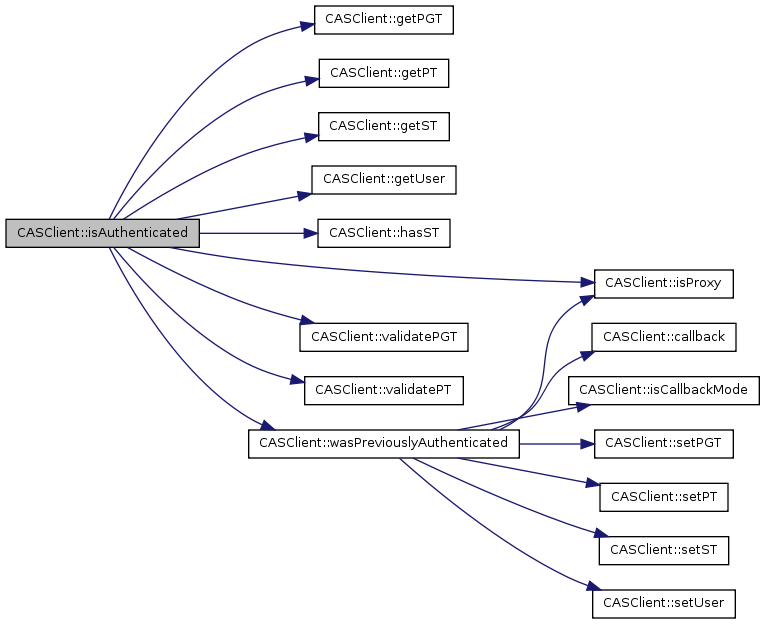
| CASClient::isCallbackMode | ( | ) | [private] |
This method returns TRUE when the CAs client is running i callback mode, FALSE otherwise.
- Returns:
- A boolean.
Definition at line 1092 of file client4.php.
    {
      return $this->_callback_mode;
    }
| CASClient::isProxy | ( | ) | [private] |
Tells if a CAS client is a CAS proxy or not.
- Returns:
- TRUE when the CAS client is a CAs proxy, FALSE otherwise
Definition at line 1001 of file client4.php.
    {
      return $this->_proxy;
    }
| CASClient::loadPGT | ( | $ | pgt_iou | ) | [private] |
This method reads a PGT from its Iou and deletes the corresponding storage entry.
- Parameters:
-
$pgt_iou the PGT Iou
- Returns:
- The PGT corresponding to the Iou, FALSE when not found.
Definition at line 1244 of file client4.php.
    {
      // ensure that storage is initialized
      $this->initPGTStorage();
      // read the PGT
      return $this->_pgt_storage->read($pgt_iou);
    }
| CASClient::logout | ( | $ | url = "" |
) |
This method is used to logout from CAS.
- Parameters:
-
$url a URL that will be transmitted to the CAS server (to come back to when logged out)
Definition at line 769 of file client4.php.
References exit, getServerLogoutURL(), getString(), printHTMLFooter(), and printHTMLHeader().
    {
      phpCAS::traceBegin();
      $cas_url = $this->getServerLogoutURL();
      // v0.4.14 sebastien.gougeon at univ-rennes1.fr
      // header('Location: '.$cas_url);
      if ( $url != "" ) {
        $url = '?service=' . $url;
      }
      header('Location: '.$cas_url . $url);
      session_unset();
      session_destroy();
      $this->printHTMLHeader($this->getString(CAS_STR_LOGOUT));
      printf('<p>'.$this->getString(CAS_STR_SHOULD_HAVE_BEEN_REDIRECTED).'</p>',$cas_url);
      $this->printHTMLFooter();
      phpCAS::traceExit();
      exit();
    }
Here is the call graph for this function:
| CASClient::printHTMLFooter | ( | ) | [private] |
This method prints the footer of the HTML output (after filtering).
If CASClient::setHTMLFooter() was not used, a default footer is output.
- See also:
- HTMLFilterOutput()
Definition at line 120 of file client4.php.
References getString(), and HTMLFilterOutput().
    {
      $this->HTMLFilterOutput(empty($this->_output_footer)
                              ?('<hr><address>phpCAS __PHPCAS_VERSION__ '.$this->getString(CAS_STR_USING_SERVER).' <a href="__SERVER_BASE_URL__">__SERVER_BASE_URL__</a> (CAS __CAS_VERSION__)</a></address></body></html>')
                              :$this->_output_footer);
    }
Here is the call graph for this function:
| CASClient::printHTMLHeader | ( | $ | title | ) | [private] |
This method prints the header of the HTML output (after filtering).
If CASClient::setHTMLHeader() was not used, a default header is output.
- Parameters:
-
$title the title of the page
- See also:
- HTMLFilterOutput()
Definition at line 92 of file client4.php.
References $title, and HTMLFilterOutput().
    {
      $this->HTMLFilterOutput(str_replace('__TITLE__',
                                          $title,
                                          (empty($this->_output_header)
                                           ? '<html><head><title>__TITLE__</title></head><body><h1>__TITLE__</h1>'
                                           : $this->output_header)
                                          )
                              );
    }
Here is the call graph for this function:
| CASClient::readURL | ( | $ | url, | |
| $ | cookies, | |||
| &$ | headers, | |||
| &$ | body, | |||
| &$ | err_msg | |||
| ) | [private] |
This method is used to acces a remote URL.
- Parameters:
-
$url the URL to access. $cookies an array containing cookies strings such as 'name=val' $headers an array containing the HTTP header lines of the response (an empty array on failure). $body the body of the response, as a string (empty on failure). $err_msg an error message, filled on failure.
- Returns:
- TRUE on success, FALSE otherwise (in this later case, $err_msg contains an error message).
Definition at line 1478 of file client4.php.
References $res.
    {
      phpCAS::traceBegin();
      $headers = '';
      $body = '';
      $err_msg = '';

      $res = TRUE;

      // initialize the CURL session
      $ch = curl_init($url);

          // verify the the server's certificate corresponds to its name
          curl_setopt($ch, CURLOPT_SSL_VERIFYHOST, 1);
          // but do not verify the certificate itself
          curl_setopt($ch, CURLOPT_SSL_VERIFYPEER, 0);

      // return the CURL output into a variable
      curl_setopt($ch, CURLOPT_RETURNTRANSFER, 1);
      // include the HTTP header with the body
      curl_setopt($ch, CURLOPT_HEADER, 1);
      // add cookies headers
      if ( is_array($cookies) ) {
        curl_setopt($ch,CURLOPT_COOKIE,implode(';',$cookies));
      }
      // perform the query
      $buf = curl_exec ($ch);
      if ( $buf === FALSE ) {
        phpCAS::trace('cur_exec() failed');
        $err_msg = 'CURL error #'.curl_errno($ch).': '.curl_error($ch);
        // close the CURL session
        curl_close ($ch);
        $res = FALSE;
      } else {
        // close the CURL session
        curl_close ($ch);

        // find the end of the headers
        // note: strpos($str,"\n\r\n\r") does not work (?)
        $pos = FALSE;
        for ($i=0; $i<strlen($buf); $i++) {
          if ( $buf[$i] == chr(13) )
            if ( $buf[$i+1] == chr(10) )
              if ( $buf[$i+2] == chr(13) )
                if ( $buf[$i+3] == chr(10) ) {
                  // header found
                  $pos = $i;
                  break;
                }
        }

        if ( $pos === FALSE ) {
          // end of header not found
          $err_msg = 'no header found';
          phpCAS::trace($err_msg);
          $res = FALSE;
        } else {
          // extract headers into an array
          $headers = preg_split ("/[\n\r]+/",substr($buf,0,$pos));
          // extract body into a string
          $body = substr($buf,$pos+4);
        }
      }

      phpCAS::traceEnd($res);
      return $res;
    }
| CASClient::redirectToCas | ( | $ | gateway | ) |
This method is used to redirect the client to the CAS server.
It is used by CASClient::forceAuthentication() and CASClient::checkAuthentication().
- Parameters:
-
$gateway true to check authentication, false to force it
Definition at line 752 of file client4.php.
References exit, getServerLoginURL(), getString(), printHTMLFooter(), and printHTMLHeader().
    {
      phpCAS::traceBegin();
      $cas_url = $this->getServerLoginURL($gateway);
      header('Location: '.$cas_url);
      $this->printHTMLHeader($this->getString(CAS_STR_AUTHENTICATION_WANTED));
      printf('<p>'.$this->getString(CAS_STR_SHOULD_HAVE_BEEN_REDIRECTED).'</p>',$cas_url);
      $this->printHTMLFooter();
      phpCAS::traceExit();
      exit();
    }
Here is the call graph for this function:
| CASClient::retrievePT | ( | $ | target_service, | |
| &$ | err_code, | |||
| &$ | err_msg | |||
| ) | [private] |
This method is used to retrieve PT's from the CAS server thanks to a PGT.
- Parameters:
-
$target_service the service to ask for with the PT. $err_code an error code (PHPCAS_SERVICE_OK on success). $err_msg an error message (empty on success).
- Returns:
- a Proxy Ticket, or FALSE on error.
Definition at line 1370 of file client4.php.
References domxml_open_mem().
    {
      phpCAS::traceBegin();

      // by default, $err_msg is set empty and $pt to TRUE. On error, $pt is
      // set to false and $err_msg to an error message. At the end, if $pt is FALSE
      // and $error_msg is still empty, it is set to 'invalid response' (the most
      // commonly encountered error).
      $err_msg = '';

      // build the URL to retrieve the PT
      $cas_url = $this->getServerProxyURL().'?targetService='.preg_replace('/&/','%26',$target_service).'&pgt='.$this->getPGT();

      // open and read the URL
      if ( !$this->readURL($cas_url,''/*cookies*/,$headers,$cas_response,$err_msg) ) {
        phpCAS::trace('could not open URL \''.$cas_url.'\' to validate ('.$err_msg.')');
        $err_code = PHPCAS_SERVICE_PT_NO_SERVER_RESPONSE;
        $err_msg = 'could not retrieve PT (no response from the CAS server)';
        phpCAS::traceEnd(FALSE);
        return FALSE;
      }

      $bad_response = FALSE;

      if ( !$bad_response ) {
        // read the response of the CAS server into a DOM object
        if ( !($dom = @domxml_open_mem($cas_response))) {
          phpCAS::trace('domxml_open_mem() failed');
          // read failed
          $bad_response = TRUE;
        }
      }

      if ( !$bad_response ) {
        // read the root node of the XML tree
        if ( !($root = $dom->document_element()) ) {
          phpCAS::trace('document_element() failed');
          // read failed
          $bad_response = TRUE;
        }
      }

      if ( !$bad_response ) {
        // insure that tag name is 'serviceResponse'
        if ( hnodename($root->node_name()) != 'serviceResponse' ) {
          phpCAS::trace('node_name() failed');
          // bad root node
          $bad_response = TRUE;
        }
      }

      if ( !$bad_response ) {
        // look for a proxySuccess tag
        if ( sizeof($arr = $root->get_elements_by_tagname("proxySuccess")) != 0) {
          // authentication succeded, look for a proxyTicket tag
          if ( sizeof($arr = $root->get_elements_by_tagname("proxyTicket")) != 0) {
            $err_code = PHPCAS_SERVICE_OK;
            $err_msg = '';
            $pt = trim($arr[0]->get_content());
            phpCAS::traceEnd($pt);
            return $pt;
          } else {
            phpCAS::trace('<proxySuccess> was found, but not <proxyTicket>');
          }
        }
        // look for a proxyFailure tag
        else if ( sizeof($arr = $root->get_elements_by_tagname("proxyFailure")) != 0) {
          // authentication failed, extract the error
          $err_code = PHPCAS_SERVICE_PT_FAILURE;
          $err_msg = 'PT retrieving failed (code=`'
            .$arr[0]->get_attribute('code')
            .'\', message=`'
            .trim($arr[0]->get_content())
            .'\')';
          phpCAS::traceEnd(FALSE);
          return FALSE;
        } else {
          phpCAS::trace('neither <proxySuccess> nor <proxyFailure> found');
        }
      }

      // at this step, we are sure that the response of the CAS server was ill-formed
      $err_code = PHPCAS_SERVICE_PT_BAD_SERVER_RESPONSE;
      $err_msg = 'Invalid response from the CAS server (response=`'.$cas_response.'\')';

      phpCAS::traceEnd(FALSE);
      return FALSE;
    }
Here is the call graph for this function:
| CASClient::serviceMail | ( | $ | url, | |
| $ | flags, | |||
| &$ | err_code, | |||
| &$ | err_msg, | |||
| &$ | pt | |||
| ) |
This method is used to access an IMAP/POP3/NNTP service.
- Parameters:
-
$url a string giving the URL of the service, including the mailing box for IMAP URLs, as accepted by imap_open(). $flags options given to imap_open(). $err_code an error code Possible values are PHPCAS_SERVICE_OK (on success), PHPCAS_SERVICE_PT_NO_SERVER_RESPONSE, PHPCAS_SERVICE_PT_BAD_SERVER_RESPONSE, PHPCAS_SERVICE_PT_FAILURE, PHPCAS_SERVICE_NOT AVAILABLE. $err_msg an error message on failure $pt the Proxy Ticket (PT) retrieved from the CAS server to access the URL on success, FALSE on error).
- Returns:
- an IMAP stream on success, FALSE otherwise (in this later case, $err_code gives the reason why it failed and $err_msg contains an error message).
Definition at line 1641 of file client4.php.
    {
      phpCAS::traceBegin();
      // at first retrieve a PT
      $pt = $this->retrievePT($target_service,$err_code,$output);

      $stream = FALSE;

      // test if PT was retrieved correctly
      if ( !$pt ) {
        // note: $err_code and $err_msg are filled by CASClient::retrievePT()
        phpCAS::trace('PT was not retrieved correctly');
      } else {
        phpCAS::trace('opening IMAP URL `'.$url.'\'...');
        $stream = @imap_open($url,$this->getUser(),$pt,$flags);
        if ( !$stream ) {
          phpCAS::trace('could not open URL');
          $err_code = PHPCAS_SERVICE_NOT_AVAILABLE;
          // give an error message
          $err_msg = sprintf($this->getString(CAS_STR_SERVICE_UNAVAILABLE),
                             $service_url,
                             var_export(imap_errors(),TRUE));
          $pt = FALSE;
          $stream = FALSE;
        } else {
          phpCAS::trace('ok');
        }
      }

      phpCAS::traceEnd($stream);
      return $stream;
  }
| CASClient::serviceWeb | ( | $ | url, | |
| &$ | err_code, | |||
| &$ | output | |||
| ) |
This method is used to access an HTTP[S] service.
- Parameters:
-
$url the service to access. $err_code an error code Possible values are PHPCAS_SERVICE_OK (on success), PHPCAS_SERVICE_PT_NO_SERVER_RESPONSE, PHPCAS_SERVICE_PT_BAD_SERVER_RESPONSE, PHPCAS_SERVICE_PT_FAILURE, PHPCAS_SERVICE_NOT AVAILABLE. $output the output of the service (also used to give an error message on failure).
- Returns:
- TRUE on success, FALSE otherwise (in this later case, $err_code gives the reason why it failed and $output contains an error message).
Definition at line 1561 of file client4.php.
References $_SESSION, and $res.
    {
      phpCAS::traceBegin();
      // at first retrieve a PT
      $pt = $this->retrievePT($url,$err_code,$output);

      $res = TRUE;

      // test if PT was retrieved correctly
      if ( !$pt ) {
        // note: $err_code and $err_msg are filled by CASClient::retrievePT()
        phpCAS::trace('PT was not retrieved correctly');
        $res = FALSE;
      } else {
        // add cookies if necessary
        if ( is_array($_SESSION['phpCAS']['services'][$url]['cookies']) ) {
          foreach ( $_SESSION['phpCAS']['services'][$url]['cookies'] as $name => $val ) {
            $cookies[] = $name.'='.$val;
          }
        }

        // build the URL including the PT
        if ( strstr($url,'?') === FALSE ) {
          $service_url = $url.'?ticket='.$pt;
        } else {
          $service_url = $url.'&ticket='.$pt;
        }

        phpCAS::trace('reading URL`'.$service_url.'\'');
        if ( !$this->readURL($service_url,$cookies,$headers,$output,$err_msg) ) {
          phpCAS::trace('could not read URL`'.$service_url.'\'');
          $err_code = PHPCAS_SERVICE_NOT_AVAILABLE;
          // give an error message
          $output = sprintf($this->getString(CAS_STR_SERVICE_UNAVAILABLE),
                            $service_url,
                            $err_msg);
          $res = FALSE;
        } else {
          // URL has been fetched, extract the cookies
          phpCAS::trace('URL`'.$service_url.'\' has been read, storing cookies:');
          foreach ( $headers as $header ) {
            // test if the header is a cookie
            if ( preg_match('/^Set-Cookie:/',$header) ) {
              // the header is a cookie, remove the beginning
              $header_val = preg_replace('/^Set-Cookie: */','',$header);
              // extract interesting information
              $name_val = strtok($header_val,'; ');
              // extract the name and the value of the cookie
              $cookie_name = strtok($name_val,'=');
              $cookie_val = strtok('=');
              // store the cookie
              $_SESSION['phpCAS']['services'][$url]['cookies'][$cookie_name] = $cookie_val;
              phpCAS::trace($cookie_name.' -> '.$cookie_val);
            }
          }
        }
      }

      phpCAS::traceEnd($res);
      return $res;
  }
| CASClient::setCallbackMode | ( | $ | callback_mode | ) | [private] |
This method sets/unsets callback mode.
- Parameters:
-
$callback_mode TRUE to set callback mode, FALSE otherwise.
Definition at line 1079 of file client4.php.
    {
      $this->_callback_mode = $callback_mode;
    }
| CASClient::setCallbackURL | ( | $ | url | ) | [private] |
This method sets the callback url.
- Parameters:
-
$callback_url url to set callback
Definition at line 1158 of file client4.php.
    {
      return $this->_callback_url = $url;
    }
| CASClient::setHTMLFooter | ( | $ | footer | ) |
This method set the HTML footer used for all outputs.
- Parameters:
-
$footer the HTML footer.
Definition at line 146 of file client4.php.
    {
      $this->_output_footer = $footer;
    }
| CASClient::setHTMLHeader | ( | $ | header | ) |
This method set the HTML header used for all outputs.
- Parameters:
-
$header the HTML header.
Definition at line 134 of file client4.php.
    {
      $this->_output_header = $header;
    }
| CASClient::setLang | ( | $ | lang | ) |
This method is used to set the language used by phpCAS.
- Note:
- Can be called only once.
- Parameters:
-
$lang a string representing the language.
- See also:
- CAS_LANG_FRENCH, CAS_LANG_ENGLISH
Definition at line 225 of file client4.php.
| CASClient::setPGT | ( | $ | pgt | ) | [private] |
This method stores the Proxy Granting Ticket.
- Parameters:
-
$pgt The Proxy Granting Ticket.
Definition at line 1037 of file client4.php.
{ $this->_pgt = $pgt; }
| CASClient::setPGTStorageDB | ( | $ | user, | |
| $ | password, | |||
| $ | database_type, | |||
| $ | hostname, | |||
| $ | port, | |||
| $ | database, | |||
| $ | table | |||
| ) |
This method is used to tell phpCAS to store the response of the CAS server to PGT requests into a database.
- Note:
- The connection to the database is done only when needed. As a consequence, bad parameters are detected only when initializing PGT storage.
- Parameters:
-
$user the user to access the data with $password the user's password $database_type the type of the database hosting the data $hostname the server hosting the database $port the port the server is listening on $database the name of the database $table the name of the table storing the data
Definition at line 1290 of file client4.php.
References $user.
    {
      // check that the storage has not already been set
      if ( is_object($this->_pgt_storage) ) {
        phpCAS::error('PGT storage already defined');
      }

      // warn the user that he should use file storage...
      trigger_error('PGT storage into database is an experimental feature, use at your own risk',E_USER_WARNING);

      // create the storage object
      $this->_pgt_storage = & new PGTStorageDB($this,$user,$password,$database_type,$hostname,$port,$database,$table);
    }
| CASClient::setPGTStorageFile | ( | $ | format = '', |
|
| $ | path = '' | |||
| ) |
This method is used to tell phpCAS to store the response of the CAS server to PGT requests onto the filesystem.
- Parameters:
-
$format the format used to store the PGT's (`plain' and `xml' allowed) $path the path where the PGT's should be stored
Definition at line 1261 of file client4.php.
    {
      // check that the storage has not already been set
      if ( is_object($this->_pgt_storage) ) {
        phpCAS::error('PGT storage already defined');
      }

      // create the storage object
      $this->_pgt_storage = &new PGTStorageFile($this,$format,$path);
    }
| CASClient::setPT | ( | $ | pt | ) | [private] |
This method stores the Proxy Ticket.
- Parameters:
-
$pt The Proxy Ticket.
Definition at line 1713 of file client4.php.
{ $this->_pt = $pt; }
| CASClient::setST | ( | $ | st | ) | [private] |
This method stores the Service Ticket.
- Parameters:
-
$st The Service Ticket.
Definition at line 827 of file client4.php.
{ $this->_st = $st; }
| CASClient::setURL | ( | $ | url | ) | [private] |
This method sets the URL of the current request.
- Parameters:
-
$url url to set for service
Definition at line 1904 of file client4.php.
    {
      $this->_url = $url;
    }
| CASClient::setUser | ( | $ | user | ) | [private] |
This method sets the CAS user's login name.
- Parameters:
-
$user the login name of the authenticated user.
Definition at line 562 of file client4.php.
References $user.
    {
      $this->_user = $user;
    }
| CASClient::storePGT | ( | $ | pgt, | |
| $ | pgt_iou | |||
| ) | [private] |
This method stores a PGT.
Halts on error.
- Parameters:
-
$pgt the PGT to store $pgt_iou its corresponding Iou
Definition at line 1227 of file client4.php.
    {
      // ensure that storage is initialized
      $this->initPGTStorage();
      // writes the PGT
      $this->_pgt_storage->write($pgt,$pgt_iou);
    }
| CASClient::validatePGT | ( | &$ | validate_url, | |
| $ | text_response, | |||
| $ | tree_response | |||
| ) | [private] |
This method is used to validate a PGT; halt on failure.
- Parameters:
-
$validate_url the URL of the request to the CAS server. $text_response the response of the CAS server, as is (XML text); result of CASClient::validateST() or CASClient::validatePT(). $tree_response the response of the CAS server, as a DOM XML tree; result of CASClient::validateST() or CASClient::validatePT().
- Returns:
- bool TRUE when successfull, halt otherwise by calling CASClient::authError().
Definition at line 1326 of file client4.php.
    {
      phpCAS::traceBegin();
      if ( sizeof($arr = $tree_response->get_elements_by_tagname("proxyGrantingTicket")) == 0) {
        phpCAS::trace('<proxyGrantingTicket> not found');
        // authentication succeded, but no PGT Iou was transmitted
        $this->authError('Ticket validated but no PGT Iou transmitted',
                     $validate_url,
                     FALSE/*$no_response*/,
                     FALSE/*$bad_response*/,
                     $text_response);
      } else {
        // PGT Iou transmitted, extract it
        $pgt_iou = trim($arr[0]->get_content());
        $pgt = $this->loadPGT($pgt_iou);
        if ( $pgt == FALSE ) {
          phpCAS::trace('could not load PGT');
          $this->authError('PGT Iou was transmitted but PGT could not be retrieved',
                       $validate_url,
                       FALSE/*$no_response*/,
                       FALSE/*$bad_response*/,
                       $text_response);
        }
        $this->setPGT($pgt);
      }
      phpCAS::traceEnd(TRUE);
      return TRUE;
    }
| CASClient::validatePT | ( | &$ | validate_url, | |
| &$ | text_response, | |||
| &$ | tree_response | |||
| ) | [private] |
This method is used to validate a PT; halt on failure.
- Returns:
- bool TRUE when successfull, halt otherwise by calling CASClient::authError().
Definition at line 1740 of file client4.php.
    {
      phpCAS::traceBegin();
      // build the URL to validate the ticket
      $validate_url = $this->getServerProxyValidateURL().'&ticket='.$this->getPT();

      if ( $this->isProxy() ) {
      // pass the callback url for CAS proxies
        $validate_url .= '&pgtUrl='.$this->getCallbackURL();
      }

      // open and read the URL
      if ( !$this->readURL($validate_url,''/*cookies*/,$headers,$text_response,$err_msg) ) {
        phpCAS::trace('could not open URL \''.$validate_url.'\' to validate ('.$err_msg.')');
        $this->authError('PT not validated',
                         $validate_url,
                         TRUE/*$no_response*/);
      }

      // read the response of the CAS server into a DOM object
      if ( !($dom = domxml_open_mem($text_response))) {
        // read failed
        $this->authError('PT not validated',
                     $alidate_url,
                     FALSE/*$no_response*/,
                     TRUE/*$bad_response*/,
                     $text_response);
      }
      // read the root node of the XML tree
      if ( !($tree_response = $dom->document_element()) ) {
        // read failed
        $this->authError('PT not validated',
                     $validate_url,
                     FALSE/*$no_response*/,
                     TRUE/*$bad_response*/,
                     $text_response);
      }
      // insure that tag name is 'serviceResponse'
      if ( hnodename($tree_response->node_name()) != 'serviceResponse' ) {
        // bad root node
        $this->authError('PT not validated',
                     $validate_url,
                     FALSE/*$no_response*/,
                     TRUE/*$bad_response*/,
                     $text_response);
      }
      if ( sizeof($arr = $tree_response->get_elements_by_tagname("authenticationSuccess")) != 0) {
        // authentication succeded, extract the user name
        if ( sizeof($arr = $tree_response->get_elements_by_tagname("user")) == 0) {
          // no user specified => error
          $this->authError('PT not validated',
                       $validate_url,
                       FALSE/*$no_response*/,
                       TRUE/*$bad_response*/,
                       $text_response);
        }
        $this->setUser(trim($arr[0]->get_content()));

      } else if ( sizeof($arr = $tree_response->get_elements_by_tagname("authenticationFailure")) != 0) {
        // authentication succeded, extract the error code and message
        $this->authError('PT not validated',
                     $validate_url,
                     FALSE/*$no_response*/,
                     FALSE/*$bad_response*/,
                     $text_response,
                     $arr[0]->get_attribute('code')/*$err_code*/,
                     trim($arr[0]->get_content())/*$err_msg*/);
      } else {
        $this->authError('PT not validated',
                     $validate_url,
                     FALSE/*$no_response*/,
                     TRUE/*$bad_response*/,
                     $text_response);
      }

      // at this step, PT has been validated and $this->_user has been set,

      phpCAS::traceEnd(TRUE);
      return TRUE;
    }
| CASClient::validateST | ( | $ | validate_url, | |
| &$ | text_response, | |||
| &$ | tree_response | |||
| ) | [private] |
This method is used to validate a ST; halt on failure, and sets $validate_url, $text_reponse and $tree_response on success.
These parameters are used later by CASClient::validatePGT() for CAS proxies.
- Parameters:
-
$validate_url the URL of the request to the CAS server. $text_response the response of the CAS server, as is (XML text). $tree_response the response of the CAS server, as a DOM XML tree.
- Returns:
- bool TRUE when successfull, halt otherwise by calling CASClient::authError().
Definition at line 861 of file client4.php.
References $user, authError(), domxml_open_mem(), getServerServiceValidateURL(), getST(), hnodename(), isProxy(), n, readURL(), and setUser().
    {
      phpCAS::traceBegin();
      // build the URL to validate the ticket
      $validate_url = $this->getServerServiceValidateURL().'&ticket='.$this->getST();
      if ( $this->isProxy() ) {
        // pass the callback url for CAS proxies
        $validate_url .= '&pgtUrl='.$this->getCallbackURL();
      }

      // open and read the URL
      if ( !$this->readURL($validate_url,''/*cookies*/,$headers,$text_response,$err_msg) ) {
        phpCAS::trace('could not open URL \''.$validate_url.'\' to validate ('.$err_msg.')');
        $this->authError('ST not validated (1)',
                         $validate_url,
                         TRUE/*$no_response*/);
      }

      // analyze the result depending on the version
      switch ($this->getServerVersion()) {
      case CAS_VERSION_1_0:
        if (preg_match('/^no\n/',$text_response)) {
          phpCAS::trace('ST has not been validated');
          $this->authError('ST not validated (2)',
                       $validate_url,
                       FALSE/*$no_response*/,
                       FALSE/*$bad_response*/,
                       $text_response);
        }
        if (!preg_match('/^yes\n/',$text_response)) {
          phpCAS::trace('ill-formed response');
          $this->authError('ST not validated (3)',
                       $validate_url,
                       FALSE/*$no_response*/,
                       TRUE/*$bad_response*/,
                       $text_response);
        }
        // ST has been validated, extract the user name
        $arr = preg_split('/\n/',$text_response);
        $this->setUser(trim($arr[1]));
        break;
      case CAS_VERSION_2_0:
        // read the response of the CAS server into a DOM object
        if ( !($dom = domxml_open_mem($text_response))) {
          phpCAS::trace('domxml_open_mem() failed');
          $this->authError('ST not validated (4)',
                       $validate_url,
                       FALSE/*$no_response*/,
                       TRUE/*$bad_response*/,
                       $text_response);
        }
        // read the root node of the XML tree
        if ( !($tree_response = $dom->document_element()) ) {
          phpCAS::trace('document_element() failed');
          $this->authError('ST not validated (5)',
                       $validate_url,
                       FALSE/*$no_response*/,
                       TRUE/*$bad_response*/,
                       $text_response);
        }
        // insure that tag name is 'serviceResponse'
        if ( hnodename($tree_response->node_name()) != 'serviceResponse' ) {
          phpCAS::trace('bad XML root node (should be `serviceResponse\' instead of `'.hnodename($tree_response->node_name()).'\'');
          $this->authError('ST not validated (6)',
                       $validate_url,
                       FALSE/*$no_response*/,
                       TRUE/*$bad_response*/,
                       $text_response);
        }
        if ( sizeof($success_elements = $tree_response->get_elements_by_tagname("authenticationSuccess")) != 0) {
          // authentication succeded, extract the user name
          if ( sizeof($user_elements = $success_elements[0]->get_elements_by_tagname("user")) == 0) {
            phpCAS::trace('<authenticationSuccess> found, but no <user>');
            $this->authError('ST not validated (7)',
                         $validate_url,
                         FALSE/*$no_response*/,
                         TRUE/*$bad_response*/,
                         $text_response);
          }
          $user = trim($user_elements[0]->get_content());
          phpCAS::trace('user = `'.$user);
          $this->setUser($user);

        } else if ( sizeof($failure_elements = $tree_response->get_elements_by_tagname("authenticationFailure")) != 0) {
          phpCAS::trace('<authenticationFailure> found');
          // authentication failed, extract the error code and message
          $this->authError('ST not validated (8)',
                       $validate_url,
                       FALSE/*$no_response*/,
                       FALSE/*$bad_response*/,
                       $text_response,
                       $failure_elements[0]->get_attribute('code')/*$err_code*/,
                       trim($failure_elements[0]->get_content())/*$err_msg*/);
        } else {
          phpCAS::trace('neither <authenticationSuccess> nor <authenticationFailure> found');
          $this->authError('ST not validated (9)',
                       $validate_url,
                       FALSE/*$no_response*/,
                       TRUE/*$bad_response*/,
                       $text_response);
        }
        break;
      }

      // at this step, ST has been validated and $this->_user has been set,
      phpCAS::traceEnd(TRUE);
      return TRUE;
    }
Here is the call graph for this function: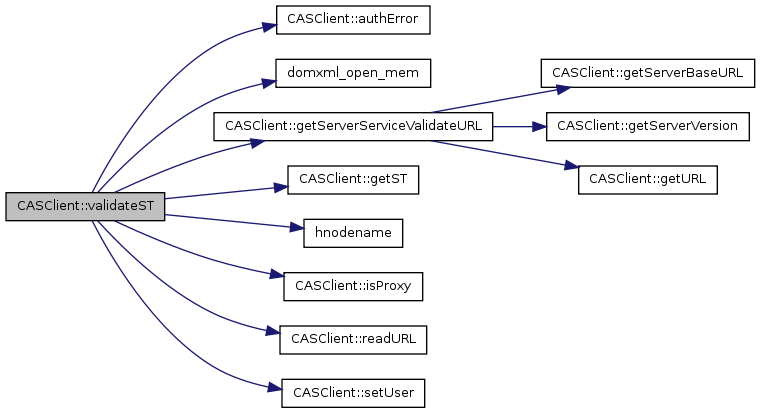
| CASClient::wasPreviouslyAuthenticated | ( | ) | [private] |
This method tells if the user has already been (previously) authenticated by looking into the session variables.
- Note:
- This function switches to callback mode when needed.
- Returns:
- TRUE when the user has already been authenticated; FALSE otherwise.
Definition at line 695 of file client4.php.
References $_SESSION, $auth, callback(), isCallbackMode(), isProxy(), setPGT(), setPT(), setST(), and setUser().
    {
      phpCAS::traceBegin();

      if ( $this->isCallbackMode() ) {
        $this->callback();
      }

      $auth = FALSE;

      if ( $this->isProxy() ) {
        // CAS proxy: username and PGT must be present
        if ( !empty($_SESSION['phpCAS']['user']) && !empty($_SESSION['phpCAS']['pgt']) ) {
          // authentication already done
          $this->setUser($_SESSION['phpCAS']['user']);
          $this->setPGT($_SESSION['phpCAS']['pgt']);
          phpCAS::trace('user = `'.$_SESSION['phpCAS']['user'].'\', PGT = `'.$_SESSION['phpCAS']['pgt'].'\'');
          $auth = TRUE;
        } elseif ( !empty($_SESSION['phpCAS']['user']) && empty($_SESSION['phpCAS']['pgt']) ) {
          // these two variables should be empty or not empty at the same time
          phpCAS::trace('username found (`'.$_SESSION['phpCAS']['user'].'\') but PGT is empty');
          // unset all tickets to enforce authentication
          unset($_SESSION['phpCAS']);
          $this->setST('');
          $this->setPT('');
        } elseif ( empty($_SESSION['phpCAS']['user']) && !empty($_SESSION['phpCAS']['pgt']) ) {
          // these two variables should be empty or not empty at the same time
          phpCAS::trace('PGT found (`'.$_SESSION['phpCAS']['pgt'].'\') but username is empty');
          // unset all tickets to enforce authentication
          unset($_SESSION['phpCAS']);
          $this->setST('');
          $this->setPT('');
        } else {
          phpCAS::trace('neither user not PGT found');
        }
      } else {
        // `simple' CAS client (not a proxy): username must be present
        if ( !empty($_SESSION['phpCAS']['user']) ) {
          // authentication already done
          $this->setUser($_SESSION['phpCAS']['user']);
          phpCAS::trace('user = `'.$_SESSION['phpCAS']['user'].'\'');
          $auth = TRUE;
        } else {
          phpCAS::trace('no user found');
        }
      }

      phpCAS::traceEnd($auth);
      return $auth;
    }
Here is the call graph for this function: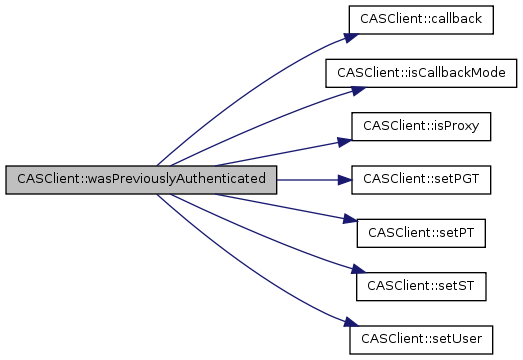
The documentation for this class was generated from the following files:
- Services/CAS/phpcas/source/CAS/client.php
- Services/CAS/phpcas/source/CAS/client4.php