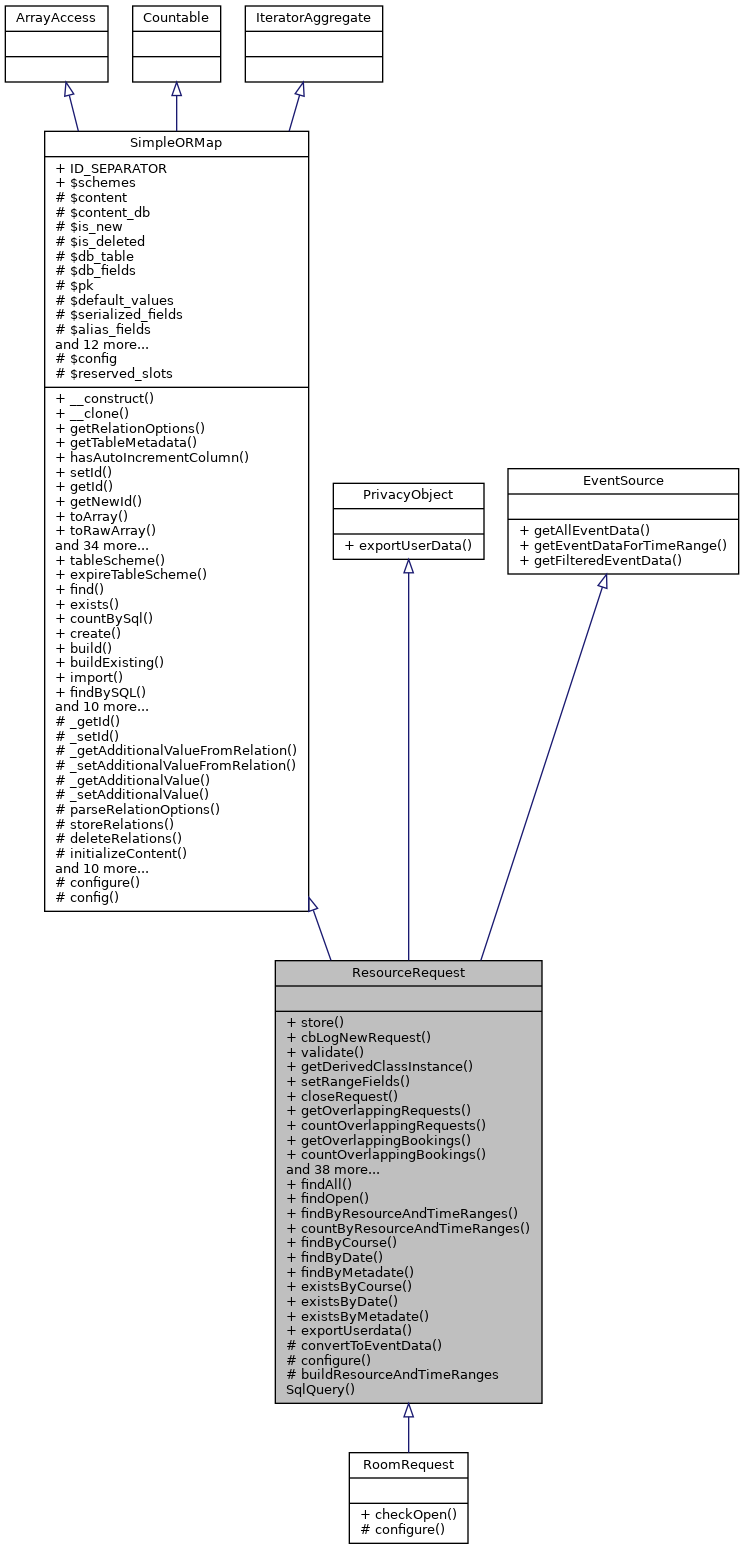
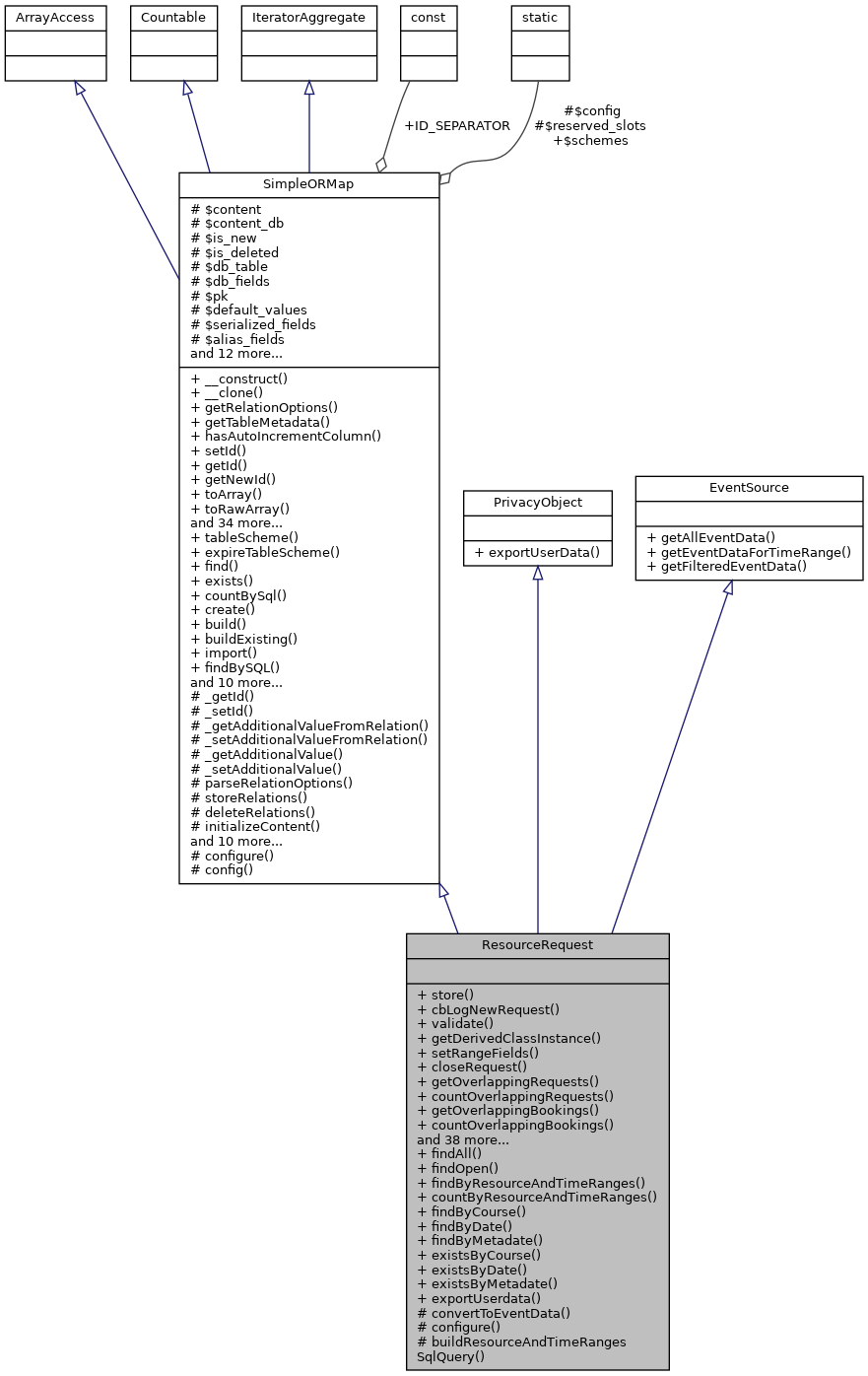
Static Public Member Functions | |
| static | findAll () |
| static | findOpen () |
| static | findByResourceAndTimeRanges (Resource $resource, $time_ranges=[], $closed_status=null, $excluded_request_ids=[], $additional_conditions='', $additional_parameters=[]) |
| static | countByResourceAndTimeRanges (Resource $resource, $time_ranges=[], $closed_status=null, $excluded_request_ids=[], $additional_conditions='', $additional_parameters=[]) |
| static | findByCourse ($course_id=null) |
| static | findByDate ($date_id=null) |
| static | findByMetadate ($metadate_id=null) |
| static | existsByCourse ( $course_id=null, $request_is_open=false) |
| static | existsByDate ( $date_id=null, $request_is_open=false) |
| static | existsByMetadate ( $metadate_id=null, $request_is_open=false) |
| static | exportUserdata (StoredUserData $user_data) |
 Static Public Member Functions inherited from SimpleORMap Static Public Member Functions inherited from SimpleORMap | |
| static | tableScheme ($db_table) |
| static | expireTableScheme () |
| static | find ($id) |
| static | exists ($id) |
| static | countBySql ($sql=1, $params=array()) |
| static | create ($data) |
| static | build ($data, $is_new=true) |
| static | buildExisting ($data) |
| static | import ($data) |
| static | findBySQL ($sql, $params=array()) |
| static | findOneBySQL ($where, $params=array()) |
| static | findThru ($foreign_key_value, $options) |
| static | findEachBySQL ($callable, $sql, $params=array()) |
| static | findMany ($pks=array(), $order='', $order_params=array()) |
| static | findEachMany ($callable, $pks=array(), $order='', $order_params=array()) |
| static | findAndMapBySQL ($callable, $where, $params=array()) |
| static | findAndMapMany ($callable, $pks=array(), $order='', $order_params=array()) |
| static | deleteBySQL ($where, $params=array()) |
| static | toObject ($id_or_object) |
| static | __callStatic ($name, $arguments) |
| Static Public Member Functions inherited from PrivacyObject | |
| static | exportUserData (StoredUserData $storage) |
Protected Member Functions | |
| convertToEventData ($time_intervals=[], User $user) | |
| Protected Member Functions inherited from SimpleORMap | |
| _getId ($field) | |
| _setId ($field, $value) | |
| _getAdditionalValueFromRelation ($field) | |
| _setAdditionalValueFromRelation ($field, $value) | |
| _getAdditionalValue ($field) | |
| _setAdditionalValue ($field, $value) | |
| parseRelationOptions ($type, $name, $options) | |
| storeRelations ($only_these=null) | |
| deleteRelations () | |
| initializeContent () | |
| applyCallbacks ($type) | |
| registerCallback ($types, $cb) | |
| unregisterCallback ($types, $cb) | |
| cbAutoIncrementColumn ($type) | |
| cbAutoKeyCreation () | |
| cbNotificationMapper ($cb_type) | |
| cbAfterInitialize ($cb_type) | |
| setSerializedValue ($field, $value) | |
| setI18nValue ($field, $value) | |
| cbI18N ($type) | |
Static Protected Member Functions | |
| static | configure ($config=[]) |
| static | buildResourceAndTimeRangesSqlQuery (Resource $resource, $time_ranges=[], $closed_status=null, $excluded_request_ids=[], $additional_conditions='', $additional_parameters=[]) |
| Static Protected Member Functions inherited from SimpleORMap | |
| static | configure ($config=array()) |
| static | config ($key) |
Additional Inherited Members | |
| Data Fields inherited from SimpleORMap | |
| const | ID_SEPARATOR = '_' |
| Static Public Attributes inherited from SimpleORMap | |
| static | $schemes = null |
| Protected Attributes inherited from SimpleORMap | |
| $content = array() | |
| $content_db = array() | |
| $is_new = true | |
| $is_deleted = false | |
| $db_table = '' | |
| $db_fields = null | |
| $pk = null | |
| $default_values = array() | |
| $serialized_fields = array() | |
| $alias_fields = array() | |
| $i18n_fields = array() | |
| $additional_fields = array() | |
| $relations = array() | |
| $has_many = array() | |
| $has_one = array() | |
| $belongs_to = array() | |
| $has_and_belongs_to_many = array() | |
| $registered_callbacks = array() | |
| $known_slots = array() | |
| $notification_map = array() | |
| $additional_data = array() | |
| $getter_setter_map = array() | |
| Static Protected Attributes inherited from SimpleORMap | |
| static | $config = array() |
| static | $reserved_slots = array('value','newid','iterator','tablemetadata', 'relationvalue','wherequery','relationoptions','data','new','id') |
Member Function Documentation
◆ buildResourceAndTimeRangesSqlQuery()
|
staticprotected |
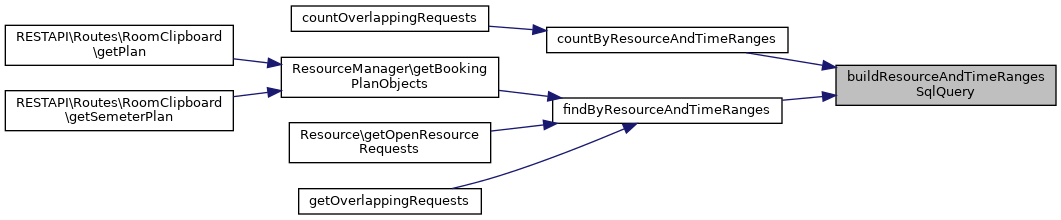
Internal method that generated the SQL query used in findByResourceAndTimeRanges and countByResourceAndTimeRanges.
- See also
- findByResourceAndTimeRanges

◆ cbLogNewRequest()
| cbLogNewRequest | ( | ) |
A callback method that creates a Stud.IP log entry when a new request has been made.

◆ closeRequest()
| closeRequest | ( | $notify_lecturers = false, |
|
$bookings = [] |
|||
| ) |
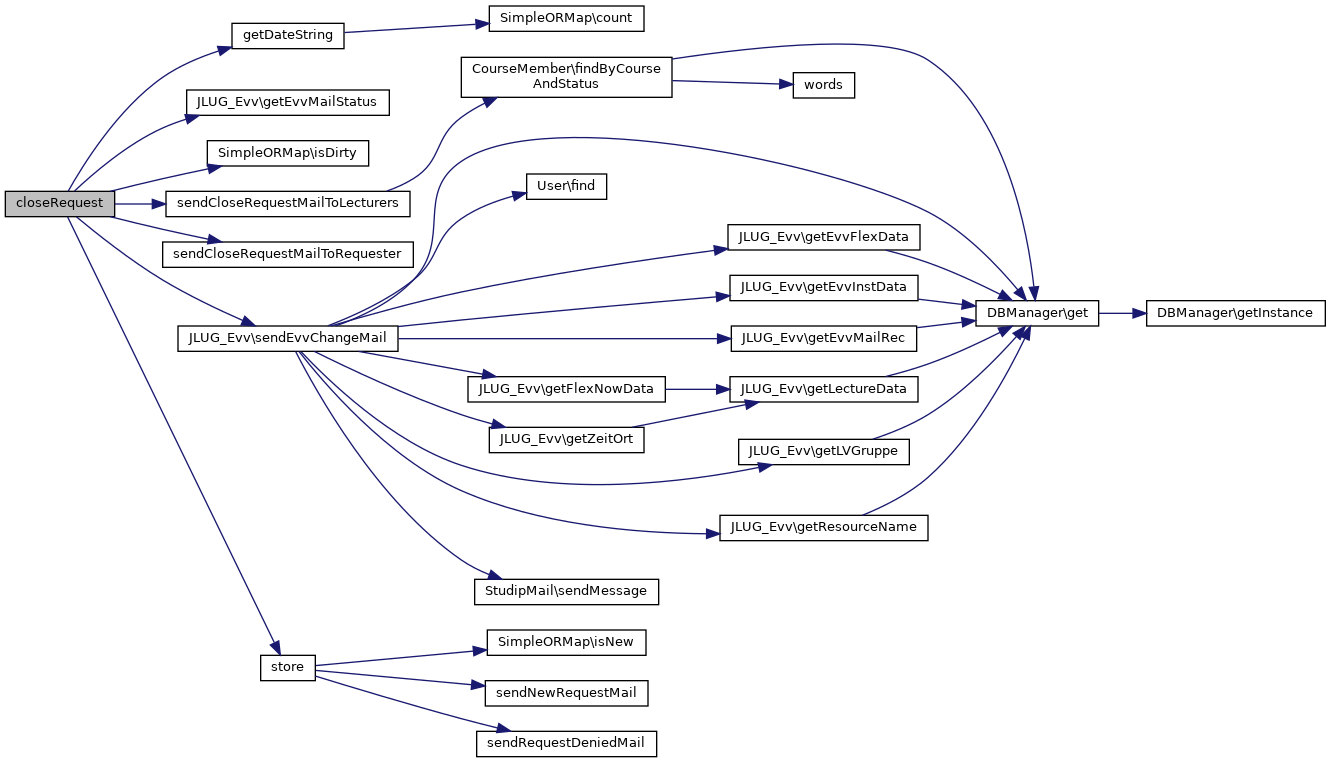
Closes the requests and sends out notification mails. If the request is closed and a resource has been booked, it can be passed as parameter to be included in the notification mails.
- Parameters
-
bool $notify_lecturers Whether to notify lecturers of a course (true) or not (false). Defaults to false. Note that this parameter is only useful in case the request is bound to a course, either directly or via a course date or a course cycle date. ResourceBooking $bookings The resource bookings that have been created from this request.

◆ configure()
|
staticprotected |
set configuration data from subclass
- Parameters
-
array $config configuration data
- Returns
- void
Reimplemented from SimpleORMap.
Reimplemented in RoomRequest.
◆ convertToEventData()
|
protected |

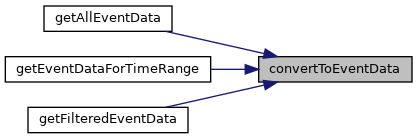
◆ countByResourceAndTimeRanges()
|
static |


◆ countOverlappingBookings()
| countOverlappingBookings | ( | ) |
Counts the resource bookings whose time ranges overlap with those of this resource request.
- Returns
- int The amount of overlapping resource bookings.

◆ countOverlappingRequests()
| countOverlappingRequests | ( | ) |
Counts the resource requests whose time ranges overlap with those of this resource request.
- Returns
- int The amount of overlapping resource requests.

◆ deletePropertyIfExists()
| deletePropertyIfExists | ( | $name = '' | ) |

◆ existsByCourse()
|
static |
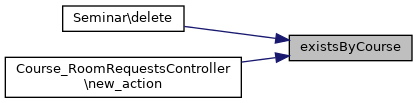
◆ existsByDate()
|
static |

◆ existsByMetadate()
|
static |

◆ exportUserdata()
|
static |

◆ findAll()
|
static |
Retrieves all resource requests from the database.
- Returns
- ResourceRequest[] An array of ResourceRequests objects or an empty array, if no resource requests are stored in the database.
◆ findByCourse()
|
static |
◆ findByDate()
|
static |

◆ findByMetadate()
|
static |
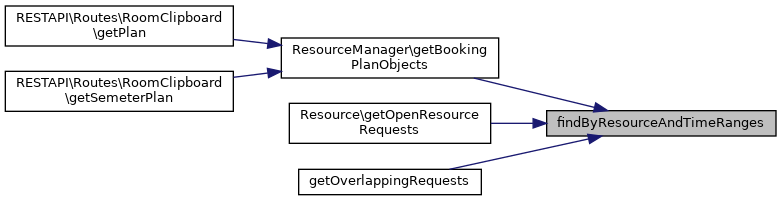
◆ findByResourceAndTimeRanges()
|
static |
Retrieves all resource requests for the given resource and time range. By default, all requests are returned. To get only open or closed requests set the $closed_status parameter.
- Parameters
-
Resource $resource The resource whose requests shall be retrieved. Array $time_ranges An array with time ranges as DateTime objects. The array has the following structure: [ [ 'begin' => begin timestamp, 'end' => end timestamp ], ... ] $closed_status An optional status for the closed column in the database. By default this is set to null which means that resource requests are not filtered by the status column field. A value of 0 means only open requests are retrived. A value of 1 means only closed requests are retrieved. Array $excluded_request_ids An array of strings representing resource request IDs. IDs specified in this array are excluded from the search.
- Returns
- SimpleORMapCollection A SimpleORMapCollection of ResourceRequest objects. If no requests can be found the collection is empty.
- Exceptions
-
InvalidArgumentException,if the time ranges are either not in an array matching the format description from above or if one of the following conditions is met in one of the time ranges: - begin > end
- begin == end

◆ findOpen()
|
static |
Retrieves all open resource requests from the database.
- Returns
- ResourceRequest[] An array of ResourceRequests objects or an empty array, if no open resource requests are stored in the database.
◆ getAffectedDates()
| getAffectedDates | ( | ) |
Returns an array of date objects which are affected by this ResourceRequest.


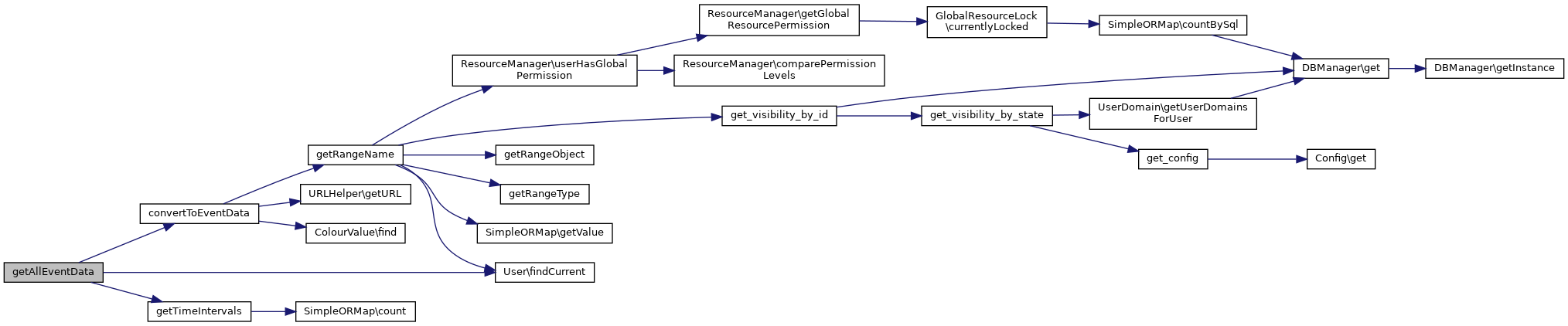
◆ getAllEventData()
| getAllEventData | ( | ) |
Returns all event data this event source can provide.
Implements EventSource.
◆ getAvailableProperties()
| getAvailableProperties | ( | $excluded_property_names = [] | ) |
Returns all resource property definitions for all properties which can be applied for this ResourceRequest by looking at the Resource category. If no resource category ID is set for the request an empty array is returned.

◆ getDateString()
| getDateString | ( | ) |


◆ getDerivedClassInstance()
| getDerivedClassInstance | ( | ) |

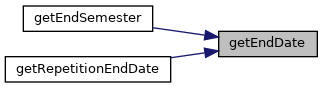
◆ getEndDate()
| getEndDate | ( | ) |

◆ getEndSemester()
| getEndSemester | ( | ) |

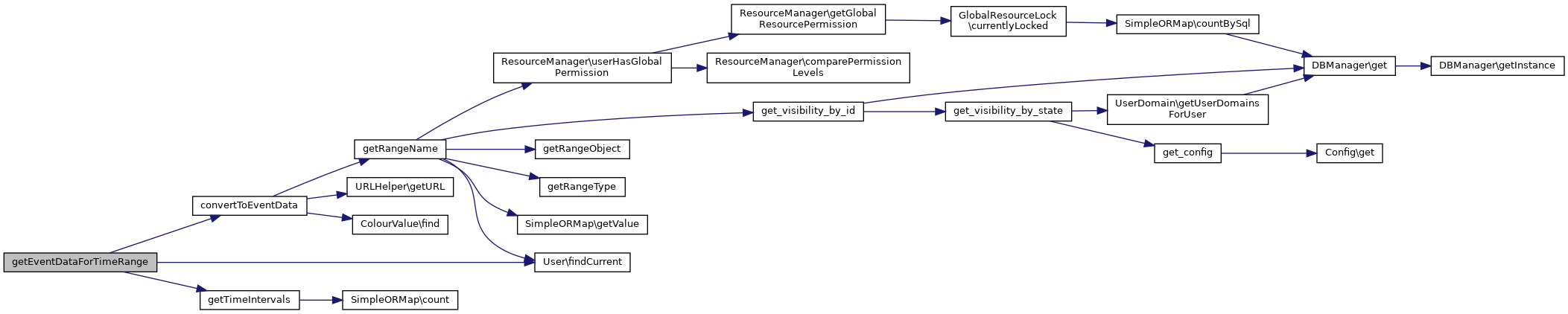
◆ getEventDataForTimeRange()
| getEventDataForTimeRange | ( | DateTime | $begin, |
| DateTime | $end | ||
| ) |
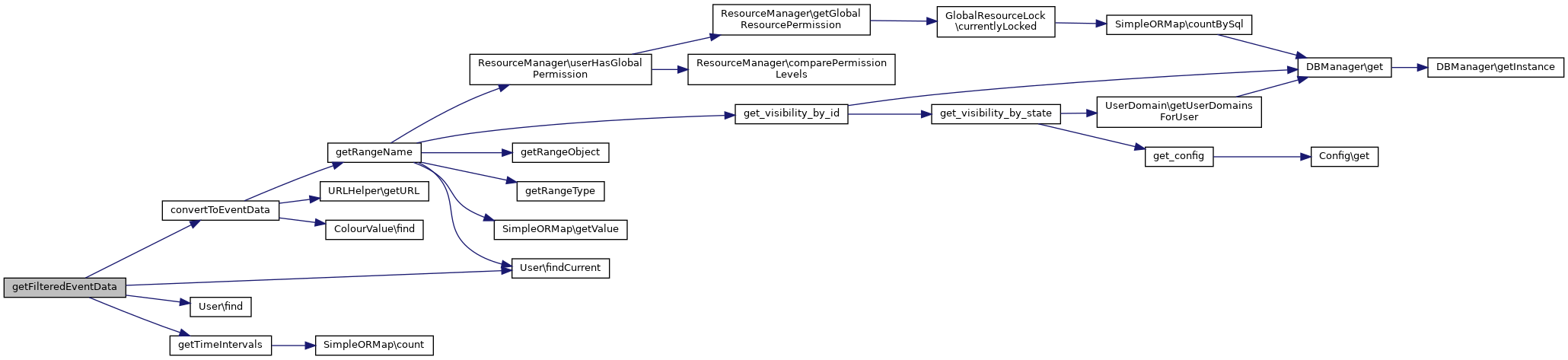
◆ getFilteredEventData()
| getFilteredEventData | ( | $user_id = null, |
|
$range_id = null, |
|||
$range_type = null, |
|||
$begin = null, |
|||
$end = null |
|||
| ) |
Allows a filtered output of event data based on a specified user, a specified range-ID and range type (must be supported by the Context class) or a specified time range. If no filters are applied the result should be the same as if the getAllEventData method from this interface is called.
- Parameters
-
string $user_id The user for whom the event data shall be retrieved. Depending on the implementation, this parameter might be necessary to check permissions for event objects. string $range_id An optional range-ID that may be necessary for an implementation to check for permissions. string $range_type An optional range type that may be necessary for an implementation to check for permissions. DateTime | int | string $begin The begin date as DateTime object or unix timestamp. DateTime | int | string $end The end date as DateTime object or unix timestamp.
Implements EventSource.
◆ getGroupedTimeIntervals()
| getGroupedTimeIntervals | ( | $with_preparation_time = false | ) |
Retrieves the time intervals by looking at metadate objects and other time interval sources and returns them grouped by metadate.
- Returns
- mixed[][][] A three-dimensional array with the following structure:
- The first dimension has the metadate-id as index. For single dates an empty string is used as index.
- The second dimension contains two elements:
- 'metadate' => The metadate object. This is only set, if the request is for a metadate.
- 'intervals' => The time intervals.
- The third dimension contains a time interval in the following format: [ 'begin' => The begin timestamp 'end' => The end timestamp 'range' => The name of the range class that provides the range_id. This is usually the name of the SORM class. 'range_id' => The ID of the single date or ResourceRequestAppointment. ]

◆ getOverlappingBookings()
| getOverlappingBookings | ( | ) |
Returns the resource bookings whose time ranges overlap with those of this resource request.
- Returns
- ResourceBooking[] An array of ResourceBooking objects.

◆ getOverlappingRequests()
| getOverlappingRequests | ( | ) |
Returns the resource requests whose time ranges overlap with those of this resource request.
- Returns
- ResourceRequest[] An array of ResourceRequest objects.

◆ getPriority()
| getPriority | ( | ) |

◆ getProperty()
| getProperty | ( | $name | ) |
Returns the state of the property specified by $name.

◆ getPropertyData()
| getPropertyData | ( | $excluded_property_names = [] | ) |
Returns a "compressed" array of resource request properties.
- Returns
- Array An associative array where the keys represent the property names and the values represent the property states. Note that the value can be an array in case of range properties.

◆ getPropertyObject()
| getPropertyObject | ( | $name | ) |
- Exceptions
-
InvalidResourceCategoryException If this resource category doesn't match the category of the resource request object. ResourcePropertyException If the name of the resource request property is not defined for this resource category.


◆ getRangeId()
| getRangeId | ( | ) |
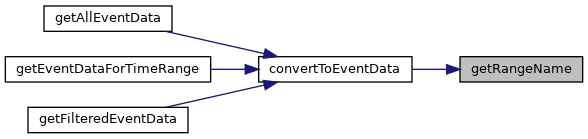
◆ getRangeName()
| getRangeName | ( | ) |

◆ getRangeObject()
| getRangeObject | ( | ) |

◆ getRangeType()
| getRangeType | ( | ) |

◆ getRepetitionEndDate()
| getRepetitionEndDate | ( | ) |

◆ getRepetitionInterval()
| getRepetitionInterval | ( | ) |
Returns the repetion interval if regular appointments are used for this request.
- Returns
- DateInterval|null In case regular appointments are used for this request a DateInterval is returned. Otherwise null is returned.

◆ getStartDate()
| getStartDate | ( | ) |


◆ getStartSemester()
| getStartSemester | ( | ) |

◆ getStatus()
| getStatus | ( | ) |
Returns a string representation of the status of the ResourceRequest.
◆ getStatusText()
| getStatusText | ( | ) |
Returns a textual representation of the status of the ResourceRequest.

◆ getTimeIntervals()
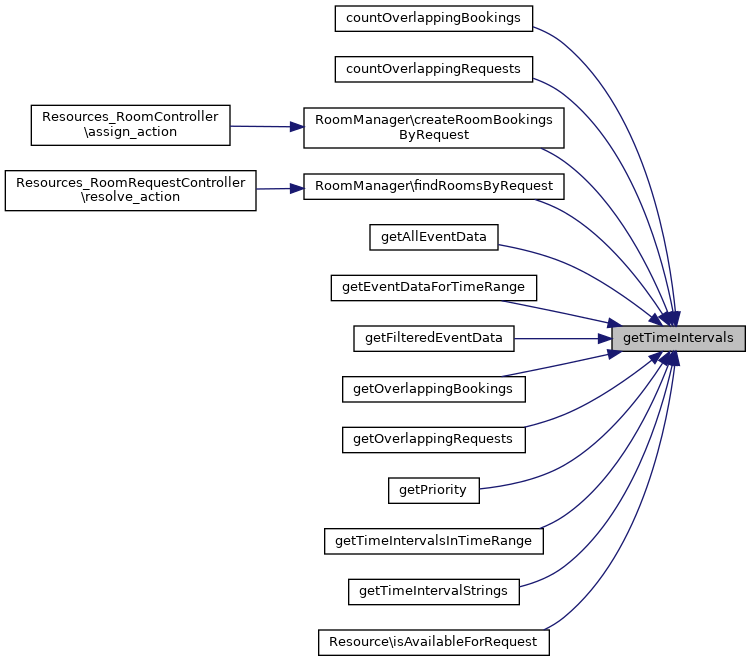
Retrieves the time intervals for this request.
- Parameters
-
bool $with_preparation_time Whether the preparation time of the request shall be prepended to the begin timestamp (true) or whether it should not be included at all (false). Defaults to false. bool $with_range Whether to include data of the Stud.IP range and its corresponding ID to the request (true) or not (false). Defaults to false.
- Returns
- string[][] A two-dimensional array of unix timestamps. The first dimension contains one entry for each date, the second dimension contains the start and end timestamp for the date. The second dimension uses the array keys 'begin' and 'end' for start and end date. If the @with_range parameter is set to true, the second array dimension also contains the key 'range' for specifying the range type and 'range_id' for specifying the ID of the range object. The range can be "CourseDate", "ResourceRequestAppointment" or "User". The last two can only be present for simple requests that are not bound to a course. The range "CourseDate" can only occur on course-bound requests.

◆ getTimeIntervalsInTimeRange()
| getTimeIntervalsInTimeRange | ( | DateTime | $begin, |
| DateTime | $end | ||
| ) |
Filters the time intervals for this request by a specified time range.
- See also
- ResourceRequest::getTimeIntervals for the return format.

◆ getTimeIntervalStrings()
| getTimeIntervalStrings | ( | ) |
Returns a string representation of the time intervals for this request.

◆ getType()
| getType | ( | ) |
Returns a string representation of the ResourceRequest's type.


◆ getTypeString()
| getTypeString | ( | $short = false | ) |
Returns a human-readable string describing the type of the request.
- Parameters
-
bool $short If this parameter is set to true, only the type of the request is returned without any information about the appointments. Otherwise, appointment information like the date or the repetition are appended. Defaults to false.

◆ isReadOnlyForUser()
| isReadOnlyForUser | ( | User | $user | ) |
◆ isSimpleRequest()
| isSimpleRequest | ( | ) |
◆ propertyExists()
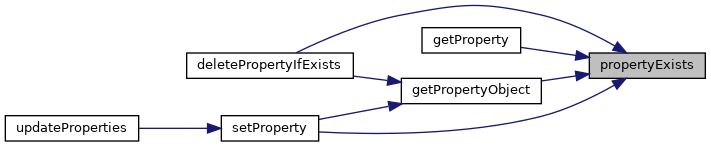
| propertyExists | ( | $name | ) |

◆ sendCloseRequestMailToLecturers()
| sendCloseRequestMailToLecturers | ( | $bookings = [] | ) |
This method sends mails to the lecurers of the course (if any) where this request has been assigned to. The sent mail informs them about the closing of the request.


◆ sendCloseRequestMailToRequester()
| sendCloseRequestMailToRequester | ( | $bookings = [] | ) |
This method sends a mail to inform the requester that the request has been closed.

◆ sendNewRequestMail()
| sendNewRequestMail | ( | ) |
This method sends a notification mail to all room administrators that informs them of this new request.

◆ sendRequestDeniedMail()
| sendRequestDeniedMail | ( | ) |
This method sends a mail to inform the requester about the denial of the request.

◆ setProperty()
| setProperty | ( | $name = '', |
|
$state = '' |
|||
| ) |
- Returns
- True, if the property state could be set, false otherwise.


◆ setRangeFields()
| setRangeFields | ( | $range_type = '', |
|
$range_ids = [] |
|||
| ) |
Sets the range fields (termin_id, metadate_id, course_id) or the ResourceRequestAppointment objects related to this request according to the range type and its range-IDs specified as parameters for this method. The ResourceRequest object is not stored after setting the fields / related objects.
- Parameters
-
string $range_type The range type for this request. One of the following: 'date', 'cycle', 'course' or 'date-multiple'. Array $range_ids An array of range-IDs to be set for the specified range type. This is mostly an array of size one since the fields termin_id, metadate_id and course_id only accept one ID. The range type 'date-multiple' accepts multiple IDs.
- Returns
- void No return value.
◆ store()
| store | ( | ) |
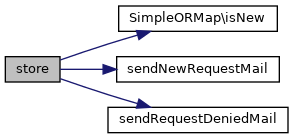
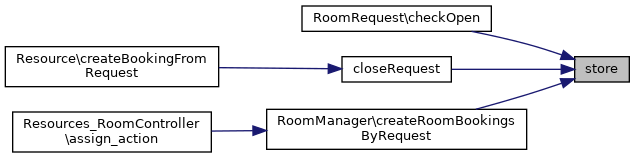
store entry in database
- Exceptions
-
UnexpectedValueException if there are forbidden NULL values
- Returns
- number|boolean
Reimplemented from SimpleORMap.
◆ updateProperties()
| updateProperties | ( | $property_list = [], |
|
$accept_null_values = false |
|||
| ) |
Sets or unsets the properties for this resource request.
- Parameters
-
Array $property_list The properties which shall be set or unset. The array has the following structure: [ property_name => property_value ] bool $accept_null_values True, if a value of null shall be used when setting the property. If $accept_null_values is set to false all properties with a value equal to null will be deleted.
- Returns
- null

◆ validate()
| validate | ( | ) |
This validation method is called before storing an object.
The documentation for this class was generated from the following file:
- lib/models/resources/ResourceRequest.class.php
